What Is a Phenotype? The Word in Four Working Fields
Phenotype was coined in 1909 to name a statistical type of appearance, and four working fields now use the word for four different instruments. Each one shows what the word can and cannot license.
Coined for a statistical type
Wilhelm Johannsen needed a word for the thing his breeding work had separated from an inherited constitution, and he built one from Greek. In Elemente der exakten Erblichkeitslehre, published in Jena in 1909, page 123 introduces Phaenotypus, with a footnote tracing it to phainomai, to appear. The definition he gave is narrower than current use: the statistically prominent type, a type of appearance. On the same page he added a warning that reads like a correction written in advance. A given phenotype may be an expression of a biological unit; it need not be.
Genotype appears seven pages later, on page 130, and the pair was coined together to stop a measured outcome from being read as an inherited plan. The word statistical in the definition is easy to pass over. A type of appearance is what emerges when measurements from many organisms are pooled, so the term named a property of a sample from its first printing. Nothing in it referred to a portrait of one organism, and nothing promised that a visible similarity implied a shared source.
In a cell, phenotype is a state
An immunologist uses the same word for a cell. A T cell carrying CD4 on its surface and one carrying CD8 are assigned different phenotypes by the markers they display, and flow cytometry reports the assignment as a count and a percentage. Immunophenotyping a blood sample produces a table of marker combinations rather than a picture. The phenotype here is a state a cell holds while it lives, and the assay records which state it was in at the moment of the draw.
Conrad Waddington gave the idea its developmental form in Nature in 1942, in a three-page paper running from page 563 to 565, where he argued that development is canalised: a pathway absorbs small disturbances and reaches the same end state anyway. The stability is measurable. Work on an allelic series of Fgf8, a gene involved in craniofacial development, found the phenotype held steady while expression stayed above forty percent of the wild-type level and broke down below it. A phenotype here is a state maintained against perturbation, with a threshold.
In a hospital, phenotype is a query
Clinical research uses the word for a rule. A computable phenotype is a query over diagnosis codes, laboratory values, prescriptions and clinical notes that returns a set of patients, and the Electronic Medical Records and Genomics network, funded by the National Human Genome Research Institute, built a catalogue of them. The Phenotype KnowledgeBase listed 92 algorithms in one published count, 30 of them public, with diagnosis codes appearing in about seventy percent. Across implementations the median case positive predictive value was 96.5 percent and median sensitivity 100 percent.
The spread behind those medians is the useful part. An algorithm identifying dementia from diagnosis codes alone reached a sensitivity of 37.1 percent, so it missed most of the cases it was built to find. One for drug-induced liver injury reached a positive predictive value of 32 percent, which means two of every three patients it flagged did not have the condition. A sentence beginning we phenotyped the cohort is therefore a claim about a rule whose error rate can be looked up, not about a measurement that speaks for itself.
In a seed catalogue, phenotype is a legal test
Plant variety protection makes the word do legal work. The UPOV Convention, signed in Paris in 1961 and revised in 1972, 1978 and 1991, defines a variety by the expression of characteristics resulting from a given genotype, which is a phenotypic definition by construction. Protection requires the variety to be distinct, uniform and stable, examined over two independent growing seasons against every variety of common knowledge. A breeder's right then runs for at least twenty years, or twenty-five for trees and vines.
The description produced by that examination is a list of characteristics with recorded states rather than a photograph. Distinctness requires one clear difference from anything already known, and uniformity is required only to the degree the method of propagation allows, so the standard is sufficiency rather than identity. Here the phenotype is the object a legal monopoly is granted on, which is about as far as the word travels from a face in a quiz.
In a bacterium, phenotype is a colour change
A clinical microbiologist reads phenotypes off a plastic strip. The API 20E holds twenty microtubes of dehydrated substrates, rehydrated with a bacterial suspension and read after eighteen to twenty-four hours, with an oxidase test added as the twenty-first reaction. The pattern of colour changes becomes a seven-digit profile, matched against a codebook. Pierre Janin developed the system at Analytab Products in the 1970s, and bioMerieux manufactures it now.
The numbers attached to that strip are worth keeping. A comparison of 345 Enterobacteriaceae isolates found the API 20E named 339 correctly, or 97.7 percent, misidentified 3 and returned no code for 5. The phenotype is a fixed battery plus a lookup table, and the species is whichever entry the table ranks first. DNA sequencing has since displaced much of this work, which is itself an argument: the strip was never reading descent, only chemistry.
The phenotype can leave the body
Richard Dawkins spent a book arguing that the boundary at the skin is a convention. The Extended Phenotype, published by Oxford University Press in 1982, sets out three forms. The first is construction: a caddisfly larva builds a case from stones, and a beaver dam impounds a stream. The second is manipulation of another organism, where a parasite alters a host's behaviour. The third is action at a distance, as when a cuckoo chick elicits feeding from a host species it never physically coerces.
The argument stretches the word, and it has been contested for that reason. It still settles one question for a catalogue of faces. If a phenotype is any observable effect of a genotype on the world, then nothing in the definition requires the observation to be a body, or the body to be alive and in front of an observer. The catalogue entries are observations of that general sort, made by people who wrote down what they saw and signed it.
What the word licenses for a 1,500-year map
Look at how the entries are named and the four uses above come together. Huanghoid takes its name from the Huang Ho and its note from loess and millet farming. Chukiangid is named for the Chu Khang river in southern China. Targid comes from Targi, the singular of Tuareg, so its label is a word in a language rather than a point on a map. East Pamirid is anchored to the Rushan, Shugan and Vakhan valleys of the Pamir mountains. Each is a place-name, a protocol and a date.
Those entries describe distributions reconstructed for roughly 1,500 years ago, and the ground has moved since. In 2020 about 56.2 percent of the world's population lived in urban areas, up from 51.6 percent a decade earlier, and internal movement on that scale rearranges who stands in front of which camera. Borders have been redrawn, villages have become suburbs, and the samples the observers measured are not the crowds a photographer meets.
So the word licenses a narrow operation. It permits a comparison between described characters and a documented pattern, with the source, the region and the year kept attached. It does not permit a claim about ancestry, nationality or identity, and none of the four fields above uses it that way. A pathologist reading a marker and a bacteriologist reading a colour change are both reading an observation, which is a smaller and more checkable thing than a person.
Frequently Asked Questions
- What is a phenotype in simple terms?
- It is the set of observable characters of an organism, produced by its inherited constitution interacting with its conditions. The word was coined in 1909 by Wilhelm Johannsen, who meant a statistically prominent type of appearance rather than a portrait of one individual. In practice a phenotype is whatever a stated method records: a marker on a cell, a diagnosis code in a record, a colour change on a test strip, or a measured head. The method belongs to the definition.
- Is phenotype the same as race?
- No. A phenotype is a measurement or an observation, and race is a classification that requires boundaries and a rule of assignment. Human variation runs in gradients that point in different directions for different traits, so the boundary that suits skin pigmentation lands somewhere else than the one that suits stature. The catalogue on this site keeps described distributions with a place and a date, and it makes no claim about any living person's identity or descent.
- Why does the same word mean different things in different fields?
- Because each field needs a different instrument. A cell biologist records marker states, a hospital records a query over codes, a plant registrar records descriptor states over two growing seasons, and a bacteriologist records a colour pattern against a codebook. All four are observations produced by a stated method, which is the only thing the word has ever promised. Reading one field's result as another field's claim is where most confusion about phenotype begins.
Related Phenotypes
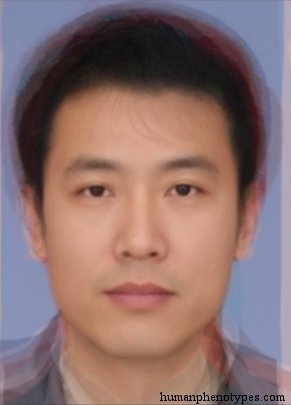
Faces from the encyclopedia that appear in this article. Open any entry for its full description, distribution, and references.
Huanghoid
East Asia
North Sinid type, named after the Huang Ho (Yellow) river in Northern China. Developed from loess and millet farmers. Usually regarded as th...
Chukiangid
East Asia
South Sinid proper subvariety, named after the Chu Khang (Xi) river in South China. Developed in the fishing and gatherer populations of sou...
Targid
North Africa
Specialised type of the Sahara, linked to Mediterranid and Orientalid - the southern counterpart of Libyid and Eurafricanid, but more strong...
East Pamirid
Central Asia
The most Europoid Pamirid subtype. Most common in Pamiri speakers of the Pamir Mountains in Eastern Tajikistan and Northern Afghanistan, esp...
Test what you learned
Put your eye for regional faces to work in the daily quiz — a composite face, a world map, and your best guess.