Chukiangid Phenotype - Face Features & Origin
South Sinid proper subvariety, named after the Chu Khang (Xi) river in South China. The entry below collects the Chukiangid composite face, its documented distribution around 23.0° N, 113.2° E in East Asia, its physical characteristics, the research history behind the name, and the academic references that support all of it.
Average Face
The Chukiangid composite below is not a photograph of a real person. Historical anthropologists aligned multiple individual portraits from the Chukiangid reference population and averaged them into one image, so recurring structures — skull outline, nose form, lip thickness, brow position — dominate while individual idiosyncrasies cancel out.
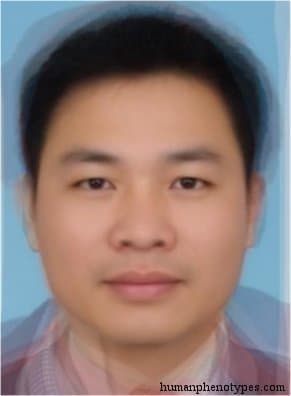
Composite source: Human Phenotypes — Chukiangid
Geographic Distribution
The reference center for Chukiangid sits near 23.0° N, 113.2° E in East Asia. Around that anchor, prevalence falls off gradually — the type is not confined to one valley or one modern border, and the historical map should be read as a gradient rather than a boundary.
Physical Characteristics
Yellow to olive- or coppery brown skin with straight hair.
- (Rather) short, macroskelic, endomorph
- Mildly brachycephalic, (mildly) hypsicranic
- Short, mesorrhine or mildly platyrrhine, round-tipped, depressed nose
- The face is 田-shaped, relatively wide and flat
- Mouth large, lips thick, prognathy mild, eyes rather open, epicanthic folds common, body hair scant
Historical Background
South Sinid proper subvariety, named after the Chu Khang (Xi) river in South China. Developed in the fishing and gatherer populations of southern subtropical forests of China. Today typical for Cantonese, Guangdong, Fukien, Southern Yunna, mixed in Vietnamese, Tai, and Muong, rare in Southern Japanese/Koreans. Millennia of colonisation and trading dispersed it across Indochina and the Sunda Islands.
Research History & Naming
The passage below traces who first defined Chukiangid, which rival names competed with it, and how later authors consolidated or disputed the classification — the raw material of any serious phenotype reference.
Named by Liu (1937) and adopted by Baker (1981) . Eickstedt (1938-1940) called it Kwangtungid variety of South Sinid, Lundman (1967) Kantonid. The typical South Sinid ( Knussmann, 1996 ; Biasutti, 1967 ). Anthropometric study by Ruffié and Olivier (1966) .
Comparison With Nearby Phenotypes
Geography, not alphabet, ordered this table: the five phenotype centers closest to Chukiangid's, with the traits most likely to be mistaken for it (Tonkinesid leads at 739 km). In gameplay, these five account for most of the wrong-but-nearby pins against Chukiangid.
| Phenotype | Region | Distance | Distinguishing trait |
|---|---|---|---|
| Tonkinesid | Southeast Asia | 739 km | Yellowish light brown skin with coarse straight to slightly wavy hair. |
| Changkiangid | East Asia | 846 km | Light to brownish yellow, sometimes fair skin with coarse straight hair. |
| Annamid | Southeast Asia | 936 km | Yellowish light brown skin, often slightly darker than in other South Sinids. |
| South Palaungid | Southeast Asia | 1,070 km | Yellowish medium brown skin with straight or wavy hair. |
| Aetid | Southeast Asia | 1,146 km | Dark brown skin and kinky hair. |
Chukiangid in the Game
In gameplay terms, Chukiangid rewards region-level recall: the score is computed from the distance between your pin and 23.0° N, 113.2° E. Players often confuse Chukiangid with Tonkinesid (739 km out) in the comparison table above — those confusions are exactly what the distance penalty is designed to expose.
Chukiangid Phenotype FAQ
- Where does the Chukiangid phenotype come from?
- Historical sources center the Chukiangid phenotype on 23.0° N, 113.2° E (East Asia). Treat that as a rough anchor: the type appeared across a wider surrounding area — its nearest documented neighbors, Tonkinesid and Changkiangid, sit 739 and 846 km from the reference point — and its present-day distribution no longer matches the historical map.
- What does the Chukiangid phenotype look like?
- The composite emphasizes recurring traits: yellow to olive- or coppery brown skin with straight hair. The full trait list for Chukiangid appears in the physical characteristics section above.
- Is the Chukiangid phenotype a race or a nationality?
- No. A phenotype is a recurring bundle of visible traits documented by historical anthropologists across a population — for Chukiangid, patterns such as yellow to olive- or coppery brown skin with straight hair. The Chukiangid entry is not a genetic ancestry, not a nationality, and not a statement about any individual person. Two people from the same country can match completely different phenotypes — one resembling Chukiangid, another closer to Tonkinesid — and one phenotype can span many modern borders.
- How does Chukiangid appear in the game?
- When the Chukiangid face comes up in Classic Daily or Challenge Mode, you pin the world map where you believe the type is historically most common, and the score decays with your distance to 23.0° N, 113.2° E. The nearest documented type, Tonkinesid, lies about 739 km away, so regional placement usually carries most of the score.
References & Literature
The Chukiangid phenotype entry above is compiled from the 7 academic references. Readers are encouraged to consult the original Chukiangid sources for verification and deeper context.
- Liu, C. H. 1937. A tentative classification of the races of China. Zeitschrift für Rassenkunde und ihre Nachbargebiete 6, 129-150.
- Baker, J.R.. 1981. Race. Oxford Univ. Press. London.
- Eickstedt, E. von 1938-1940. Forschungen in Süd- und Ostasien. In: Zeitschrift für Rassenkunde 8, 10, 11.
- Lundman, B. 1967. Geographische Anthropologie. Rassen und Völker der Erde. G. Fischer, Stuttgart
- Knussmann, R. 1996. Vergleichende Biologie des Menschen: Lehrbuch der Anthropologie und Humangenetik. 2ed. Spektrum Akademischer Verlag.
- Biasutti, R. 1967 (1941). Le Razze e i Popoli della terra. 4th Ed. Vol 1-4. U.T.E.T., Torino.
- Ruffié J. and G, Olivier. 1966. Les Chinois du Sud et la race sud-mongole. Bulletin de l'Ecole française d'Extrême-Orient. 53(1).
Related Phenotypes
Other human phenotypes whose documented centers lie in the same part of the map as Chukiangid.
Tonkinesid
Southeast Asia · 739 km away
South Sinid subvariety, typical for the plains of the Red River in Northern Vietnam. Named after the old Tonkin protectorate / Ðông Kinh reg...
Changkiangid
East Asia · 846 km away
Sinid subtype, named after the Chang Kiang (Yangtze) river in Central China. Today the most populous human variety in the world. Developed f...
Annamid
Southeast Asia · 936 km away
South Sinid subvariety with less pronounced Sinid features that often tend to be very gracile. Typical for the old province of Annam in Viet...
South Palaungid
Southeast Asia · 1,070 km away
Southern Palaungid variety, weakly influenced by Veddid. Typical for the hill tribes of Thailand, Laos, and parts of Vietnam. Occasionally i...
Aetid
Southeast Asia · 1,146 km away
Ancient type found in the mountains of the Philippine islands of Luzon, Mindandao and Palawan. Probably developed during the Paleolithic. Si...
Further Reading
Background articles from the blog that explain where the Chukiangid type fits, how these composites are built, and what a face can and cannot tell you.
Ethnicity Quiz: Five Question Types Behind the Label
A face quiz, a census form, a reaction-time experiment, a surname model and an ancestry report all answer to the same phrase.
What Is a Phenotype - and Why It Is Not a Race
Phenotype is a century-old scientific term for observable traits, not a synonym for race. The difference matters: clines, Lewontin's 85...