Changkiangid Phenotype - Face Features & Origin
Historical anthropology places the Changkiangid phenotype in East Asia, with a documented center near 30.6° N, 114.3° E. Sinid subtype, named after the Chang Kiang (Yangtze) river in Central China. The sections that follow unpack the Changkiangid entry in practice: the composite face, the traits it summarizes, the naming history, and the sources.
Average Face
Averaging the portraits behind Changkiangid leaves the features that repeat and erases the ones that do not. That is exactly how the Changkiangid composite below was built: individual photographs were aligned and statistically merged, exaggerating shared structure into a single reference face that no actual person looks like.
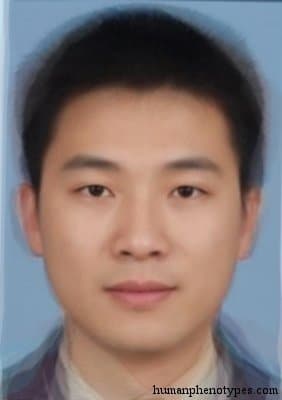
Composite source: Human Phenotypes — Changkiangid
Geographic Distribution
The reference center for Changkiangid sits near 30.6° N, 114.3° E in East Asia. Around that anchor, prevalence falls off gradually — the type is not confined to one valley or one modern border, and the historical map should be read as a gradient rather than a boundary.
Physical Characteristics
Light to brownish yellow, sometimes fair skin with coarse straight hair.
- Medium height, sometimes rather short, macroskelic, ectomorph
- Mesocephalic, rarely brachycephalic, mildly hypsicranic
- Depressed, lepto- mesorrhine, somewhat flattened nose with a broad bridge
- The face is oval, relatively flat, cheekbones rather prominent
- Lips thin, epicanthic folds common, eyes almond-shaped, body hair scant
Historical Background
Sinid subtype, named after the Chang Kiang (Yangtze) river in Central China. Today the most populous human variety in the world. Developed from the river and rice farmers in Central China. Typical in Kiangsu, Chekiang, Anhuei, Kiangsi, Hupei, Hunan, Szechuan, Kueichow, and Yunnan. Millennia of ancient colonisation and trading dispersed it across the Sunda Islands, Tibetan Plateau, and Indochina.
Research History & Naming
Every label in the historical catalogue has an author and a date, and Changkiangid has accumulated its share of competing attributions. For Changkiangid, the literature extract below shows the naming chain — from the first definition through the later revisions that shaped the current entry.
The type was defined and named by Liu (1937) , the name was also used by later authors ( Baker, 1981 ). Eickstedt ( 1944 , 1952c ), Knussmann (1996) and many others named it Middle Sinid. Biasutti (1967) Sinica centrale, Lundman (1967) Kiangid.
Comparison With Nearby Phenotypes
Ranked by great-circle distance from Changkiangid's reference center, these are the five nearest documented phenotypes — the closest being Chukiangid at 846 km. Overlapping distributions like these are exactly what makes the quiz hard, and the Chukiangid row is where to start looking.
| Phenotype | Region | Distance | Distinguishing trait |
|---|---|---|---|
| Chukiangid | East Asia | 846 km | Yellow to olive- or coppery brown skin with straight hair. |
| East Palaungid | Southeast Asia | 1,357 km | Yellowish light brown skin with straight or wavy hair. |
| Tonkinesid | Southeast Asia | 1,360 km | Yellowish light brown skin with coarse straight to slightly wavy hair. |
| Gobid | Central Asia | 1,526 km | Light yellowish-brown skin, coarse straight, rarely wavy hair. |
| Satsuma | East Asia | 1,551 km | Yellowish light, sometimes medium brown skin with coarse straight, sometimes wavy hair. |
Changkiangid in the Game
When the Changkiangid composite shows up in the quiz, players who know the East Asia distribution pattern have the edge. The reference answer sits near 30.6° N, 114.3° E; pins on the wrong continent score close to zero, so even a rough regional instinct beats a precise but misdirected pin.
Changkiangid Phenotype FAQ
- Where does the Changkiangid phenotype come from?
- The reference coordinates for the Changkiangid phenotype sit near 30.6° N, 114.3° E, in East Asia. That point marks the center of the East Asia distribution documented roughly 1500 years ago — actual prevalence spread well beyond it, toward entries such as Chukiangid 846 km away, and modern migration has blurred those boundaries further.
- What does the Changkiangid phenotype look like?
- In the historical literature, light to brownish yellow, sometimes fair skin with coarse straight hair. For Changkiangid these are statistical tendencies across a population, not a checklist every individual matches.
- Is the Changkiangid phenotype a race or a nationality?
- No. Phenotypes like Changkiangid are descriptive averages, not ancestry groups. Changkiangid is one of several types documented in and around East Asia — see the comparison table above — and the same individual can carry traits associated with several of them at once. The Changkiangid entry describes a statistical pattern, not a group of people and not a nationality.
- How does Changkiangid appear in the game?
- In Classic Daily and Challenge Mode, the Changkiangid composite face appears without a label. Your task is to drop a pin on the world map where you think that face is historically most common — the scoring uses the distance between your pin and the reference coordinates near 30.6° N, 114.3° E. The post-round review then shows the correct location, your distance error, and this Changkiangid entry.
References & Literature
Primary sources for the Changkiangid entry, listed as cited in the historical literature. The naming and classification debates around Changkiangid referenced above run through these works.
- Liu, C. H. 1937. A tentative classification of the races of China. Zeitschrift für Rassenkunde und ihre Nachbargebiete 6, 129-150.
- Baker, J.R.. 1981. Race. Oxford Univ. Press. London.
- Eickstedt, E. von. 1944. Rassendynamik von Ostasien. Walter de Gruyter. Berlin.
- Eickstedt, E. von. 1952c. Rassentypen und Typendynamik von Asien In: Historia Mundi. Band 1, Munich, 147-166.
- Knussmann, R. 1996. Vergleichende Biologie des Menschen: Lehrbuch der Anthropologie und Humangenetik. 2ed. Spektrum Akademischer Verlag.
- Biasutti, R. 1967 (1941). Le Razze e i Popoli della terra. 4th Ed. Vol 1-4. U.T.E.T., Torino.
- Lundman, B. 1967. Geographische Anthropologie. Rassen und Völker der Erde. G. Fischer, Stuttgart
Related Phenotypes
If Changkiangid interested you, these neighboring phenotype entries cover adjacent parts of the map with distinctly different trait bundles.
Chukiangid
East Asia · 846 km away
South Sinid proper subvariety, named after the Chu Khang (Xi) river in South China. Developed in the fishing and gatherer populations of sou...
East Palaungid
Southeast Asia · 1,357 km away
Eastern Palaungid variety, found in the hills of South China. Shows stronger Sinoid tendencies. Common along the China-Myanmar /-Vietnam bor...
Tonkinesid
Southeast Asia · 1,360 km away
South Sinid subvariety, typical for the plains of the Red River in Northern Vietnam. Named after the old Tonkin protectorate / Ðông Kinh reg...
Gobid
Central Asia · 1,526 km away
Tungid variety of the vast Central Asian deserts and steppes, e.g. the Gobi and Southern Siberia. Developed in ancient stock-farming nomads ...
Satsuma
East Asia · 1,551 km away
South Mongolid type of Japan and Korea, somewhat influenced by Tungid. Named after the Satsuma region of Kagoshima. Today the most populous ...
Further Reading
Background articles from the blog that explain where the Changkiangid type fits, how these composites are built, and what a face can and cannot tell you.
What Is My Ethnicity? Who Is Asking Changes the Answer
What the phrase assumes is that ethnicity is one thing a person has. Four registers answer it instead: a census form, a family record, a...
Ethnicity Quiz: Five Question Types Behind the Label
A face quiz, a census form, a reaction-time experiment, a surname model and an ancestry report all answer to the same phrase.