Satsuma Phenotype - Face Features & Origin
Historical anthropology places the Satsuma phenotype in East Asia, with a documented center near 31.5° N, 130.5° E. South Mongolid type of Japan and Korea, somewhat influenced by Tungid. The sections that follow unpack the Satsuma entry in practice: the composite face, the traits it summarizes, the naming history, and the sources.
Average Face
Averaging the portraits behind Satsuma leaves the features that repeat and erases the ones that do not. That is exactly how the Satsuma composite below was built: individual photographs were aligned and statistically merged, exaggerating shared structure into a single reference face that no actual person looks like.
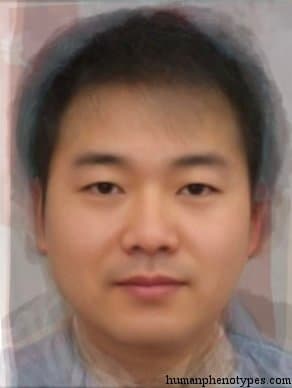
Composite source: Human Phenotypes — Satsuma
Geographic Distribution
Geographically, Satsuma anchors to 31.5° N, 130.5° E (East Asia). That is the point where historical anthropologists judged Satsuma most concentrated, not a hard edge; modern migration and intermarriage have long since softened whatever boundaries once existed.
Physical Characteristics
Yellowish light, sometimes medium brown skin with coarse straight, sometimes wavy hair.
- Short, endo- mesomorph, macroskelia pronounced
- Brachycephalic, hypsicranic with a mesorrhine, often flattened nose
- The face is broad, rather shallow, the cheekbones usually prominent
- The mouth is rather wide, the Mongolian fold common
Historical Background
South Mongolid type of Japan and Korea, somewhat influenced by Tungid. Named after the Satsuma region of Kagoshima. Today the most populous element in Japan as it is found along the densely populated southern coasts of Kagoshima, Shikoku, and Honshu. Also in the Ryukyu Islands and along Korea's south coast. Developed through ancient South Chinese / Malayan migrations to the North.
Research History & Naming
The passage below traces who first defined Satsuma, which rival names competed with it, and how later authors consolidated or disputed the classification — the raw material of any serious phenotype reference.
Defined and named early by Baelz (1883) , the name was kept by Ten-Kate (1902) , Eickstedt (1952c) , Hulse (1943) , Drexel (1955) , Weinert (1965) , Vallois (1971) and Matsumara ( cp. Matsumoto, 1921 ). Lundman (1967) noted the strong Malaid element.
Comparison With Nearby Phenotypes
Geography, not alphabet, ordered this table: the five phenotype centers closest to Satsuma's, with the traits most likely to be mistaken for it (Chikuzen leads at 215 km). In gameplay, these five account for most of the wrong-but-nearby pins against Satsuma.
| Phenotype | Region | Distance | Distinguishing trait |
|---|---|---|---|
| Chikuzen | East Asia | 215 km | Yellowish light brown skin with coarse straight, sometimes wavy hair. |
| Aoshima | East Asia | 306 km | Light brown skin, wavy to curly, mostly black hair. |
| Choshiu | East Asia | 317 km | Light to brownish yellow skin with coarse straight hair. |
| Ishikawa | East Asia | 837 km | Yellowish light brown skin with coarse straight to wavy hair. |
| Yakonin | East Asia | 978 km | Light to brownish yellow skin with coarse straight to wavy hair. |
Satsuma in the Game
In gameplay terms, Satsuma rewards region-level recall: the score is computed from the distance between your pin and 31.5° N, 130.5° E. Players often confuse Satsuma with Chikuzen (215 km out) in the comparison table above — those confusions are exactly what the distance penalty is designed to expose.
Satsuma Phenotype FAQ
- Where does the Satsuma phenotype come from?
- The reference coordinates for the Satsuma phenotype sit near 31.5° N, 130.5° E, in East Asia. That point marks the center of the East Asia distribution documented roughly 1500 years ago — actual prevalence spread well beyond it, toward entries such as Chikuzen 215 km away, and modern migration has blurred those boundaries further.
- What does the Satsuma phenotype look like?
- In the historical literature, yellowish light, sometimes medium brown skin with coarse straight, sometimes wavy hair. For Satsuma these are statistical tendencies across a population, not a checklist every individual matches.
- Is the Satsuma phenotype a race or a nationality?
- No. A phenotype is a recurring bundle of visible traits documented by historical anthropologists across a population — for Satsuma, patterns such as yellowish light, sometimes medium brown skin with coarse straight, sometimes wavy hair. The Satsuma entry is not a genetic ancestry, not a nationality, and not a statement about any individual person. Two people from the same country can match completely different phenotypes — one resembling Satsuma, another closer to Chikuzen — and one phenotype can span many modern borders.
- How does Satsuma appear in the game?
- In Classic Daily and Challenge Mode, the Satsuma composite face appears without a label. Your task is to drop a pin on the world map where you think that face is historically most common — the scoring uses the distance between your pin and the reference coordinates near 31.5° N, 130.5° E. The post-round review then shows the correct location, your distance error, and this Satsuma entry.
References & Literature
The Satsuma phenotype entry above is compiled from the 9 academic references. Readers are encouraged to consult the original Satsuma sources for verification and deeper context.
- Baelz, E.. 1883. Die körperlichen Eigenschaften der Japaner. Mitteilungen den DGNVO 3, 28.
- Ten-Kate, H. 1902. Anthropologisches und Verwandtes aus Japan. Internationales Zentralblatt für Anthropologie und verwandte Wissenschaften 7.
- Eickstedt, E. von. 1952c. Rassentypen und Typendynamik von Asien In: Historia Mundi. Band 1, Munich, 147-166.
- Hulse, F. S. 1943. Physical types among the Japanese. In: Coon, C. S. and J. M. Andrews. Studies in the Anthropology of OCeania and Asia. Papers of the Peabody Museum 20, 122-133.
- Drexel, A. 1955. Die Völker der Erde. 2nd Ed. Akademie Verlag. Zürich.
- Weinert, H. 1965. Die heutigen Rassen der Menschheit. In: Lundwig, B. and H. Plank. Handbuch der Biologie. Vol 9 (2).
- Vallois, H. V. 1971. Las races humaines. 8 Ed. Grammont.
- Matsumoto, H. 1921. Notes on the stone age people of Japan. American Anthropologist 23, 1.
- Lundman, B. 1967. Geographische Anthropologie. Rassen und Völker der Erde. G. Fischer, Stuttgart
Related Phenotypes
Other human phenotypes whose documented centers lie in the same part of the map as Satsuma.
Chikuzen
East Asia · 215 km away
Special Japanese type, influenced by ancient regional elements. Named after the old Chikuzen province that is today part of Fukuoka Prefectu...
Aoshima
East Asia · 306 km away
Ainuid proper, the most ancient type of Japan. Resembles Paleolithic Japanese populations like the Jomon people. Probably a relict of an old...
Choshiu
East Asia · 317 km away
Gracilised variant of the Manchu-Korean type, named after the old Japanese Choshu Domain. Once common in Chinese-Korean aristocracy. Today m...
Ishikawa
East Asia · 837 km away
Special Japanese type, influenced by ancient regional elements. Named after the Ishikawa region of Honshu. Probably represents admixed varia...
Yakonin
East Asia · 978 km away
East Asian type that has been associated with the ancient Japanese government and nobility circles. The name derives from yakunin (Jap.: bur...
Further Reading
Background articles from the blog that explain where the Satsuma type fits, how these composites are built, and what a face can and cannot tell you.
Average Face of Japan: What the Composite Contains
A national composite is a mean, not a portrait. Reading the Japan entry against the six Japanese patterns in the catalogue shows how...
Ethnicity Quiz: Five Question Types Behind the Label
A face quiz, a census form, a reaction-time experiment, a surname model and an ancestry report all answer to the same phrase.