Ishikawa Phenotype - Face Features & Origin
Special Japanese type, influenced by ancient regional elements. Its reference coordinates sit near 37.0° N, 136.8° E in East Asia. Rather than a single portrait, the Ishikawa composite below is a statistical average, and the surrounding sections — traits, distribution, research history, references — give that average its context.
Average Face
What you see below is a statistical construction of the Ishikawa reference population. Faces recorded from the Ishikawa sample were overlaid and merged; the result keeps the features most members shared and discards personal variation. It reads like a Ishikawa portrait, but it works like a histogram.
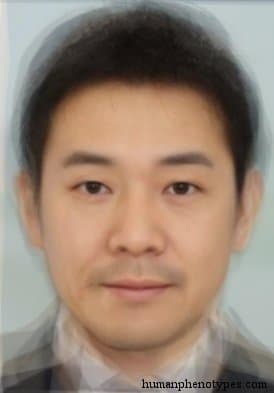
Composite source: Human Phenotypes — Ishikawa
Geographic Distribution
Geographically, Ishikawa anchors to 37.0° N, 136.8° E (East Asia). That is the point where historical anthropologists judged Ishikawa most concentrated, not a hard edge; modern migration and intermarriage have long since softened whatever boundaries once existed.
Physical Characteristics
Yellowish light brown skin with coarse straight to wavy hair.
- Short, mildly macroskelic, ectomorph to endomorph
- Mesocephalic, orthocranic
- Mesorrhine, sometimes mildly platyrrhine nose, often with a depressed root
- Face moderately short, straight and shallow, jaw weak
- Eyes are relatively large, the cheekbones are weakly prominent
- The Mongolian fold appears sometimes
Historical Background
Special Japanese type, influenced by ancient regional elements. Named after the Ishikawa region of Honshu. Probably represents admixed variant of the Ainuid Miyato Island dwarf type of the Neolithic. Most common in the northern middle and northeastern part of Honshu Island. Sometimes in Ainu. Occasionally found across all Japanese islands.
Research History & Naming
Typological names were coined, contested, and renamed repeatedly across the 20th century, and Ishikawa is no exception. The extract below records the researchers who defined Ishikawa, the alternative labels it accumulated, and where the modern consensus settled.
Defined and named by Hasebe and Matsumura (c.p. Matsumoto, 1921 , 1925 ). A more detailed analysis on the type was made by Hulse (1943) . Levin (1963) analyses its position within the different classifications.
Comparison With Nearby Phenotypes
The five phenotypes whose documented centers lie closest to Ishikawa, ranked by great-circle distance. They are the types players most often confuse with Ishikawa in the quiz, precisely because their distributions overlap.
| Phenotype | Region | Distance | Distinguishing trait |
|---|---|---|---|
| Yakonin | East Asia | 221 km | Light to brownish yellow skin with coarse straight to wavy hair. |
| Aoshima | East Asia | 534 km | Light brown skin, wavy to curly, mostly black hair. |
| Choshiu | East Asia | 563 km | Light to brownish yellow skin with coarse straight hair. |
| Chikuzen | East Asia | 688 km | Yellowish light brown skin with coarse straight, sometimes wavy hair. |
| Satsuma | East Asia | 837 km | Yellowish light, sometimes medium brown skin with coarse straight, sometimes wavy hair. |
Ishikawa in the Game
Ishikawa is one of the faces that can appear in Classic Daily and Challenge Mode. When it does, the winning pin lands near 37.0° N, 136.8° E in East Asia — and because the scoring decays with distance, recognizing the region matters more than pixel-perfect placement.
Ishikawa Phenotype FAQ
- Where does the Ishikawa phenotype come from?
- Historical sources center the Ishikawa phenotype on 37.0° N, 136.8° E (East Asia). Treat that as a rough anchor: the type appeared across a wider surrounding area — its nearest documented neighbors, Yakonin and Aoshima, sit 221 and 534 km from the reference point — and its present-day distribution no longer matches the historical map.
- What does the Ishikawa phenotype look like?
- The composite emphasizes recurring traits: yellowish light brown skin with coarse straight to wavy hair. The full trait list for Ishikawa appears in the physical characteristics section above.
- Is the Ishikawa phenotype a race or a nationality?
- No — and the Ishikawa naming history above shows why. Ishikawa was defined, renamed, and regrouped repeatedly by different researchers, which is the opposite of how a fixed racial category would behave. A phenotype is a recurring bundle of visible traits recorded across a population; the Ishikawa label says nothing about where any individual's ancestors were born.
- How does Ishikawa appear in the game?
- When the Ishikawa face comes up in Classic Daily or Challenge Mode, you pin the world map where you believe the type is historically most common, and the score decays with your distance to 37.0° N, 136.8° E. Fair warning: the nearest other entry in our dataset, Yakonin, sits just 221 km away, so this face rewards precise placement — the right country alone is not always enough.
References & Literature
Every claim on this page traces back to the sources below — the researchers who defined, measured, and argued over the Ishikawa type. The originals behind the Ishikawa entry are worth consulting directly.
- Matsumoto, H. 1921. Notes on the stone age people of Japan. American Anthropologist 23, 1.
- Matsumoto, H. 1925. Racially, Who Are the Japanese People? In: The World Tomorrow. June 1925.
- Hulse, F. S. 1943. Physical types among the Japanese. In: Coon, C. S. and J. M. Andrews. Studies in the Anthropology of OCeania and Asia. Papers of the Peabody Museum 20, 122-133.
- Levin, M. G. 1963. Ethnic origins of the people of Northeastern Asia. Arctic Inst. North America, Anthropology of the North. Translations from Russian sources 3. Toronto.
Related Phenotypes
More entries from the same region of the historical map as Ishikawa, each with its own composite and trait profile.
Yakonin
East Asia · 221 km away
East Asian type that has been associated with the ancient Japanese government and nobility circles. The name derives from yakunin (Jap.: bur...
Aoshima
East Asia · 534 km away
Ainuid proper, the most ancient type of Japan. Resembles Paleolithic Japanese populations like the Jomon people. Probably a relict of an old...
Choshiu
East Asia · 563 km away
Gracilised variant of the Manchu-Korean type, named after the old Japanese Choshu Domain. Once common in Chinese-Korean aristocracy. Today m...
Chikuzen
East Asia · 688 km away
Special Japanese type, influenced by ancient regional elements. Named after the old Chikuzen province that is today part of Fukuoka Prefectu...
Satsuma
East Asia · 837 km away
South Mongolid type of Japan and Korea, somewhat influenced by Tungid. Named after the Satsuma region of Kagoshima. Today the most populous ...
Further Reading
Background articles from the blog that explain where the Ishikawa type fits, how these composites are built, and what a face can and cannot tell you.
What Country Do I Look Like: The Count Comes Before the Face
Which country a face resembles depends on which official list you are using, and the world publishes several that disagree on how many...
AI Phenotype Scanner: What a Scanner Cannot Do for a Face
The phrase names a face classifier, not a device that reads a stored record. What the scanner metaphor hides, what the 209-entry...