Choshiu Phenotype - Face Features & Origin
Gracilised variant of the Manchu-Korean type, named after the old Japanese Choshu Domain. Its reference coordinates sit near 34.2° N, 131.6° E in East Asia. Rather than a single portrait, the Choshiu composite below is a statistical average, and the surrounding sections — traits, distribution, research history, references — give that average its context.
Average Face
What you see below is a statistical construction of the Choshiu reference population. Faces recorded from the Choshiu sample were overlaid and merged; the result keeps the features most members shared and discards personal variation. It reads like a Choshiu portrait, but it works like a histogram.
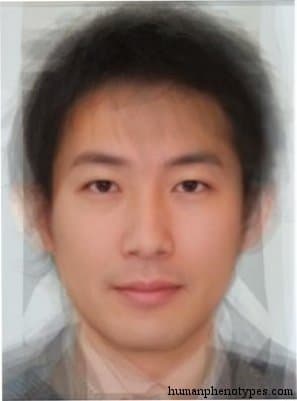
Composite source: Human Phenotypes — Choshiu
Geographic Distribution
Choshiu is documented across East Asia, with its historical reference center near 34.2° N, 131.6° E. The coordinates mark where the type was most characteristic roughly 1500 years ago; population movements since then have scattered and blended the distribution far beyond that point.
Physical Characteristics
Light to brownish yellow skin with coarse straight hair.
- Rather short to medium height, macroskelic, ectomorph
- Mesocephalic, sometimes dolichocephalic, (mildly) hypsicranic
- Mildly leptorrhine, sometimes convex nose
- The face is narrow and elongated, the mouth small, and the eyes oblique, often with the epicanthic fold
Historical Background
Gracilised variant of the Manchu-Korean type, named after the old Japanese Choshu Domain. Once common in Chinese-Korean aristocracy. Today mainly found in Japan. Can be placed in North Sinid. Probably developed through selection of gracile female features in marriages of the noble circles. In its purest form along the west coast of Honshu, but found across all Japanese islands and sometimes in Korea.
Research History & Naming
Every label in the historical catalogue has an author and a date, and Choshiu has accumulated its share of competing attributions. For Choshiu, the literature extract below shows the naming chain — from the first definition through the later revisions that shaped the current entry.
Defined and named early by Baelz (1883) , the name was kept by Eickstedt (1952c) , Saller (1949) , Weinert (1965) , Vallois (1971) and others. Lundman (1967) equated it with the Yakonin type, who was seen a rare modification by others ( Klenke, 1938 ). Matsumoto's (1921) Chikuzen type is similar, but closer to Satsuma.
Comparison With Nearby Phenotypes
Geography, not alphabet, ordered this table: the five phenotype centers closest to Choshiu's, with the traits most likely to be mistaken for it (Aoshima leads at 100 km). In gameplay, these five account for most of the wrong-but-nearby pins against Choshiu.
| Phenotype | Region | Distance | Distinguishing trait |
|---|---|---|---|
| Aoshima | East Asia | 100 km | Light brown skin, wavy to curly, mostly black hair. |
| Chikuzen | East Asia | 126 km | Yellowish light brown skin with coarse straight, sometimes wavy hair. |
| Satsuma | East Asia | 317 km | Yellowish light, sometimes medium brown skin with coarse straight, sometimes wavy hair. |
| Ishikawa | East Asia | 563 km | Yellowish light brown skin with coarse straight to wavy hair. |
| Yakonin | East Asia | 740 km | Light to brownish yellow skin with coarse straight to wavy hair. |
Choshiu in the Game
In gameplay terms, Choshiu rewards region-level recall: the score is computed from the distance between your pin and 34.2° N, 131.6° E. Players often confuse Choshiu with Aoshima (100 km out) in the comparison table above — those confusions are exactly what the distance penalty is designed to expose.
Choshiu Phenotype FAQ
- Where does the Choshiu phenotype come from?
- Historical sources center the Choshiu phenotype on 34.2° N, 131.6° E (East Asia). Treat that as a rough anchor: the type appeared across a wider surrounding area — its nearest documented neighbors, Aoshima and Chikuzen, sit 100 and 126 km from the reference point — and its present-day distribution no longer matches the historical map.
- What does the Choshiu phenotype look like?
- The composite emphasizes recurring traits: light to brownish yellow skin with coarse straight hair. The full trait list for Choshiu appears in the physical characteristics section above.
- Is the Choshiu phenotype a race or a nationality?
- No — and the Choshiu naming history above shows why. Choshiu was defined, renamed, and regrouped repeatedly by different researchers, which is the opposite of how a fixed racial category would behave. A phenotype is a recurring bundle of visible traits recorded across a population; the Choshiu label says nothing about where any individual's ancestors were born.
- How does Choshiu appear in the game?
- When the Choshiu face comes up in Classic Daily or Challenge Mode, you pin the world map where you believe the type is historically most common, and the score decays with your distance to 34.2° N, 131.6° E. Fair warning: the nearest other entry in our dataset, Aoshima, sits just 100 km away, so this face rewards precise placement — the right country alone is not always enough.
References & Literature
Primary sources for the Choshiu entry, listed as cited in the historical literature. The naming and classification debates around Choshiu referenced above run through these works.
- Bernhard, W. 1983. Ethnogenesis of South Asia with special reference to India. Anthropologischer Anzeiger 41, 2, 93-110.
- Eickstedt, E. von. 1952c. Rassentypen und Typendynamik von Asien In: Historia Mundi. Band 1, Munich, 147-166.
- Saller, K. 1949. Art- und Rassenlehre des Menschen. Curt E. Schwab. Stuttgart.
- Weinert, H. 1965. Die heutigen Rassen der Menschheit. In: Lundwig, B. and H. Plank. Handbuch der Biologie. Vol 9 (2).
- Vallois, H. V. 1971. Las races humaines. 8 Ed. Grammont.
- Lundman, B. 1967. Geographische Anthropologie. Rassen und Völker der Erde. G. Fischer, Stuttgart
- Klenke, W. 1938. Zur Anthropologie japanischer Wettkämpfer, Zeitschrift für Rassenkunde 8.
- Matsumoto, H. 1921. Notes on the stone age people of Japan. American Anthropologist 23, 1.
Related Phenotypes
Other human phenotypes whose documented centers lie in the same part of the map as Choshiu.
Aoshima
East Asia · 100 km away
Ainuid proper, the most ancient type of Japan. Resembles Paleolithic Japanese populations like the Jomon people. Probably a relict of an old...
Chikuzen
East Asia · 126 km away
Special Japanese type, influenced by ancient regional elements. Named after the old Chikuzen province that is today part of Fukuoka Prefectu...
Satsuma
East Asia · 317 km away
South Mongolid type of Japan and Korea, somewhat influenced by Tungid. Named after the Satsuma region of Kagoshima. Today the most populous ...
Ishikawa
East Asia · 563 km away
Special Japanese type, influenced by ancient regional elements. Named after the Ishikawa region of Honshu. Probably represents admixed varia...
Yakonin
East Asia · 740 km away
East Asian type that has been associated with the ancient Japanese government and nobility circles. The name derives from yakunin (Jap.: bur...
Further Reading
Background articles from the blog that explain where the Choshiu type fits, how these composites are built, and what a face can and cannot tell you.
Average Face of Japan: What the Composite Contains
A national composite is a mean, not a portrait. Reading the Japan entry against the six Japanese patterns in the catalogue shows how...
What Country Do I Look Like: The Count Comes Before the Face
Which country a face resembles depends on which official list you are using, and the world publishes several that disagree on how many...