Chinese, Japanese or Korean: What the Catalogue Cannot Sort
The checklist everyone expects does not exist: the record holds eleven East Asian entries, spaced by who measured rather than by difference. Six describe Japanese provinces, and none is named China or Korea.
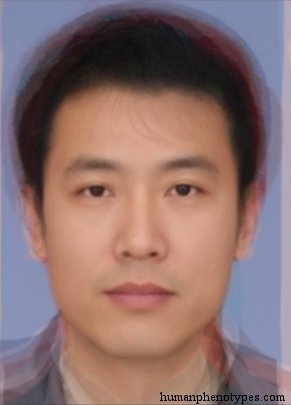
The question a quiz invites
Type the phrase into a search box and the results promise a checklist: an eye shape here, a jaw line there, a brow that supposedly means one country and not the others. The promise is older than the internet. It belongs to the typological handbooks, which sorted photographed faces into regional types and printed the plates side by side for comparison. This site's catalogue descends from those books, and that makes it a fair test of the question, because if any collection of documented appearance patterns could answer it, this one could. It cannot, and the reason is more interesting than a failed checklist. The limit is not in the eye of the observer. It sits in the resolution of the record itself, which holds eleven entries for the whole of East Asia and spaces them according to who did the measuring rather than according to how much the populations differ.
Eleven entries for three countries
The catalogue holds 209 entries. Sorting them by region leaves eleven in East Asia: Huanghoid, Changkiangid, Chukiangid, Kham, Manchu-Korean, Aoshima, Chikuzen, Choshiu, Ishikawa, Satsuma and Yakonin. Read the names as a map and the asymmetry appears immediately. Four are anchored to Chinese geography, from the Huang Ho and the Chang Kiang to the Chu Khang and the eastern Tibetan plateau of Kham. Six are anchored to provinces and districts inside Japan. One straddles a modern border: Manchu-Korean, defined by Baelz in 1901 for Manchuria and the Korean peninsula, and called simply Korean by Debets in 1974. No entry is named China. No entry is named Japan. A reader who wants a national answer is asking a grid built from river basins, prefectures and mountain regions to return a word it does not contain.
Why Japan has six entries and Korea none
The six Japanese entries were not drawn because Japan differs more from its neighbours. They were drawn because the measuring was denser there. Weisbach named Yakonin in 1878, taking the word from yakunin, a bureaucrat. Baelz named Choshiu and Satsuma in 1883. Matsumura and Hasebe added Chikuzen and Ishikawa in the years around 1921. Klenke reported Yakonin in six percent of Japanese Olympic athletes in 1938. Those citations trace a national anatomical establishment publishing in its own journals, in a country that had built university anatomy departments and a railway network able to reach its subjects. Korea, administered as a Japanese colony from 1910, produced far less of that literature in the same window, and its coverage in the catalogue arrives through a type named for two places at once. The resolution of a historical catalogue tracks the density of its observers. Satsuma, recorded as the most populous element in Japan and also present along the south coast of Korea, shows how little those lines ever followed borders.
What the genome says about the three labels
A 2018 study by Wang and colleagues in Hereditas took 1,032 individuals from twelve East Asian populations and computed pairwise Fst, the share of genetic variation that sits between groups rather than inside them. The three smallest values in the panel were between north and south Han Chinese at 0.0014, between the Dai of Xishuangbanna and the Kinh of Ho Chi Minh City at 0.0024, and between north Han and Koreans at 0.0026. Koreans and Japanese came out at 0.0033. Every pairwise value among Han, Japanese and Korean fell between 0.0026 and 0.0090. For scale, the smallest distance in that study between a European sample and any East Asian one was 0.0838. The three national labels sit a fifth to a hundredth of the way along the same axis that separates continents.
One number inside that paper is worth carrying around. Two Mongolian samples, Buryat and a Qinghai group, differed from each other by 0.0053, which is more than the gap between Koreans and Japanese. Nobody writes search results about telling those two apart, because the labels that feel obvious are administrative and the differences are not arranged by how familiar a border is. The 1000 Genomes Project makes the same point in its sampling: its East Asian superpopulation, 504 people, is five populations rather than three countries, and Beijing Han, southern Han, Dai, Tokyo Japanese and Kinh all sit inside it. A face drawn from Tokyo is a draw from that cloud, and so is a face drawn from Seoul.
The cues that do sort, and are not facial
If the visual checklist is weak, something else is doing the work when people report success. In ordinary recognition the deciding signals are usually grooming and speech. Hairstyle, brow shaping, makeup finish, the cut of a collar, the presence of a school uniform: these are conventions that change within a decade and are learned by watching other people. Accent and dialect carry more real information than any jaw measurement, because a dialect is acquired in a particular place. It is also the one cue that is honest about what it measures. A dialect reports where someone learned to talk, and it moves when they move.
- Grooming: brow shape and hairline follow fashion cycles measured in years, not centuries.
- Clothing: a uniform or a bag can identify a school district faster than any facial feature.
- Speech: accent is learned locally and is the only cue with a documented geographic anchor.
- Context: a photograph carries a street, a season and a camera, and all three get read before the face.
A national average is a container
Country composites inherit the borders they were averaged inside, and those borders are younger than the faces. Hokkaido was placed under the Kaitakushi, the colonization commission, in 1869, and Okinawa Prefecture replaced the Ryukyu Kingdom in 1879. A composite labelled Japan therefore mixes populations that entered the state at different dates, including island groups with their own entries in this catalogue. Aoshima is the clearest case: the Ainuid type described as the most ancient in Japan, tied to Jomon remains, catalogued inside Japan while being recorded as almost extinct there by the twentieth century after surviving in Hokkaido. The container also keeps filling. At the end of 2024 the Immigration Services Agency counted 3,768,977 foreign residents in Japan, among them 873,286 Chinese and 409,238 South Korean nationals, alongside 274,023 people holding special permanent resident status. A face photographed in Osaka this year is drawn from that population, not from a national average.
What the question can honestly return
A face does not carry a passport, and a quiz that pretends otherwise is selling a checklist it cannot supply. What the catalogue can return is narrower and more defensible. It can say that a set of features was recorded as typical of a river basin, a plateau, a province or an island, at a stated period, by named observers, with the printed sources listed. It can say that neighbours were described differently, as the Chikuzen and Choshiu entries do, one with a face significantly wider and shorter than the other. It cannot say that a living person belongs to the place their face resembles, because every entry describes a historical distribution and never a person. Asked about a stranger, the honest answer is to ask the stranger. Asked about a pattern, the honest answer names the region and the decade.
Frequently Asked Questions
- Can you really tell Chinese, Japanese and Korean faces apart?
- Not from anatomy, at the level of a reliable rule. The pairwise Fst values among Han, Japanese and Korean samples in a 2018 study of 1,032 people ran from 0.0026 to 0.0090, against 0.0838 for the smallest comparison between a European and an East Asian sample, so the populations overlap heavily. What observers actually use is grooming, clothing, context and accent. Each of those can be right about where someone grew up and wrong about anything else.
- Why does the catalogue list six Japanese types and no Chinese or Korean type?
- Because the entries follow the literature, and the literature followed the observers. Weisbach named Yakonin in 1878, Baelz named Choshiu and Satsuma in 1883, and Matsumura and Hasebe described Chikuzen and Ishikawa around 1921, in a country with dense anatomical publishing. Chinese coverage arrives as three river types and the Kham plateau type, most of them named by Liu in 1937. Korean coverage arrives inside Manchu-Korean, defined by Baelz in 1901 and called Korean by Debets in 1974.
- Is a phenotype the same thing as a nationality?
- No. A phenotype entry is a statistical tendency recorded in a historical sample, anchored here to roughly 1500 years ago, with a region attached. Nationality is a legal status granted by a state, and the state may be younger than the record. The two can share a name, as when a type is called after a province that later belonged to a different country, and that overlap is where most of the confusion begins.
Related Phenotypes
Faces from the encyclopedia that appear in this article. Open any entry for its full description, distribution, and references.
Huanghoid
East Asia
North Sinid type, named after the Huang Ho (Yellow) river in Northern China. Developed from loess and millet farmers. Usually regarded as th...
Changkiangid
East Asia
Sinid subtype, named after the Chang Kiang (Yangtze) river in Central China. Today the most populous human variety in the world. Developed f...
Aoshima
East Asia
Ainuid proper, the most ancient type of Japan. Resembles Paleolithic Japanese populations like the Jomon people. Probably a relict of an old...
Choshiu
East Asia
Gracilised variant of the Manchu-Korean type, named after the old Japanese Choshu Domain. Once common in Chinese-Korean aristocracy. Today m...
Test what you learned
Put your eye for regional faces to work in the daily quiz — a composite face, a world map, and your best guess.