Aoshima Phenotype - Face Features & Origin
Ainuid proper, the most ancient type of Japan. The entry below collects the Aoshima composite face, its documented distribution around 33.7° N, 132.5° E in East Asia, its physical characteristics, the research history behind the name, and the academic references that support all of it.
Average Face
The Aoshima composite below is not a photograph of a real person. Historical anthropologists aligned multiple individual portraits from the Aoshima reference population and averaged them into one image, so recurring structures — skull outline, nose form, lip thickness, brow position — dominate while individual idiosyncrasies cancel out.
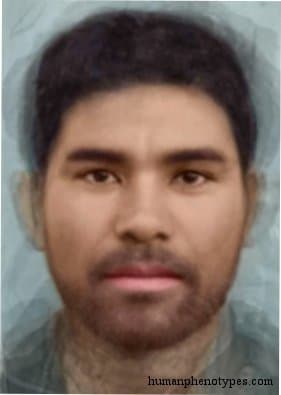
Composite source: Human Phenotypes — Aoshima
Geographic Distribution
Aoshima is documented across East Asia, with its historical reference center near 33.7° N, 132.5° E. The coordinates mark where the type was most characteristic roughly 1500 years ago; population movements since then have scattered and blended the distribution far beyond that point.
Physical Characteristics
Light brown skin, wavy to curly, mostly black hair.
- Short, mesoskelic, endo- sometimes mesomorph
- Dolicho- mesocephalic, orthocranic, rather large-headed
- Mesorrhine, prominent nose with a depressed root
- Face wide and low with marked features, strong supraorbital arches, heavy jaw, and thick eye-brows
- Body hair strong, differing significantly from surrounding populations
- Forehead is sloping, prognathy mild
Historical Background
Ainuid proper, the most ancient type of Japan. Resembles Paleolithic Japanese populations like the Jomon people. Probably a relict of an old group once widespread in Asia. Survived in the Ainu of Hokkaido until the 20th century. Today almost extinct due to admixture caused by centuries of Japanese assimilation policy. Occasionally in South Sakhalin, Kamchatka, Honshu, and the Kuril and Ryukyu islands.
Research History & Naming
Typological names were coined, contested, and renamed repeatedly across the 20th century, and Aoshima is no exception. The extract below records the researchers who defined Aoshima, the alternative labels it accumulated, and where the modern consensus settled.
Named by Matsumura ( cp. Matsumoto, 1921 ) and called like this by Hulse (1943) , Eickstedt ( 1944 , 1952 ), among others. Very detailed descriptions were given by Montandon (1927) and Koya (1937) . Appears in typologies as Ainu ( Cole, 1965 ; Biasutti, 1967 ), Ainuid ( Vogel, 1974 ; Knusmann, 1996 ) or Ainoid Lundman, 1967 ).
Comparison With Nearby Phenotypes
Geography, not alphabet, ordered this table: the five phenotype centers closest to Aoshima's, with the traits most likely to be mistaken for it (Choshiu leads at 100 km). In gameplay, these five account for most of the wrong-but-nearby pins against Aoshima.
| Phenotype | Region | Distance | Distinguishing trait |
|---|---|---|---|
| Choshiu | East Asia | 100 km | Light to brownish yellow skin with coarse straight hair. |
| Chikuzen | East Asia | 177 km | Yellowish light brown skin with coarse straight, sometimes wavy hair. |
| Satsuma | East Asia | 306 km | Yellowish light, sometimes medium brown skin with coarse straight, sometimes wavy hair. |
| Ishikawa | East Asia | 534 km | Yellowish light brown skin with coarse straight to wavy hair. |
| Yakonin | East Asia | 690 km | Light to brownish yellow skin with coarse straight to wavy hair. |
Aoshima in the Game
In gameplay terms, Aoshima rewards region-level recall: the score is computed from the distance between your pin and 33.7° N, 132.5° E. Players often confuse Aoshima with Choshiu (100 km out) in the comparison table above — those confusions are exactly what the distance penalty is designed to expose.
Aoshima Phenotype FAQ
- Where does the Aoshima phenotype come from?
- The reference coordinates for the Aoshima phenotype sit near 33.7° N, 132.5° E, in East Asia. That point marks the center of the East Asia distribution documented roughly 1500 years ago — actual prevalence spread well beyond it, toward entries such as Choshiu 100 km away, and modern migration has blurred those boundaries further.
- What does the Aoshima phenotype look like?
- In the historical literature, light brown skin, wavy to curly, mostly black hair. For Aoshima these are statistical tendencies across a population, not a checklist every individual matches.
- Is the Aoshima phenotype a race or a nationality?
- No — and the Aoshima naming history above shows why. Aoshima was defined, renamed, and regrouped repeatedly by different researchers, which is the opposite of how a fixed racial category would behave. A phenotype is a recurring bundle of visible traits recorded across a population; the Aoshima label says nothing about where any individual's ancestors were born.
- How does Aoshima appear in the game?
- In Classic Daily and Challenge Mode, the Aoshima composite face appears without a label. Your task is to drop a pin on the world map where you think that face is historically most common — the scoring uses the distance between your pin and the reference coordinates near 33.7° N, 132.5° E. The post-round review then shows the correct location, your distance error, and this Aoshima entry.
References & Literature
Every claim on this page traces back to the sources below — the researchers who defined, measured, and argued over the Aoshima type. The originals behind the Aoshima entry are worth consulting directly.
- Matsumoto, H. 1921. Notes on the stone age people of Japan. American Anthropologist 23, 1.
- Hulse, F. S. 1943. Physical types among the Japanese. In: Coon, C. S. and J. M. Andrews. Studies in the Anthropology of OCeania and Asia. Papers of the Peabody Museum 20, 122-133.
- Eickstedt, E. von. 1944. Rassendynamik von Ostasien. Walter de Gruyter. Berlin.
- Eickstedt, E. von. 1952. Biodynamik der Europiden. In: Historia Mundi. Band 1, Munich, 115-134.
- Montandon, G. 1927. Au Pays des Ainou, Paris.
- Koya, Y.. 1937.Rassenkunde der Aino. Japanische Gesellschaft zur Förderung der Wissenschaftlichen Foschungen.
- Cole, S. 1965. Races of Man. Butler & Tanner Ltd. Frome and London.
- Biasutti, R. 1967 (1941). Le Razze e i Popoli della terra. 4th Ed. Vol 1-4. U.T.E.T., Torino.
- Virchow, R. 1874. Die physische Anthropologie der Finnen. Verh. Berliner Ges. Anthr. Ethnol. Urg. VI. 185-189.
- Knussmann, R. 1996. Vergleichende Biologie des Menschen: Lehrbuch der Anthropologie und Humangenetik. 2ed. Spektrum Akademischer Verlag.
- Lundman, B. 1967. Geographische Anthropologie. Rassen und Völker der Erde. G. Fischer, Stuttgart
Related Phenotypes
Other human phenotypes whose documented centers lie in the same part of the map as Aoshima.
Choshiu
East Asia · 100 km away
Gracilised variant of the Manchu-Korean type, named after the old Japanese Choshu Domain. Once common in Chinese-Korean aristocracy. Today m...
Chikuzen
East Asia · 177 km away
Special Japanese type, influenced by ancient regional elements. Named after the old Chikuzen province that is today part of Fukuoka Prefectu...
Satsuma
East Asia · 306 km away
South Mongolid type of Japan and Korea, somewhat influenced by Tungid. Named after the Satsuma region of Kagoshima. Today the most populous ...
Ishikawa
East Asia · 534 km away
Special Japanese type, influenced by ancient regional elements. Named after the Ishikawa region of Honshu. Probably represents admixed varia...
Yakonin
East Asia · 690 km away
East Asian type that has been associated with the ancient Japanese government and nobility circles. The name derives from yakunin (Jap.: bur...
Further Reading
Background articles from the blog that explain where the Aoshima type fits, how these composites are built, and what a face can and cannot tell you.
Average Face of Japan: What the Composite Contains
A national composite is a mean, not a portrait. Reading the Japan entry against the six Japanese patterns in the catalogue shows how...
What Ethnicity Am I? Three Ways to Actually Answer It
The question is personal, but the answers arrive from three different places: records, DNA, and appearance. Each can tell you something...