Huanghoid Phenotype - Face Features & Origin
North Sinid type, named after the Huang Ho (Yellow) river in Northern China. The entry below collects the Huanghoid composite face, its documented distribution around 35.1° N, 97.9° E in East Asia, its physical characteristics, the research history behind the name, and the academic references that support all of it.
Average Face
The Huanghoid composite below is not a photograph of a real person. Historical anthropologists aligned multiple individual portraits from the Huanghoid reference population and averaged them into one image, so recurring structures — skull outline, nose form, lip thickness, brow position — dominate while individual idiosyncrasies cancel out.
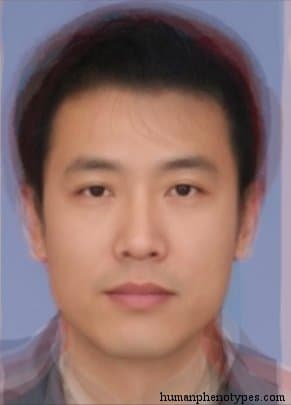
Composite source: Human Phenotypes — Huanghoid
Geographic Distribution
Geographically, Huanghoid anchors to 35.1° N, 97.9° E (East Asia). That is the point where historical anthropologists judged Huanghoid most concentrated, not a hard edge; modern migration and intermarriage have long since softened whatever boundaries once existed.
Physical Characteristics
Pale yellow to dusky yellow-brown skin, straight hair.
- Medium height to rather tall, macroskelic, ectomorph to mesomorph
- Mesocephalic, sometimes dolichocephalic, mildly hypsicranic with a leptorrhine, relatively long and straight, sometimes aquiline nose
- The face is relatively high, oblong and square, 口-shaped
- Cheek-bones relatively weak
- Lips thin, epicanthic folds pronounced, body hair scant
Historical Background
North Sinid type, named after the Huang Ho (Yellow) river in Northern China. Developed from loess and millet farmers. Usually regarded as the Sinid proper, associated with the Xia dynasty and the beginning of the Chinese empire. Typical in Liaoning, Kirin, Heilungkiang and Jehol, sometimes Hoklo in Fuijan. Ancient colonisation and trading dispersed it across China, Manchuria, Mongolia, Korea, and more sporadically, Japan.
Research History & Naming
Typological names were coined, contested, and renamed repeatedly across the 20th century, and Huanghoid is no exception. The extract below records the researchers who defined Huanghoid, the alternative labels it accumulated, and where the modern consensus settled.
The type was defined and named by Liu (1937) , "Huanghoid" was later used by others ( Baker, 1981 ). Eickstedt ( 1934 , 1944 , 1952c ), Knussmann (1996) and others named it North Sinid. Biasutti (1967) Sinica, Lundman (1967) Hoid, Cole (1965) North Chinese type.
Comparison With Nearby Phenotypes
Ranked by great-circle distance from Huanghoid's reference center, these are the five nearest documented phenotypes — the closest being Kham at 509 km. Overlapping distributions like these are exactly what makes the quiz hard, and the Kham row is where to start looking.
| Phenotype | Region | Distance | Distinguishing trait |
|---|---|---|---|
| Kham | East Asia | 509 km | Light, sometimes medium olive brown skin with straight, sometimes wavy hair. |
| Kachinid | Southeast Asia | 1,009 km | Yellowish light to medium brown skin with wavy, sometimes straight hair. |
| Tibetid | South Asia | 1,041 km | Light olive-brown skin with straight, sometimes wavy hair. |
| Gobid | Central Asia | 1,176 km | Light yellowish-brown skin, coarse straight, rarely wavy hair. |
| East Palaungid | Southeast Asia | 1,187 km | Yellowish light brown skin with straight or wavy hair. |
Huanghoid in the Game
When the Huanghoid composite shows up in the quiz, players who know the East Asia distribution pattern have the edge. The reference answer sits near 35.1° N, 97.9° E; pins on the wrong continent score close to zero, so even a rough regional instinct beats a precise but misdirected pin.
Huanghoid Phenotype FAQ
- Where does the Huanghoid phenotype come from?
- Historical sources center the Huanghoid phenotype on 35.1° N, 97.9° E (East Asia). Treat that as a rough anchor: the type appeared across a wider surrounding area — its nearest documented neighbors, Kham and Kachinid, sit 509 and 1,009 km from the reference point — and its present-day distribution no longer matches the historical map.
- What does the Huanghoid phenotype look like?
- The composite emphasizes recurring traits: pale yellow to dusky yellow-brown skin, straight hair. The full trait list for Huanghoid appears in the physical characteristics section above.
- Is the Huanghoid phenotype a race or a nationality?
- No. Phenotypes like Huanghoid are descriptive averages, not ancestry groups. Huanghoid is one of several types documented in and around East Asia — see the comparison table above — and the same individual can carry traits associated with several of them at once. The Huanghoid entry describes a statistical pattern, not a group of people and not a nationality.
- How does Huanghoid appear in the game?
- When the Huanghoid face comes up in Classic Daily or Challenge Mode, you pin the world map where you believe the type is historically most common, and the score decays with your distance to 35.1° N, 97.9° E. The nearest documented type, Kham, lies about 509 km away, so regional placement usually carries most of the score.
References & Literature
Every claim on this page traces back to the sources below — the researchers who defined, measured, and argued over the Huanghoid type. The originals behind the Huanghoid entry are worth consulting directly.
- Liu, C. H. 1937. A tentative classification of the races of China. Zeitschrift für Rassenkunde und ihre Nachbargebiete 6, 129-150.
- Baker, J.R.. 1981. Race. Oxford Univ. Press. London.
- Eickstedt, E. von. 1934. Rassenkunde und Rassengeschichte der Menschheit. Ferdinand Enke. Stuttgart.
- Eickstedt, E. von. 1944. Rassendynamik von Ostasien. Walter de Gruyter. Berlin.
- Eickstedt, E. von. 1952c. Rassentypen und Typendynamik von Asien In: Historia Mundi. Band 1, Munich, 147-166.
- Knussmann, R. 1996. Vergleichende Biologie des Menschen: Lehrbuch der Anthropologie und Humangenetik. 2ed. Spektrum Akademischer Verlag.
- Biasutti, R. 1967 (1941). Le Razze e i Popoli della terra. 4th Ed. Vol 1-4. U.T.E.T., Torino.
- Lundman, B. 1967. Geographische Anthropologie. Rassen und Völker der Erde. G. Fischer, Stuttgart
Related Phenotypes
Other human phenotypes whose documented centers lie in the same part of the map as Huanghoid.
Kham
East Asia · 509 km away
Robust Sinid variety, found in its highest concentration in Eastern Tibet, especially in the Kham region in nomads and warrior castes. Could...
Kachinid
Southeast Asia · 1,009 km away
Robust Proto Malayid subtype that probably originated in the Tibet/China border region and spread southwards some millennia ago. Named after...
Tibetid
South Asia · 1,041 km away
Contact type of Indid and Sinid. Possibly also Paleo Sibirid groups that have adapted to the high altitude of the Tibetan Plateau, sometimes...
Gobid
Central Asia · 1,176 km away
Tungid variety of the vast Central Asian deserts and steppes, e.g. the Gobi and Southern Siberia. Developed in ancient stock-farming nomads ...
East Palaungid
Southeast Asia · 1,187 km away
Eastern Palaungid variety, found in the hills of South China. Shows stronger Sinoid tendencies. Common along the China-Myanmar /-Vietnam bor...
Further Reading
Background articles from the blog that explain where the Huanghoid type fits, how these composites are built, and what a face can and cannot tell you.
What Is a Phenotype - and Why It Is Not a Race
Phenotype is a century-old scientific term for observable traits, not a synonym for race. The difference matters: clines, Lewontin's 85...
AI Phenotype Scanner: What a Scanner Cannot Do for a Face
The phrase names a face classifier, not a device that reads a stored record. What the scanner metaphor hides, what the 209-entry...