Tibetid Phenotype - Face Features & Origin
Historical anthropology places the Tibetid phenotype in South Asia, with a documented center near 31.8° N, 87.4° E. Contact type of Indid and Sinid. The sections that follow unpack the Tibetid entry in practice: the composite face, the traits it summarizes, the naming history, and the sources.
Average Face
Averaging the portraits behind Tibetid leaves the features that repeat and erases the ones that do not. That is exactly how the Tibetid composite below was built: individual photographs were aligned and statistically merged, exaggerating shared structure into a single reference face that no actual person looks like.
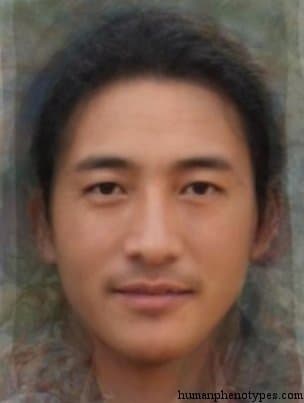
Composite source: Human Phenotypes — Tibetid
Geographic Distribution
Tibetid is documented across South Asia, with its historical reference center near 31.8° N, 87.4° E. The coordinates mark where the type was most characteristic roughly 1500 years ago; population movements since then have scattered and blended the distribution far beyond that point.
Physical Characteristics
Light olive-brown skin with straight, sometimes wavy hair.
- Medium height, macro- mesoskelic, ectomorph to endomorph
- Mesocephalic, mildly hypsicranic
- Relatively prominent, long, mildly leptorrhine and slightly convex nose
- Face is relatively broad, but narrower than in Sinids and Kham Tibetids
- Eyelids narrow, epicanthic folds occur in some individuals, cheekbones pronounced, forehead narrow
Historical Background
Contact type of Indid and Sinid. Possibly also Paleo Sibirid groups that have adapted to the high altitude of the Tibetan Plateau, sometimes features appear Indianiform. Most typical in Ladhak of Northern India and West Tibetans. Also in Eastern and Northern Tibetans, especially in nomads, as well as in Szechuan and Northern Yunnan (especially in Yi, sometimes Miao). In lower frequencies across China, Nepal, Burma, and Central Asia.
Research History & Naming
Typological names were coined, contested, and renamed repeatedly across the 20th century, and Tibetid is no exception. The extract below records the researchers who defined Tibetid, the alternative labels it accumulated, and where the modern consensus settled.
Defined by Turner (1913) . Cole (1965) called it Tibetan/Himalayan race, Biasutti (1967) Tibetana, Alexeev (1979) Tibetan, Lundman ( 1961 , 1967 ) Tibetid - Indid-Sinid contact type. Sometimes placed in Paleo (South) Mongolid or Sinid (Eickstedt, 1934 , 1952 ). Eickstedt's (1944) Sino-Europids (Yi) may be integrated.
Comparison With Nearby Phenotypes
Ranked by great-circle distance from Tibetid's reference center, these are the five nearest documented phenotypes — the closest being East Brachid at 504 km. Overlapping distributions like these are exactly what makes the quiz hard, and the East Brachid row is where to start looking.
| Phenotype | Region | Distance | Distinguishing trait |
|---|---|---|---|
| East Brachid | South Asia | 504 km | Light brown skin, usually straight hair. |
| Kham | East Asia | 907 km | Light, sometimes medium olive brown skin with straight, sometimes wavy hair. |
| Gracile Indid | South Asia | 910 km | Light to medium brown skin, straight to wavy hair. |
| Kolid | South Asia | 955 km | Black-brown skin, often darker than Veddoids except for Malids. |
| Mountain Indid | South Asia | 965 km | Light brown skin, straight or wavy hair. |
Tibetid in the Game
When the Tibetid composite shows up in the quiz, players who know the South Asia distribution pattern have the edge. The reference answer sits near 31.8° N, 87.4° E; pins on the wrong continent score close to zero, so even a rough regional instinct beats a precise but misdirected pin.
Tibetid Phenotype FAQ
- Where does the Tibetid phenotype come from?
- Historical sources center the Tibetid phenotype on 31.8° N, 87.4° E (South Asia). Treat that as a rough anchor: the type appeared across a wider surrounding area — its nearest documented neighbors, East Brachid and Kham, sit 504 and 907 km from the reference point — and its present-day distribution no longer matches the historical map.
- What does the Tibetid phenotype look like?
- The composite emphasizes recurring traits: light olive-brown skin with straight, sometimes wavy hair. The full trait list for Tibetid appears in the physical characteristics section above.
- Is the Tibetid phenotype a race or a nationality?
- No. Phenotypes like Tibetid are descriptive averages, not ancestry groups. Tibetid is one of several types documented in and around South Asia — see the comparison table above — and the same individual can carry traits associated with several of them at once. The Tibetid entry describes a statistical pattern, not a group of people and not a nationality.
- How does Tibetid appear in the game?
- When the Tibetid face comes up in Classic Daily or Challenge Mode, you pin the world map where you believe the type is historically most common, and the score decays with your distance to 31.8° N, 87.4° E. The nearest documented type, East Brachid, lies about 504 km away, so regional placement usually carries most of the score.
References & Literature
Every claim on this page traces back to the sources below — the researchers who defined, measured, and argued over the Tibetid type. The originals behind the Tibetid entry are worth consulting directly.
- Turner, W. Bhils, Frontier Tribes of Burma, Pakkou Tribes. South Shan Tribes, Tibetans. Transactions of the Royal Society of Edinburgh 49. 705-734.
- Cole, S. 1965. Races of Man. Butler & Tanner Ltd. Frome and London.
- Biasutti, R. 1967 (1941). Le Razze e i Popoli della terra. 4th Ed. Vol 1-4. U.T.E.T., Torino.
- Alexeev, V. P. 1979. The Differential Geography of Races. In: Stini, W. A. Physiological and Morphological Adaptation and Evolution. De Gruyter.
- Lundman, B. 1967. Geographische Anthropologie. Rassen und Völker der Erde. G. Fischer, Stuttgart
- Eickstedt, E. von. 1934. Rassenkunde und Rassengeschichte der Menschheit. Ferdinand Enke. Stuttgart.
- Eickstedt, E. von. 1952. Biodynamik der Europiden. In: Historia Mundi. Band 1, Munich, 115-134.
- Eickstedt, E. von. 1944. Rassendynamik von Ostasien. Walter de Gruyter. Berlin.
Related Phenotypes
If Tibetid interested you, these neighboring phenotype entries cover adjacent parts of the map with distinctly different trait bundles.
East Brachid
South Asia · 504 km away
Relatively recent contact type intermediate between Indids and South Mongolids. Widespread, reaching from Western Himalaya / Nepal to Bhutan...
Kham
East Asia · 907 km away
Robust Sinid variety, found in its highest concentration in Eastern Tibet, especially in the Kham region in nomads and warrior castes. Could...
Gracile Indid
South Asia · 910 km away
The most widespread and frequent Indid subtype, one of the most populous phenotypes in the world. Common along the Ganges river and Deccan, ...
Kolid
South Asia · 955 km away
North Dravidian type, related to Melanids but with stronger Gondid influence. An important population element in India. Purest in Jharkhand ...
Mountain Indid
South Asia · 965 km away
(Gracile) Indid variety native to the valleys south of the Western Himalaya and in the Hindu Kush. Once the principal element of the Khas an...
Further Reading
Background articles from the blog that explain where the Tibetid type fits, how these composites are built, and what a face can and cannot tell you.
Guess My Ethnicity: What One Guess Can Carry
When someone types guess my ethnicity, they are asking a stranger to place a bet, and the odds depend far more on the list of labels...
Geography Games Like GeoGuessr: Six Kinds of Clue
Street panoramas, country outlines and average faces all answer one question. Here are six geography games sorted by the clue they hand...