Kham Phenotype - Face Features & Origin
Robust Sinid variety, found in its highest concentration in Eastern Tibet, especially in the Kham region in nomads and warrior castes. The entry below collects the Kham composite face, its documented distribution around 30.6° N, 96.8° E in East Asia, its physical characteristics, the research history behind the name, and the academic references that support all of it.
Average Face
The Kham composite below is not a photograph of a real person. Historical anthropologists aligned multiple individual portraits from the Kham reference population and averaged them into one image, so recurring structures — skull outline, nose form, lip thickness, brow position — dominate while individual idiosyncrasies cancel out.
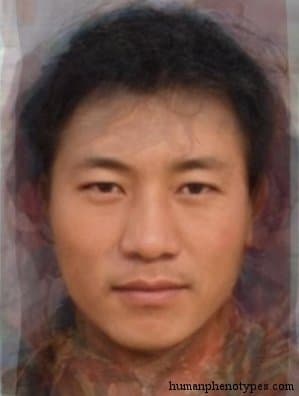
Composite source: Human Phenotypes — Kham
Geographic Distribution
Geographically, Kham anchors to 30.6° N, 96.8° E (East Asia). That is the point where historical anthropologists judged Kham most concentrated, not a hard edge; modern migration and intermarriage have long since softened whatever boundaries once existed.
Physical Characteristics
Light, sometimes medium olive brown skin with straight, sometimes wavy hair.
- Medium height, mesoskelic, ectomorph to mesomorph
- The head is large and robust, dolicho- mesocephalic and hypsicranic
- Mesorrhine, straight or convex, sometimes low-rooted nose
- Face broader than in Tibetid proper, mildly flattened
- The Mongolian fold is found regularly
- Mildly prognathous
Historical Background
Robust Sinid variety, found in its highest concentration in Eastern Tibet, especially in the Kham region in nomads and warrior castes. Could be an older Sinid type, or alternatively just an adaption to the high altitude. Also in South Tibetans, Qinghai, Gansu, Szechuan, Yunnan, Northern Burma, Arunachal Pradesh, and in lower frequencies across many regions of East Asia including Indochina.
Research History & Naming
The passage below traces who first defined Kham, which rival names competed with it, and how later authors consolidated or disputed the classification — the raw material of any serious phenotype reference.
An Eastern Kham Tibetan variant was separated by various authors ( Turner, 1913 ; Morant, 1924 ; Montandon, 1933 ; Biasutti and Gomez-Tabanera, 1967 ), also mentioned by Eickstedt (1934) . Similar to Michalski's (1938) Highland type (Q).
Comparison With Nearby Phenotypes
Ranked by great-circle distance from Kham's reference center, these are the five nearest documented phenotypes — the closest being Huanghoid at 509 km. Overlapping distributions like these are exactly what makes the quiz hard, and the Huanghoid row is where to start looking.
| Phenotype | Region | Distance | Distinguishing trait |
|---|---|---|---|
| Huanghoid | East Asia | 509 km | Pale yellow to dusky yellow-brown skin, straight hair. |
| Kachinid | Southeast Asia | 513 km | Yellowish light to medium brown skin with wavy, sometimes straight hair. |
| East Palaungid | Southeast Asia | 803 km | Yellowish light brown skin with straight or wavy hair. |
| Tibetid | South Asia | 907 km | Light olive-brown skin with straight, sometimes wavy hair. |
| Palaungid | Southeast Asia | 1,017 km | Yellowish-reddish light to medium brown skin with straight or wavy hair. |
Kham in the Game
When the Kham composite shows up in the quiz, players who know the East Asia distribution pattern have the edge. The reference answer sits near 30.6° N, 96.8° E; pins on the wrong continent score close to zero, so even a rough regional instinct beats a precise but misdirected pin.
Kham Phenotype FAQ
- Where does the Kham phenotype come from?
- Historical sources center the Kham phenotype on 30.6° N, 96.8° E (East Asia). Treat that as a rough anchor: the type appeared across a wider surrounding area — its nearest documented neighbors, Huanghoid and Kachinid, sit 509 and 513 km from the reference point — and its present-day distribution no longer matches the historical map.
- What does the Kham phenotype look like?
- The composite emphasizes recurring traits: light, sometimes medium olive brown skin with straight, sometimes wavy hair. The full trait list for Kham appears in the physical characteristics section above.
- Is the Kham phenotype a race or a nationality?
- No. A phenotype is a recurring bundle of visible traits documented by historical anthropologists across a population — for Kham, patterns such as light, sometimes medium olive brown skin with straight, sometimes wavy hair. The Kham entry is not a genetic ancestry, not a nationality, and not a statement about any individual person. Two people from the same country can match completely different phenotypes — one resembling Kham, another closer to Huanghoid — and one phenotype can span many modern borders.
- How does Kham appear in the game?
- When the Kham face comes up in Classic Daily or Challenge Mode, you pin the world map where you believe the type is historically most common, and the score decays with your distance to 30.6° N, 96.8° E. The nearest documented type, Huanghoid, lies about 509 km away, so regional placement usually carries most of the score.
References & Literature
The Kham phenotype entry above is compiled from the 6 academic references. Readers are encouraged to consult the original Kham sources for verification and deeper context.
- Turner, W. Bhils, Frontier Tribes of Burma, Pakkou Tribes. South Shan Tribes, Tibetans. Transactions of the Royal Society of Edinburgh 49. 705-734.
- Morant, G. M. 1924. A study of certain oriental series of crania. Biometrica 16. Camebridge.
- Montandon, G. 1933. La race, les races: mise au point d éthnologie somatique. Payot. Paris.
- Biasutti, R. and J. Gomez-Tabanera. 1967. L'Asia Centrale. In: Biasutti, R. Le Razze e i Popoli della terra. 4th Ed. Vol 1-4. U.T.E.T., Torino.
- Eickstedt, E. von. 1934. Rassenkunde und Rassengeschichte der Menschheit. Ferdinand Enke. Stuttgart.
- Michalski I. 1938.Skladniki rasowe Chinczyków,
Related Phenotypes
More entries from the same region of the historical map as Kham, each with its own composite and trait profile.
Huanghoid
East Asia · 509 km away
North Sinid type, named after the Huang Ho (Yellow) river in Northern China. Developed from loess and millet farmers. Usually regarded as th...
Kachinid
Southeast Asia · 513 km away
Robust Proto Malayid subtype that probably originated in the Tibet/China border region and spread southwards some millennia ago. Named after...
East Palaungid
Southeast Asia · 803 km away
Eastern Palaungid variety, found in the hills of South China. Shows stronger Sinoid tendencies. Common along the China-Myanmar /-Vietnam bor...
Tibetid
South Asia · 907 km away
Contact type of Indid and Sinid. Possibly also Paleo Sibirid groups that have adapted to the high altitude of the Tibetan Plateau, sometimes...
Palaungid
Southeast Asia · 1,017 km away
The proper Palaungid variety, typical for the Central Burmese hill tribes, also in Yunnan, Himalaya, South Tibet, Thailand, and parts of Ind...
Further Reading
Background articles from the blog that explain where the Kham type fits, how these composites are built, and what a face can and cannot tell you.
Ethnicity Guesser vs Ethnoguessr: What Each One Counts
Two products answer to nearly the same name in a search box, and the totals they advertise count two kinds of object that do not...
What Is a Phenotype - and Why It Is Not a Race
Phenotype is a century-old scientific term for observable traits, not a synonym for race. The difference matters: clines, Lewontin's 85...