Ethnicity Guesser vs Ethnoguessr: What Each One Counts
Two products answer to nearly the same name in a search box, and the totals they advertise count two kinds of object that do not compare. The rest of this page sets out what each publishes and which question each suits.
Two addresses behind one term
Search for the phrase ethnicity guesser and the results mix two projects whose names differ by a couple of letters rather than by a design. This site publishes a catalogue of 209 documented appearance patterns drawn from the anthropological literature, alongside 48 country-level face composites, and runs a daily round built from those composites. The other site, ethnoguessr.org, runs a guessing game over ethnic groups and countries. Its own pages state 350-plus ethnic groups, 195 countries and four game modes, which its menu lists as Classic, Genomes, Countries and DoggoGuessr.
Both are free quiz sites, and both put a face in front of a player and ask for a location on a map. The differences worth reading are not about which one plays better. They are about what each one counts, what a finished round returns, and how much of the material behind the answer a visitor can still inspect afterwards, which is the part a screenshot never shows.
Where the larger total comes from
One site states 350-plus ethnic groups; this one counts 209 patterns. That gap is not a gap in coverage, because the two numbers do not measure the same unit. An ethnic group is a social and linguistic classification, and its edges move with whichever criterion is applied. Ethnologue, the standard catalogue of the world's languages, listed 7,164 living languages in its 2024 edition and 7,168 the year before, and its editors note that the total cannot be known precisely, because what is known about the world's languages keeps changing. A count of groups is a count of decisions.
The catalogue here counts something else: appearance patterns that appear in a published body of anthropometry, each with a named region, a recorded trait list and a set of neighbouring patterns it grades into. Those 209 entries were reduced from a literature that often distinguished far more local variants, and the reduction is deliberate. A reader can open an entry and see what was recorded and by whom, which is a different offer from a group inventory that states a total and moves on.
A pattern is not a group
Four entries show what a catalogue row holds. Mtebid is a Caucasus pattern named by Lundman in 1967 after the Georgian word for mountain, mtebi, and recorded as typical of Georgian populations; its trait list notes the lowest nasal index in the region. Kham is a robust variety concentrated in the Kham region of eastern Tibet, separated by authors including Turner in 1913, and also recorded in Qinghai, Gansu and Sichuan. Guineo Camerunian was named by Pales and Saint-Péreuse in 1953, who compared measurements across hundreds of West African ethnicities and published the resulting pattern rather than the list of names behind it. Neo Danubian, described by Coon in 1939 as an eastern European variety with Nordic and Ladogian elements, is recorded with ash blonde hair and grey-mixed eyes.
What those four share is worth stating plainly. Each is anchored to a place or to a word in a local language, each carries a date and an author, and not one of them corresponds to a nationality. A catalogue built that way cannot claim to enumerate peoples, because enumeration is not what it was assembled to do. It records what observers measured, where they measured it, and which neighbouring forms they thought it graded into.
Why a pattern crosses borders
Appearance changes gradually across geography rather than in blocks, which is why the catalogue's entries spill over modern frontiers. Neo Danubian is recorded in Belarus, Greater Russia and Poland, and intermittently from Siberia to Greece and Hungary. Kham reaches from eastern Tibet into Yunnan, northern Burma and Arunachal Pradesh. That structure has a name. Wright described isolation by distance in 1943: where mating is mostly local, gene frequencies shift smoothly with distance, and Livingstone argued in 1962 that human variation follows clines rather than races. Neither argument lets a pattern line up neatly with a passport.
The 48 country composites work on a different logic, and it is worth being candid about it. A country is a jurisdiction with a border and a name, so a national composite can be built reliably and read at a glance. It is also a blunt instrument. The interesting boundary in the data usually runs through a country rather than around it, and a nationwide mean flattens exactly the gradient a curious reader would want to see.
Both lists describe a past
Neither inventory describes the street outside the window, and the size of the mismatch is measurable. The International Organization for Migration put the world's international migrant stock at about 281 million people in 2020, or 3.6 percent of the global population, and that figure is 128 million higher than the estimate for 1990. Receiving cities therefore hold populations that no catalogue assembled from older field observations, and no group list compiled at a single date, can summarise. The catalogue states its baseline as roughly 1,500 years ago, which is honest about the gap rather than unusually large.
The practical consequence lands the same way on both products. A round reports how close an answer came to a recorded centre. It says nothing about the person who clicked, because a social or legal label and a set of measured traits are different kinds of object, and a quiz cannot convert one into the other under any domain name.
Where that site is the better pick
There is a real advantage on the other side, and generosity about it costs nothing. A four-mode menu offers more ways in than a single daily draw. Anyone who wants to grind one category, play a themed set or switch formats will find more to do there, and a visitor who is not yet sure whether the format interests them gets several doors instead of one. A larger stated group inventory also puts more distinct answers inside a round, which is a legitimate design choice with consequences of its own.
The consequence is the one that comes with any long list. More answers means more entries sitting close together, and closely spaced entries are genuinely hard to separate on the evidence of one composite image. Breadth is a strength in access and in variety. It is not automatically a gain in how much a round can actually discriminate, and treating it as one would misread what the game is doing.
Which question you are asking
Choose by question rather than by winner. If the goal is volume, variety and a longer session, that site carries more of all three, and there is no reason to pretend otherwise. If the goal is to see the material behind a face as a record, with a named region, a dated trait list and an author attached, then a catalogue is the whole point and this site publishes one. Plenty of players will use both in the same week, and nothing about that is contradictory.
The habit worth keeping is shorter than the comparison: read the address before trusting the result. Two products can sit close enough in a search box to be confused, and three questions separate them. What are the faces, where did the answer set come from, and what does the score measure. A page that answers those can be reasoned about, on any domain.
Frequently Asked Questions
- Is ethnoguessr.org the same site as this one?
- No. They are separate projects with different owners, and their names differ by a few letters rather than by any partnership. That site runs a guessing game over ethnic groups and countries with several modes. This site publishes a catalogue of 209 documented appearance patterns with 48 country composites, plus a daily round. The overlap is in the format and in the literature both draw on, not in ownership or affiliation.
- Which one is more accurate at guessing ethnicity?
- Neither format identifies anyone. Both put a face against a set of answers, and a score reports how close an answer sat to a recorded centre. The claim made here is deliberately the narrower one: the catalogue describes patterns documented in the literature at a baseline of roughly 1,500 years and states that appearance is not ancestry. Read how each page frames a result, and treat any score as a geography exercise.
- Why do the two sites report such different totals?
- Because they count different objects. A figure of 350-plus ethnic groups is a social and linguistic inventory, and such counts shift with the criterion applied; Ethnologue's own totals for living languages moved by a few entries between two recent editions. The 209 entries here count appearance patterns recorded in a body of anthropometry, each with a region, a trait list and a named source. Comparing the two totals directly produces no ranking of either one.
Related Phenotypes
Faces from the encyclopedia that appear in this article. Open any entry for its full description, distribution, and references.
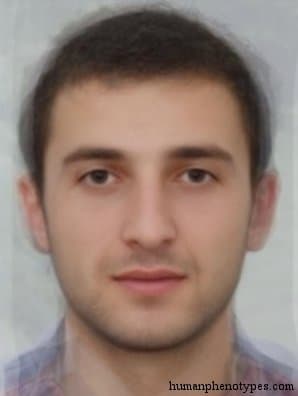
Mtebid
Caucasus
Regional type of the Caucasus Mountains. Probably an Alpinised Dinaro-Armenid adapted to life in mountainous regions. Mtebids are typical of...
Kham
East Asia
Robust Sinid variety, found in its highest concentration in Eastern Tibet, especially in the Kham region in nomads and warrior castes. Could...
Neo Danubian
Eastern Europe
East Europid variety with Nordic and Ladogan elements, associated with Slavs. Became more populous during the last centuries, increasing bra...
Guineo Camerunian
West Africa
West African type, the shorter-skulled counterpart of Guinesids. May constitute the transition to Congolesids. Common in forest regions of C...
Test what you learned
Put your eye for regional faces to work in the daily quiz — a composite face, a world map, and your best guess.