Neo Danubian Phenotype - Face Features & Origin
East Europid variety with Nordic and Ladogan elements, associated with Slavs. The entry below collects the Neo Danubian composite face, its documented distribution around 53.4° N, 27.7° E in Eastern Europe, its physical characteristics, the research history behind the name, and the academic references that support all of it.
Average Face
The Neo Danubian composite below is not a photograph of a real person. Historical anthropologists aligned multiple individual portraits from the Neo Danubian reference population and averaged them into one image, so recurring structures — skull outline, nose form, lip thickness, brow position — dominate while individual idiosyncrasies cancel out.
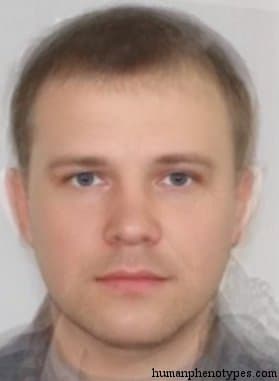
Composite source: Human Phenotypes — Neo Danubian
Geographic Distribution
Neo Danubian is documented across Eastern Europe, with its historical reference center near 53.4° N, 27.7° E. The coordinates mark where the type was most characteristic roughly 1500 years ago; population movements since then have scattered and blended the distribution far beyond that point.
Physical Characteristics
Pale to fair skin.
- Straight, rarely wavy ash blonde sometimes brown hair, grey-mixed eyes
- Medium height, meso- macroskelic, short arms, endomorph to mesomorph
- Brachycephalic, sometimes mesocephalic, mildly hypsicranic, globular, modest-sized head
- Leptorrhine, low-rooted, concave snub-nose, not very thin lips, weak, rounded chin
- Face rather flat and squarish, short jaw, forehead low and sloping
- Sometimes weakly slanted eyes
- Malars moderate
Historical Background
East Europid variety with Nordic and Ladogan elements, associated with Slavs. Became more populous during the last centuries, increasing brachycephaly in Russia. Frequent in Belarus, Greater Russia, and Poland. Widespread, from Siberia to Greece and Hungary. Sometimes in Baltic countries, Finland, Ukraine, Romania, Bulgaria, Czechia, Slovakia, Serbia, even Germany and Austria.
Research History & Naming
Every label in the historical catalogue has an author and a date, and Neo Danubian has accumulated its share of competing attributions. For Neo Danubian, the literature extract below shows the naming chain — from the first definition through the later revisions that shaped the current entry.
Originally described by Deniker (1900) as Oriental and adpoted as Eastern by Saller (1949) . Coon (1939) named and defined it as Neo Danubian, linking it to Danubian Nordics. The main variety of Osteuropid (German for East Europid) in Eickstedt (1934) , Bunak (1976) , Vondernach (2008) and of Baltic by Biasutti (1967) .
Comparison With Nearby Phenotypes
Ranked by great-circle distance from Neo Danubian's reference center, these are the five nearest documented phenotypes — the closest being Pre Slavic at 339 km. Overlapping distributions like these are exactly what makes the quiz hard, and the Pre Slavic row is where to start looking.
| Phenotype | Region | Distance | Distinguishing trait |
|---|---|---|---|
| Pre Slavic | Eastern Europe | 339 km | Pale to fair skin, straight or wavy, brown, rarely blonde hair, brown or mixed eyes. |
| North Pontid | Northern Europe | 590 km | Fair skin, straight or wavy, dark blonde to dark brown hair. |
| Aisto Nordid | Northern Europe | 610 km | Pale skin, straight, usually blonde hair with blue or grey eyes. |
| Gorid | Central Europe | 688 km | Fair to light brown skin, straight to wavy brown, sometimes blonde hair. |
| Carpathid | Eastern Europe | 777 km | Pale to light brown skin, straight or wavy, often brown hair and dark-mixed eyes. |
Neo Danubian in the Game
When the Neo Danubian composite shows up in the quiz, players who know the Eastern Europe distribution pattern have the edge. The reference answer sits near 53.4° N, 27.7° E; pins on the wrong continent score close to zero, so even a rough regional instinct beats a precise but misdirected pin.
Neo Danubian Phenotype FAQ
- Where does the Neo Danubian phenotype come from?
- Historical sources center the Neo Danubian phenotype on 53.4° N, 27.7° E (Eastern Europe). Treat that as a rough anchor: the type appeared across a wider surrounding area — its nearest documented neighbors, Pre Slavic and North Pontid, sit 339 and 590 km from the reference point — and its present-day distribution no longer matches the historical map.
- What does the Neo Danubian phenotype look like?
- The composite emphasizes recurring traits: pale to fair skin. The full trait list for Neo Danubian appears in the physical characteristics section above.
- Is the Neo Danubian phenotype a race or a nationality?
- No. A phenotype is a recurring bundle of visible traits documented by historical anthropologists across a population — for Neo Danubian, patterns such as pale to fair skin. The Neo Danubian entry is not a genetic ancestry, not a nationality, and not a statement about any individual person. Two people from the same country can match completely different phenotypes — one resembling Neo Danubian, another closer to Pre Slavic — and one phenotype can span many modern borders.
- How does Neo Danubian appear in the game?
- When the Neo Danubian face comes up in Classic Daily or Challenge Mode, you pin the world map where you believe the type is historically most common, and the score decays with your distance to 53.4° N, 27.7° E. Fair warning: the nearest other entry in our dataset, Pre Slavic, sits just 339 km away, so this face rewards precise placement — the right country alone is not always enough.
References & Literature
Primary sources for the Neo Danubian entry, listed as cited in the historical literature. The naming and classification debates around Neo Danubian referenced above run through these works.
- D00
- Saller, K. 1949. Art- und Rassenlehre des Menschen. Curt E. Schwab. Stuttgart.
- Coon, C.S.. 1939.. The Races of Europe. The Macmillan Company. New York.
- Eickstedt, E. von. 1934. Rassenkunde und Rassengeschichte der Menschheit. Ferdinand Enke. Stuttgart.
- Bunak, V. V. 1976. Rassengeschichte Osteuropas. In: Schwidetzky, I.: Rassengeschichte der Menschheit, Ost- und Nordeuropa. R. Odenbourg. München. Wien.
- V09
- Biasutti, R. 1967 (1941). Le Razze e i Popoli della terra. 4th Ed. Vol 1-4. U.T.E.T., Torino.
Related Phenotypes
More entries from the same region of the historical map as Neo Danubian, each with its own composite and trait profile.
Pre Slavic
Eastern Europe · 339 km away
Ancient Central European element, associated with Pre-Slavic people. Common in Poles and West Ukrainians, especially in Volhynia, Galicia, P...
North Pontid
Northern Europe · 590 km away
Altered Mediterranoid of Eastern Europe that connects Pontids with more northern types. Most common in a large area from Poland to the Russi...
Aisto Nordid
Northern Europe · 610 km away
East Nordid subvariety, common in coastal regions of Baltic countries. One of the last strongholds of East Nordids that are only a minority ...
Gorid
Central Europe · 688 km away
East Alpinid variety, named after the Polish word for mountain (Gora). Metrically intermediate between West Alpinid and East Europid. The nu...
Carpathid
Eastern Europe · 777 km away
European type with Gorid and Dinaro-Armenid elements. Common around the Carpathian Mountains of Central Eastern Europe, e.g. in Huzulis and ...
Further Reading
Background articles from the blog that explain where the Neo Danubian type fits, how these composites are built, and what a face can and cannot tell you.
Ethnicity Guesser vs Ethnoguessr: What Each One Counts
Two products answer to nearly the same name in a search box, and the totals they advertise count two kinds of object that do not...
What Nationality Do I Look Like? A Legal Status, Not a Face
Nationality is a status that states assign and reassign. A face can resemble a documented regional pattern; it cannot resemble a...