North Pontid Phenotype - Face Features & Origin
Altered Mediterranoid of Eastern Europe that connects Pontids with more northern types. Its reference coordinates sit near 52.2° N, 19.1° E in Northern Europe. Rather than a single portrait, the North Pontid composite below is a statistical average, and the surrounding sections — traits, distribution, research history, references — give that average its context.
Average Face
What you see below is a statistical construction of the North Pontid reference population. Faces recorded from the North Pontid sample were overlaid and merged; the result keeps the features most members shared and discards personal variation. It reads like a North Pontid portrait, but it works like a histogram.
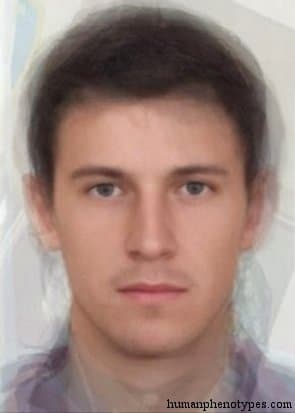
Composite source: Human Phenotypes — North Pontid
Geographic Distribution
The reference center for North Pontid sits near 52.2° N, 19.1° E in Northern Europe. Around that anchor, prevalence falls off gradually — the type is not confined to one valley or one modern border, and the historical map should be read as a gradient rather than a boundary.
Physical Characteristics
Fair skin, straight or wavy, dark blonde to dark brown hair.
- Medium height, mesoskelic, ectomorph to mesomorph
- Mesocephalic, mildly hypsicranic with a straight and leptorrhine nose
- Differs from Pontids proper by wider faces, sharper facial features, and fairer pigmentation
- Blue eyes are almost as common as dark eyes
Historical Background
Altered Mediterranoid of Eastern Europe that connects Pontids with more northern types. Most common in a large area from Poland to the Russian city of Penza. Extends north to Finland and south to Macedonia, Bulgaria, Greece (Thracia, North Thessalia), and Georgia. Occasionally west to Eastern Germany. Has a Polesian (transitional to Pre Slavic), Central Eastern European, and Ryazan subvariety.
Research History & Naming
The passage below traces who first defined North Pontid, which rival names competed with it, and how later authors consolidated or disputed the classification — the raw material of any serious phenotype reference.
Named and described by Bunak ( 1932 , 1976 ). He integrated it in Ryazan type of Tschepurkowski (1911) that was also used by Saller (1949) , Drexel, 1955 and Glowatzki (1976) . Czekanowski (1938) and Kapica (1967) regarded it part of North Western (synonymous with North Atlantid).
Comparison With Nearby Phenotypes
The five phenotypes whose documented centers lie closest to North Pontid, ranked by great-circle distance. They are the types players most often confuse with North Pontid in the quiz, precisely because their distributions overlap.
| Phenotype | Region | Distance | Distinguishing trait |
|---|---|---|---|
| Gorid | Central Europe | 310 km | Fair to light brown skin, straight to wavy brown, sometimes blonde hair. |
| Pre Slavic | Eastern Europe | 458 km | Pale to fair skin, straight or wavy, brown, rarely blonde hair, brown or mixed eyes. |
| Proto Nordid | Northern Europe | 540 km | Pale to fair skin, straight or wavy, usually blonde, sometimes reddish hair with blue, green, or grey eyes. |
| Neo Danubian | Eastern Europe | 590 km | Pale to fair skin. |
| Central Brachid | Central Europe | 610 km | Medium brown skin, straight or wavy hair, rather tall, mesoskelic, endomorph to ectomorph. |
North Pontid in the Game
North Pontid is one of the faces that can appear in Classic Daily and Challenge Mode. When it does, the winning pin lands near 52.2° N, 19.1° E in Northern Europe — and because the scoring decays with distance, recognizing the region matters more than pixel-perfect placement.
North Pontid Phenotype FAQ
- Where does the North Pontid phenotype come from?
- The reference coordinates for the North Pontid phenotype sit near 52.2° N, 19.1° E, in Northern Europe. That point marks the center of the Northern Europe distribution documented roughly 1500 years ago — actual prevalence spread well beyond it, toward entries such as Gorid 310 km away, and modern migration has blurred those boundaries further.
- What does the North Pontid phenotype look like?
- In the historical literature, fair skin, straight or wavy, dark blonde to dark brown hair. For North Pontid these are statistical tendencies across a population, not a checklist every individual matches.
- Is the North Pontid phenotype a race or a nationality?
- No — and the North Pontid naming history above shows why. North Pontid was defined, renamed, and regrouped repeatedly by different researchers, which is the opposite of how a fixed racial category would behave. A phenotype is a recurring bundle of visible traits recorded across a population; the North Pontid label says nothing about where any individual's ancestors were born.
- How does North Pontid appear in the game?
- In Classic Daily and Challenge Mode, the North Pontid composite face appears without a label. Your task is to drop a pin on the world map where you think that face is historically most common — the scoring uses the distance between your pin and the reference coordinates near 52.2° N, 19.1° E. The post-round review then shows the correct location, your distance error, and this North Pontid entry.
References & Literature
The North Pontid phenotype entry above is compiled from the 8 academic references. Readers are encouraged to consult the original North Pontid sources for verification and deeper context.
- Bunak, V. 1932. Neues Material zur Aussonderung anthropologischer Typen unter der Bevölkerung Osteuropas. Zeitschrift für Morphologie und Anthropologie, 30 (3). 441-503.
- Bunak, V. V. 1976. Rassengeschichte Osteuropas. In: Schwidetzky, I.: Rassengeschichte der Menschheit, Ost- und Nordeuropa. R. Odenbourg. München. Wien.
- Tschepurkowski, E. 1911. Anthropologische Studien. Archiv für Anthropologie.
- Saller, K. 1949. Art- und Rassenlehre des Menschen. Curt E. Schwab. Stuttgart.
- Dart, R. 1955. Three Strandloper from the Kaokoveld Coast. S. Afr. J. Sci 51. 175-179.
- Glowatzki, G.. 1976. Die Rassen des Menschen. Kosmos Verlags-Gmbh. Stuttgart.
- Czekanowski J.. 1938. Czlowiek, jego rasy i zycie.
- K67
Related Phenotypes
If North Pontid interested you, these neighboring phenotype entries cover adjacent parts of the map with distinctly different trait bundles.
Gorid
Central Europe · 310 km away
East Alpinid variety, named after the Polish word for mountain (Gora). Metrically intermediate between West Alpinid and East Europid. The nu...
Pre Slavic
Eastern Europe · 458 km away
Ancient Central European element, associated with Pre-Slavic people. Common in Poles and West Ukrainians, especially in Volhynia, Galicia, P...
Proto Nordid
Northern Europe · 540 km away
Ancient East Nordid variety, the eastern counterpart of the Aisto Nordids. Together with early Mediterranids it was widespread in prehistori...
Neo Danubian
Eastern Europe · 590 km away
East Europid variety with Nordic and Ladogan elements, associated with Slavs. Became more populous during the last centuries, increasing bra...
Central Brachid
Central Europe · 610 km away
Indo Brachid variety, with a morphological and geographical position between West and East (Indo) Brachids, but possibly resulting from diff...
Further Reading
Background articles from the blog that explain where the North Pontid type fits, how these composites are built, and what a face can and cannot tell you.
Ethnicity Guesser Photo: What Happens to the File First
A photo handed to a face tool stops being a photograph almost at once: the file is decoded, rotated, colour-converted and resized before...
Ethnicity Quiz: Five Question Types Behind the Label
A face quiz, a census form, a reaction-time experiment, a surname model and an ancestry report all answer to the same phrase.