Anglo-Saxon Phenotype - Face Features & Origin
North-West European type, similar to Trønder, but with a stronger Hallstatt component. The entry below collects the Anglo-Saxon composite face, its documented distribution around 52.5° N, 0.7° E in Northern Europe, its physical characteristics, the research history behind the name, and the academic references that support all of it.
Average Face
The Anglo-Saxon composite below is not a photograph of a real person. Historical anthropologists aligned multiple individual portraits from the Anglo-Saxon reference population and averaged them into one image, so recurring structures — skull outline, nose form, lip thickness, brow position — dominate while individual idiosyncrasies cancel out.
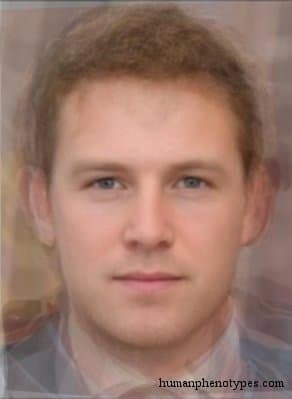
Composite source: Human Phenotypes — Anglo-Saxon
Geographic Distribution
Anglo-Saxon is documented across Northern Europe, with its historical reference center near 52.5° N, 0.7° E. The coordinates mark where the type was most characteristic roughly 1500 years ago; population movements since then have scattered and blended the distribution far beyond that point.
Physical Characteristics
Pale skin, straight to curly, often blonde, sometimes red or brown hair with light(-mixed) eyes.
- Rather tall, mesoskelic, ectomorph to mesomorph
- Mesocephalic, chamae- orthocranic with narrower faces and more roundish features than Trønder, and more robust features than Hallstatt as well as more prominent cheek-bones
- Nose is hyperleptorrhine, the forehead high
Historical Background
North-West European type, similar to Trønder, but with a stronger Hallstatt component. Was typified by the ancient Germanic tribes of Angles, Saxons, and Jutes who conquered Britain from the 5th century on. Most common today in East England, but also Frisia (Netherlands), North-West Germany, West Denmark, and parts of Northern France and Ireland.
Research History & Naming
Every label in the historical catalogue has an author and a date, and Anglo-Saxon has accumulated its share of competing attributions. For Anglo-Saxon, the literature extract below shows the naming chain — from the first definition through the later revisions that shaped the current entry.
Coon (1939) defined the type as a Nordic subtype after earlier works had pointed out its distinctiveness ( Shore, 1906 ). Also used by some later authors like Cole (1965) . Biasutti (1967) describes it as a special Nordic subtype he called "britannico".
Comparison With Nearby Phenotypes
Geography, not alphabet, ordered this table: the five phenotype centers closest to Anglo-Saxon's, with the traits most likely to be mistaken for it (North Atlantid leads at 587 km). In gameplay, these five account for most of the wrong-but-nearby pins against Anglo-Saxon.
| Phenotype | Region | Distance | Distinguishing trait |
|---|---|---|---|
| North Atlantid | Northern Europe | 587 km | Pale, sometimes ruddy or freckled skin. |
| Central Brachid | Central Europe | 685 km | Medium brown skin, straight or wavy hair, rather tall, mesoskelic, endomorph to ectomorph. |
| Borreby | Central Europe | 722 km | Pale to fair skin, straight or wavy blonde, sometimes red or brown hair, blue or mixed eyes. |
| West Alpinid | Central Europe | 892 km | Fair to light brown skin, straight or wavy, usually (light) brown hair with a blonde minority. |
| Proto Nordid | Northern Europe | 921 km | Pale to fair skin, straight or wavy, usually blonde, sometimes reddish hair with blue, green, or grey eyes. |
Anglo-Saxon in the Game
In gameplay terms, Anglo-Saxon rewards region-level recall: the score is computed from the distance between your pin and 52.5° N, 0.7° E. Players often confuse Anglo-Saxon with North Atlantid (587 km out) in the comparison table above — those confusions are exactly what the distance penalty is designed to expose.
Anglo-Saxon Phenotype FAQ
- Where does the Anglo-Saxon phenotype come from?
- Historical sources center the Anglo-Saxon phenotype on 52.5° N, 0.7° E (Northern Europe). Treat that as a rough anchor: the type appeared across a wider surrounding area — its nearest documented neighbors, North Atlantid and Central Brachid, sit 587 and 685 km from the reference point — and its present-day distribution no longer matches the historical map.
- What does the Anglo-Saxon phenotype look like?
- The composite emphasizes recurring traits: pale skin, straight to curly, often blonde, sometimes red or brown hair with light(-mixed) eyes. The full trait list for Anglo-Saxon appears in the physical characteristics section above.
- Is the Anglo-Saxon phenotype a race or a nationality?
- No. A phenotype is a recurring bundle of visible traits documented by historical anthropologists across a population — for Anglo-Saxon, patterns such as pale skin, straight to curly, often blonde, sometimes red or brown hair with light(-mixed) eyes. The Anglo-Saxon entry is not a genetic ancestry, not a nationality, and not a statement about any individual person. Two people from the same country can match completely different phenotypes — one resembling Anglo-Saxon, another closer to North Atlantid — and one phenotype can span many modern borders.
- How does Anglo-Saxon appear in the game?
- When the Anglo-Saxon face comes up in Classic Daily or Challenge Mode, you pin the world map where you believe the type is historically most common, and the score decays with your distance to 52.5° N, 0.7° E. The nearest documented type, North Atlantid, lies about 587 km away, so regional placement usually carries most of the score.
References & Literature
Primary sources for the Anglo-Saxon entry, listed as cited in the historical literature. The naming and classification debates around Anglo-Saxon referenced above run through these works.
- Coon, C.S.. 1939.. The Races of Europe. The Macmillan Company. New York.
- Shore, T. W. 1906. Origin of the Anglo-Saxon Race. London.
- Cole, S. 1965. Races of Man. Butler & Tanner Ltd. Frome and London.
- Czekanowski, J.. 1967. Cz owiek w czasie i przestrzenie. Pa stwowe Wydawnictwo Naukowe. Warsaw.
Related Phenotypes
More entries from the same region of the historical map as Anglo-Saxon, each with its own composite and trait profile.
North Atlantid
Northern Europe · 587 km away
Western European type that combines features of Nordid and Mediterranid in a unique way. Resembles British Iron Age Celts. The principal ele...
Central Brachid
Central Europe · 685 km away
Indo Brachid variety, with a morphological and geographical position between West and East (Indo) Brachids, but possibly resulting from diff...
Borreby
Central Europe · 722 km away
Ancient Northern European variety. Named after some of the Neolithic Borreby skulls of Denmark (not all!). Some emphasised resemblance with ...
West Alpinid
Central Europe · 892 km away
Alpinid proper, historically found in the mountain regions of Western Europe. Often a cohabitant of a second mountain type, the Dinarid. The...
Proto Nordid
Northern Europe · 921 km away
Ancient East Nordid variety, the eastern counterpart of the Aisto Nordids. Together with early Mediterranids it was widespread in prehistori...
Further Reading
Background articles from the blog that explain where the Anglo-Saxon type fits, how these composites are built, and what a face can and cannot tell you.
Guess the Nationality: What 48 Country Average Faces Actually Show
National average faces converge with geography - neighbors look alike because populations mix along the routes terrain allows.
What Is an Ethnicity Guesser? The Map Game Where Faces Are the Clues
Ethnicity guessers are the newest branch of geography gaming: a composite face appears, you pin the map. Here is the genre, where it...