Borreby Phenotype - Face Features & Origin
Historical anthropology places the Borreby phenotype in Central Europe, with a documented center near 55.7° N, 10.3° E. Ancient Northern European variety. The sections that follow unpack the Borreby entry in practice: the composite face, the traits it summarizes, the naming history, and the sources.
Average Face
Averaging the portraits behind Borreby leaves the features that repeat and erases the ones that do not. That is exactly how the Borreby composite below was built: individual photographs were aligned and statistically merged, exaggerating shared structure into a single reference face that no actual person looks like.
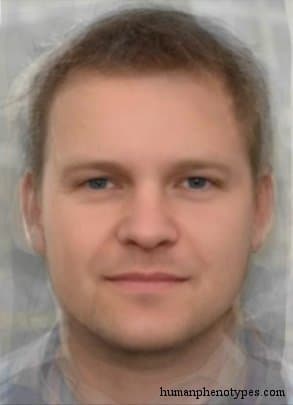
Composite source: Human Phenotypes — Borreby
Geographic Distribution
Borreby is documented across Central Europe, with its historical reference center near 55.7° N, 10.3° E. The coordinates mark where the type was most characteristic roughly 1500 years ago; population movements since then have scattered and blended the distribution far beyond that point.
Physical Characteristics
Pale to fair skin, straight or wavy blonde, sometimes red or brown hair, blue or mixed eyes.
- Tall, meso- macroskelic, mesomorph to endomorph with a heavy bone structure
- Mildly brachycephalic, with an extraordinary large head
- Leptorrhine, straight, sometimes concave nose
- Face roundish and robust, forehead high
Historical Background
Ancient Northern European variety. Named after some of the Neolithic Borreby skulls of Denmark (not all!). Some emphasised resemblance with Cro-Magnons. Similar to Faelid, but shorter-skulled with East Baltid and Alpinid tendencies. Most common in Denmark, South Norway (Jæren), and North Germany (esp. Fehmarn). Extends to the Baltic region, Britain, Italy, and Montenegro.
Research History & Naming
Every label in the historical catalogue has an author and a date, and Borreby has accumulated its share of competing attributions. For Borreby, the literature extract below shows the naming chain — from the first definition through the later revisions that shaped the current entry.
Named and defined by Coon (1939) as a common Upper Paleolithic type, used by Birket-Smith (1940) . Schwidetzky (1974) regards it a broader-skulled Faelid. Broader-skulled Dalics were also adressed by Vallois ( 1943, 1971) . Part of Montandon's (1933) Subnordid. Often solely a prehistoric type ( Charles, 1960 ; Saller, 1962 ) with few recombinations in modern East Baltids ( Saller, 1949 ) or Alpinids ( Hooton, 1946 ). Resembles Cheboksarov's (1961) West Baltic.
Comparison With Nearby Phenotypes
Geography, not alphabet, ordered this table: the five phenotype centers closest to Borreby's, with the traits most likely to be mistaken for it (Proto Nordid leads at 207 km). In gameplay, these five account for most of the wrong-but-nearby pins against Borreby.
| Phenotype | Region | Distance | Distinguishing trait |
|---|---|---|---|
| Proto Nordid | Northern Europe | 207 km | Pale to fair skin, straight or wavy, usually blonde, sometimes reddish hair with blue, green, or grey eyes. |
| Central Brachid | Central Europe | 501 km | Medium brown skin, straight or wavy hair, rather tall, mesoskelic, endomorph to ectomorph. |
| Scando Lappid | Northern Europe | 617 km | Light greyish brown skin, straight, usually dark brown, sometimes blonde or red hair, and brown eyes that are sporadically slanted. |
| Dalofaelid | Northern Europe | 640 km | Pale to fair skin. |
| Paleo Atlantid | Northern Europe | 645 km | Fair skin, curly or wavy, sometimes straight, usually brown-black, occasionally red or blonde hair, eyes mixed. |
Borreby in the Game
In gameplay terms, Borreby rewards region-level recall: the score is computed from the distance between your pin and 55.7° N, 10.3° E. Players often confuse Borreby with Proto Nordid (207 km out) in the comparison table above — those confusions are exactly what the distance penalty is designed to expose.
Borreby Phenotype FAQ
- Where does the Borreby phenotype come from?
- Historical sources center the Borreby phenotype on 55.7° N, 10.3° E (Central Europe). Treat that as a rough anchor: the type appeared across a wider surrounding area — its nearest documented neighbors, Proto Nordid and Central Brachid, sit 207 and 501 km from the reference point — and its present-day distribution no longer matches the historical map.
- What does the Borreby phenotype look like?
- The composite emphasizes recurring traits: pale to fair skin, straight or wavy blonde, sometimes red or brown hair, blue or mixed eyes. The full trait list for Borreby appears in the physical characteristics section above.
- Is the Borreby phenotype a race or a nationality?
- No — and the Borreby naming history above shows why. Borreby was defined, renamed, and regrouped repeatedly by different researchers, which is the opposite of how a fixed racial category would behave. A phenotype is a recurring bundle of visible traits recorded across a population; the Borreby label says nothing about where any individual's ancestors were born.
- How does Borreby appear in the game?
- When the Borreby face comes up in Classic Daily or Challenge Mode, you pin the world map where you believe the type is historically most common, and the score decays with your distance to 55.7° N, 10.3° E. Fair warning: the nearest other entry in our dataset, Proto Nordid, sits just 207 km away, so this face rewards precise placement — the right country alone is not always enough.
References & Literature
Primary sources for the Borreby entry, listed as cited in the historical literature. The naming and classification debates around Borreby referenced above run through these works.
- Coon, C.S.. 1939.. The Races of Europe. The Macmillan Company. New York.
- Birket-Smith, K. 1940. Wir Menschen. Einst und Jetzt. Orell Füssli Verlag. Zürich.
- Schwidetzky, I.. 1974. Grundlagen der Rassensystematik. B.I.-Wissenschaftsverlag. Mannheim.
- Vallois, H. V. 1943. Anthropologie de la population française. 4th Ed. Didier.
- Vallois, H. V. 1971. Las races humaines. 8 Ed. Grammont.
- Montandon, G. 1933. La race, les races: mise au point d éthnologie somatique. Payot. Paris.
- Charles, R. P. 1960. Le peuplement de l'Europe méditerranéenne pendant les IIIe et IIe millénaires avant Jésus-Christ. Bull. et Mém. de la Soc. d'anthr. de Paris 1. 3-156.
- Saller, K. 1962. Die Ofnet-Funde in neuer Zusammensetzung: Ihre Stellung in der Rassengeschichte Europas. Zeitschr. für Morphologie und Anthropologie 52(1). 1-51.
- Saller, K. 1949. Art- und Rassenlehre des Menschen. Curt E. Schwab. Stuttgart.
- Hooton, E.A. 1946. Up from the Ape. Rev. ed. Macmillan Company . New York.
- Cheboksarov, N. N. 1961. The Racial types of the German people. Internat. Journal of American Linguistics 27, 3. 114-138.
Related Phenotypes
More entries from the same region of the historical map as Borreby, each with its own composite and trait profile.
Proto Nordid
Northern Europe · 207 km away
Ancient East Nordid variety, the eastern counterpart of the Aisto Nordids. Together with early Mediterranids it was widespread in prehistori...
Central Brachid
Central Europe · 501 km away
Indo Brachid variety, with a morphological and geographical position between West and East (Indo) Brachids, but possibly resulting from diff...
Scando Lappid
Northern Europe · 617 km away
Lappid proper - an ancient European type associated with Southern Saami people (formerly "Lapps"). Rare today, often mixed, typical in North...
Dalofaelid
Northern Europe · 640 km away
Coarse, Cromagniform Nordid variety of Central and Northern Europe. Named after the Swedish province of Dalarna and the German region of Wes...
Paleo Atlantid
Northern Europe · 645 km away
Ancient type that is sporadically found in Northern and Western Europe, usually only in relict populations. A resemblance with Cro-Magnons h...
Further Reading
Background articles from the blog that explain where the Borreby type fits, how these composites are built, and what a face can and cannot tell you.
Guess the Nationality: What 48 Country Average Faces Actually Show
National average faces converge with geography - neighbors look alike because populations mix along the routes terrain allows.
Ethnicity Guesser vs DNA Test: Two Different Questions About Where You're From
A DNA test answers 'what fraction of my ancestors came from reference regions' - a face quiz answers 'what historical pattern does this...