Central Brachid Phenotype - Face Features & Origin
Indo Brachid variety, with a morphological and geographical position between West and East (Indo) Brachids, but possibly resulting from different, more Alpinoid migrations. Its reference coordinates sit near 51.2° N, 10.4° E in Central Europe. Rather than a single portrait, the Central Brachid composite below is a statistical average, and the surrounding sections — traits, distribution, research history, references — give that average its context.
Average Face
What you see below is a statistical construction of the Central Brachid reference population. Faces recorded from the Central Brachid sample were overlaid and merged; the result keeps the features most members shared and discards personal variation. It reads like a Central Brachid portrait, but it works like a histogram.
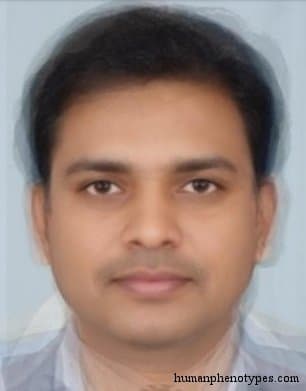
Composite source: Human Phenotypes — Central Brachid
Geographic Distribution
The reference center for Central Brachid sits near 51.2° N, 10.4° E in Central Europe. Around that anchor, prevalence falls off gradually — the type is not confined to one valley or one modern border, and the historical map should be read as a gradient rather than a boundary.
Physical Characteristics
Medium brown skin, straight or wavy hair, rather tall, mesoskelic, endomorph to ectomorph.
- Rather brachycephalic, hypsicranic
- Often mesorrhine nose, slightly wider and more frequently concave than in West Brachids
- In addition, the vault is higher and the stature taller
Historical Background
Indo Brachid variety, with a morphological and geographical position between West and East (Indo) Brachids, but possibly resulting from different, more Alpinoid migrations. Overall taller. Most common in Uttar Pradesh, South Nepal, the Gangetic Plain, the Deccan Plateau, and other parts of Central India as far as Orissa.
Research History & Naming
Every label in the historical catalogue has an author and a date, and Central Brachid has accumulated its share of competing attributions. For Central Brachid, the literature extract below shows the naming chain — from the first definition through the later revisions that shaped the current entry.
First named Homo indicus brachimorphus by Giuffrida-Ruggeri (1912) . Eickstedt (1937) named the type Central Brachid and described it as most common in the Doab. Generally placed in Indobrachid ( Eickstedt, 1944 ) . Giuffrida-Ruggeri (1921) and Haddon (1925) linked the type to early migrations of Alpinoids.
Comparison With Nearby Phenotypes
The five phenotypes whose documented centers lie closest to Central Brachid, ranked by great-circle distance. They are the types players most often confuse with Central Brachid in the quiz, precisely because their distributions overlap.
| Phenotype | Region | Distance | Distinguishing trait |
|---|---|---|---|
| Hallstatt | Central Europe | 464 km | Pinkish pale skin. |
| Borreby | Central Europe | 501 km | Pale to fair skin, straight or wavy blonde, sometimes red or brown hair, blue or mixed eyes. |
| Norid | Southeastern Europe | 549 km | Pale to fair skin. |
| Proto Nordid | Northern Europe | 562 km | Pale to fair skin, straight or wavy, usually blonde, sometimes reddish hair with blue, green, or grey eyes. |
| West Alpinid | Central Europe | 602 km | Fair to light brown skin, straight or wavy, usually (light) brown hair with a blonde minority. |
Central Brachid in the Game
Central Brachid is one of the faces that can appear in Classic Daily and Challenge Mode. When it does, the winning pin lands near 51.2° N, 10.4° E in Central Europe — and because the scoring decays with distance, recognizing the region matters more than pixel-perfect placement.
Central Brachid Phenotype FAQ
- Where does the Central Brachid phenotype come from?
- Historical sources center the Central Brachid phenotype on 51.2° N, 10.4° E (Central Europe). Treat that as a rough anchor: the type appeared across a wider surrounding area — its nearest documented neighbors, Hallstatt and Borreby, sit 464 and 501 km from the reference point — and its present-day distribution no longer matches the historical map.
- What does the Central Brachid phenotype look like?
- The composite emphasizes recurring traits: medium brown skin, straight or wavy hair, rather tall, mesoskelic, endomorph to ectomorph. The full trait list for Central Brachid appears in the physical characteristics section above.
- Is the Central Brachid phenotype a race or a nationality?
- No. Phenotypes like Central Brachid are descriptive averages, not ancestry groups. Central Brachid is one of several types documented in and around Central Europe — see the comparison table above — and the same individual can carry traits associated with several of them at once. The Central Brachid entry describes a statistical pattern, not a group of people and not a nationality.
- How does Central Brachid appear in the game?
- When the Central Brachid face comes up in Classic Daily or Challenge Mode, you pin the world map where you believe the type is historically most common, and the score decays with your distance to 51.2° N, 10.4° E. The nearest documented type, Hallstatt, lies about 464 km away, so regional placement usually carries most of the score.
References & Literature
Primary sources for the Central Brachid entry, listed as cited in the historical literature. The naming and classification debates around Central Brachid referenced above run through these works.
- Giuffrida-Ruggeri, V. 1912. Schema di Classificazione degli hominidae attuali. Arch. per l'A. e l'Etn. XLII.
- Eickstedt, E. von. 1937. Geschichte der anthropologischen Namengebung und Klassifikation. In: Zeitschrift für Rassenkunde. Band 5, 209-282, Band 6, 36-96, 151-210.
- Eickstedt, E. von. 1944. Rassendynamik von Ostasien. Walter de Gruyter. Berlin.
- Giuffrida-Ruggeri, V. 1921. The first outlines of a Systematic Anthropology of Asia. Calcutta University Press.
- Haddon, A.C.. 1925. The Races of Man and their distribution. Cambridge at the University Press. London.
Related Phenotypes
If Central Brachid interested you, these neighboring phenotype entries cover adjacent parts of the map with distinctly different trait bundles.
Hallstatt
Central Europe · 464 km away
Nordid proper, resembles the Iron Age remains of the Austrian village of Hallstatt. Most common among Swedes and South Norwegians. Frequent ...
Borreby
Central Europe · 501 km away
Ancient Northern European variety. Named after some of the Neolithic Borreby skulls of Denmark (not all!). Some emphasised resemblance with ...
Norid
Southeastern Europe · 549 km away
Central European type that closely resembles Dinarids except for lighter pigmentation. Authors interpret this to be the result of Nordid and...
Proto Nordid
Northern Europe · 562 km away
Ancient East Nordid variety, the eastern counterpart of the Aisto Nordids. Together with early Mediterranids it was widespread in prehistori...
West Alpinid
Central Europe · 602 km away
Alpinid proper, historically found in the mountain regions of Western Europe. Often a cohabitant of a second mountain type, the Dinarid. The...
Further Reading
Background articles from the blog that explain where the Central Brachid type fits, how these composites are built, and what a face can and cannot tell you.
Why Do Northern Europeans Have Light Eyes?
Every blue-eyed person alive today descends from one ancestor who carried a single mutation 6,000-10,000 years ago.
Guess My Ethnicity: What One Guess Can Carry
When someone types guess my ethnicity, they are asking a stranger to place a bet, and the odds depend far more on the list of labels...