Proto Nordid Phenotype - Face Features & Origin
Historical anthropology places the Proto Nordid phenotype in Northern Europe, with a documented center near 55.8° N, 13.6° E. Ancient East Nordid variety, the eastern counterpart of the Aisto Nordids. The sections that follow unpack the Proto Nordid entry in practice: the composite face, the traits it summarizes, the naming history, and the sources.
Average Face
Averaging the portraits behind Proto Nordid leaves the features that repeat and erases the ones that do not. That is exactly how the Proto Nordid composite below was built: individual photographs were aligned and statistically merged, exaggerating shared structure into a single reference face that no actual person looks like.
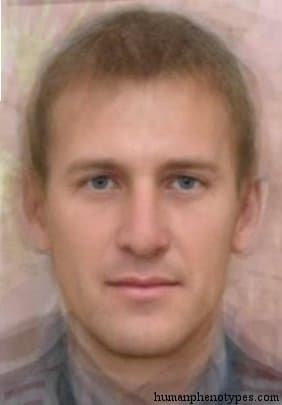
Composite source: Human Phenotypes — Proto Nordid
Geographic Distribution
Geographically, Proto Nordid anchors to 55.8° N, 13.6° E (Northern Europe). That is the point where historical anthropologists judged Proto Nordid most concentrated, not a hard edge; modern migration and intermarriage have long since softened whatever boundaries once existed.
Physical Characteristics
Pale to fair skin, straight or wavy, usually blonde, sometimes reddish hair with blue, green, or grey eyes.
- Tall, mesoskelic, ectomorph to mesomorph
- Dolichocephalic, mildly hypsicranic
- Face long, nose prominent, long and hyperleptorrhine, sometimes convex
- Rather rugged features, a deep mandible and a marked chin
Historical Background
Ancient East Nordid variety, the eastern counterpart of the Aisto Nordids. Together with early Mediterranids it was widespread in prehistoric Proto-Indo-European populations of the Eurasian steppes (Fatyanovo). Diluted today. Still found sporadically in Russians, Balts, Rhodopians, Kurds, Gilani, Alawis, Samaritans, Druze, some Persians, Kalash, Pamiri, and sometimes even in Uyghurs.
Research History & Naming
Typological names were coined, contested, and renamed repeatedly across the 20th century, and Proto Nordid is no exception. The extract below records the researchers who defined Proto Nordid, the alternative labels it accumulated, and where the modern consensus settled.
Eickstedt (1952) and Vondernach's (2008) called similar types Proto Nordid, Wellisch (1937) Altnordid (Old Nordid). Lundman (1943) defined it as Arin Nordid - his eastern East Nordid variety. Coon's (1939) Corded is similar. Iranian Nordoids ( Cole, 1965 ; Eickstedt, 1961 ; Biasutti, 1967 ) can be included. Keyser et al. (2009) confirmed a high frequencies of blonde hair and green eyes in early Kurgans.
Comparison With Nearby Phenotypes
Ranked by great-circle distance from Proto Nordid's reference center, these are the five nearest documented phenotypes — the closest being Borreby at 207 km. Overlapping distributions like these are exactly what makes the quiz hard, and the Borreby row is where to start looking.
| Phenotype | Region | Distance | Distinguishing trait |
|---|---|---|---|
| Borreby | Central Europe | 207 km | Pale to fair skin, straight or wavy blonde, sometimes red or brown hair, blue or mixed eyes. |
| Scando Lappid | Northern Europe | 470 km | Light greyish brown skin, straight, usually dark brown, sometimes blonde or red hair, and brown eyes that are sporadically slanted. |
| North Pontid | Northern Europe | 540 km | Fair skin, straight or wavy, dark blonde to dark brown hair. |
| Central Brachid | Central Europe | 562 km | Medium brown skin, straight or wavy hair, rather tall, mesoskelic, endomorph to ectomorph. |
| Dalofaelid | Northern Europe | 581 km | Pale to fair skin. |
Proto Nordid in the Game
When the Proto Nordid composite shows up in the quiz, players who know the Northern Europe distribution pattern have the edge. The reference answer sits near 55.8° N, 13.6° E; pins on the wrong continent score close to zero, so even a rough regional instinct beats a precise but misdirected pin.
Proto Nordid Phenotype FAQ
- Where does the Proto Nordid phenotype come from?
- Historical sources center the Proto Nordid phenotype on 55.8° N, 13.6° E (Northern Europe). Treat that as a rough anchor: the type appeared across a wider surrounding area — its nearest documented neighbors, Borreby and Scando Lappid, sit 207 and 470 km from the reference point — and its present-day distribution no longer matches the historical map.
- What does the Proto Nordid phenotype look like?
- The composite emphasizes recurring traits: pale to fair skin, straight or wavy, usually blonde, sometimes reddish hair with blue, green, or grey eyes. The full trait list for Proto Nordid appears in the physical characteristics section above.
- Is the Proto Nordid phenotype a race or a nationality?
- No. Phenotypes like Proto Nordid are descriptive averages, not ancestry groups. Proto Nordid is one of several types documented in and around Northern Europe — see the comparison table above — and the same individual can carry traits associated with several of them at once. The Proto Nordid entry describes a statistical pattern, not a group of people and not a nationality.
- How does Proto Nordid appear in the game?
- When the Proto Nordid face comes up in Classic Daily or Challenge Mode, you pin the world map where you believe the type is historically most common, and the score decays with your distance to 55.8° N, 13.6° E. Fair warning: the nearest other entry in our dataset, Borreby, sits just 207 km away, so this face rewards precise placement — the right country alone is not always enough.
References & Literature
Every claim on this page traces back to the sources below — the researchers who defined, measured, and argued over the Proto Nordid type. The originals behind the Proto Nordid entry are worth consulting directly.
- Eickstedt, E. von. 1952. Biodynamik der Europiden. In: Historia Mundi. Band 1, Munich, 115-134.
- Vonderach, A. 2008. Anthropologie Europas. Völker, Typen und Gene vom Neandertaler bis zur Gegenwart. Ares Verlag. Graz.
- Wellisch, S. 1937. Anthropologische Rassenanalyse. In: Zeitschrift für Rassenkunde, 5, 144-152, 288-295.
- Lundman, B. 1943. Jordens Människoraser och Folkstammar. Nybloms Förlag, Uppsala.
- Coon, C.S.. 1939.. The Races of Europe. The Macmillan Company. New York.
- Cole, S. 1965. Races of Man. Butler & Tanner Ltd. Frome and London.
- Eickstedt, E. von. 1961. Türken, Kurden und Iraner seit dem Altertum: Probleme einer anthropologischen Reise. Gustav Fischer Verlag, Stuttgart.
- Biasutti, R. 1967 (1941). Le Razze e i Popoli della terra. 4th Ed. Vol 1-4. U.T.E.T., Torino.
- Keyser et al. 2009. Ancient DNA provides new insights into the history of south Siberian Kurgan people. Human Genetics 126, 3. 395-410.
Related Phenotypes
More entries from the same region of the historical map as Proto Nordid, each with its own composite and trait profile.
Borreby
Central Europe · 207 km away
Ancient Northern European variety. Named after some of the Neolithic Borreby skulls of Denmark (not all!). Some emphasised resemblance with ...
Scando Lappid
Northern Europe · 470 km away
Lappid proper - an ancient European type associated with Southern Saami people (formerly "Lapps"). Rare today, often mixed, typical in North...
North Pontid
Northern Europe · 540 km away
Altered Mediterranoid of Eastern Europe that connects Pontids with more northern types. Most common in a large area from Poland to the Russi...
Central Brachid
Central Europe · 562 km away
Indo Brachid variety, with a morphological and geographical position between West and East (Indo) Brachids, but possibly resulting from diff...
Dalofaelid
Northern Europe · 581 km away
Coarse, Cromagniform Nordid variety of Central and Northern Europe. Named after the Swedish province of Dalarna and the German region of Wes...
Further Reading
Background articles from the blog that explain where the Proto Nordid type fits, how these composites are built, and what a face can and cannot tell you.
Guess the Nationality: What 48 Country Average Faces Actually Show
National average faces converge with geography - neighbors look alike because populations mix along the routes terrain allows.
What Is an Ethnicity Guesser? The Map Game Where Faces Are the Clues
Ethnicity guessers are the newest branch of geography gaming: a composite face appears, you pin the map. Here is the genre, where it...