Dalofaelid Phenotype - Face Features & Origin
Historical anthropology places the Dalofaelid phenotype in Northern Europe, with a documented center near 61.1° N, 14.2° E. Coarse, Cromagniform Nordid variety of Central and Northern Europe. The sections that follow unpack the Dalofaelid entry in practice: the composite face, the traits it summarizes, the naming history, and the sources.
Average Face
Averaging the portraits behind Dalofaelid leaves the features that repeat and erases the ones that do not. That is exactly how the Dalofaelid composite below was built: individual photographs were aligned and statistically merged, exaggerating shared structure into a single reference face that no actual person looks like.
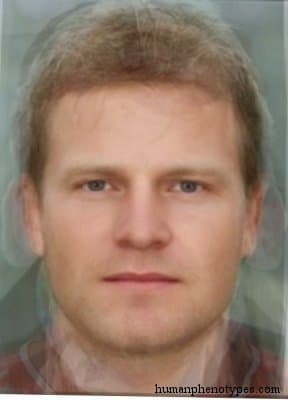
Composite source: Human Phenotypes — Dalofaelid
Geographic Distribution
Dalofaelid is documented across Northern Europe, with its historical reference center near 61.1° N, 14.2° E. The coordinates mark where the type was most characteristic roughly 1500 years ago; population movements since then have scattered and blended the distribution far beyond that point.
Physical Characteristics
Pale to fair skin.
- Straight to curly, blonde, sometimes red or brown hair
- Grey-blue or mixed eyes
- Tall, mesoskelic, mesomorph with robust bones, in old age sometimes endomorph
- Mesocephalic, chamae- orthocranic with a curved occiput, very large-headed
- Leptorrhine, straight or mildly convex nose
- Wide face, broad angular jaw and zygomatic arches
- Brow ridges strong, deep-set, small eyes
- Forehead broad, mildly sloping
- Broad mouth with thin lips
Historical Background
Coarse, Cromagniform Nordid variety of Central and Northern Europe. Named after the Swedish province of Dalarna and the German region of Westphalia. Typical areas include Central Germany, Netherlands, and Southern Sweden / Norway, partially even Southern Finland. Germanic migrations in Antiquity dispersed it across Europe. A Dalic, Faelid, and Västmanland subvariety can be distinguished.
Research History & Naming
Typological names were coined, contested, and renamed repeatedly across the 20th century, and Dalofaelid is no exception. The extract below records the researchers who defined Dalofaelid, the alternative labels it accumulated, and where the modern consensus settled.
Paudler (1917) , Kern (1927) , Biasutti (1967) and Vallois ( 1943 , 1971 ) called it Dalic, Günther (1942) Faelid. Vondernach (2008) addressed a Dalic and Faelic variety. Eickstedt (1934) / Baker (1981) use Dalofa(e)lid, Eickstedt ( 1937 , 1952 ) / Knussmann (1996) Dalo Nordid and Lundmann (1967) Fälo Nordid. An eastern branch of Coon's (1939) Brünn. Confirmed by Schwidetzky and Walter (1967) .
Comparison With Nearby Phenotypes
The five phenotypes whose documented centers lie closest to Dalofaelid, ranked by great-circle distance. They are the types players most often confuse with Dalofaelid in the quiz, precisely because their distributions overlap.
| Phenotype | Region | Distance | Distinguishing trait |
|---|---|---|---|
| Scando Lappid | Northern Europe | 288 km | Light greyish brown skin, straight, usually dark brown, sometimes blonde or red hair, and brown eyes that are sporadically slanted. |
| Trønder | Northern Europe | 375 km | Rosy-white skin, straight or wavy, often golden blonde, sometimes red or brown hair with light eyes. |
| Paleo Atlantid | Northern Europe | 422 km | Fair skin, curly or wavy, sometimes straight, usually brown-black, occasionally red or blonde hair, eyes mixed. |
| Savolaxid | Northern Europe | 523 km | Pale to fair skin, straight, dirty blonde or brown hair, often light eyes. |
| Proto Nordid | Northern Europe | 581 km | Pale to fair skin, straight or wavy, usually blonde, sometimes reddish hair with blue, green, or grey eyes. |
Dalofaelid in the Game
Dalofaelid is one of the faces that can appear in Classic Daily and Challenge Mode. When it does, the winning pin lands near 61.1° N, 14.2° E in Northern Europe — and because the scoring decays with distance, recognizing the region matters more than pixel-perfect placement.
Dalofaelid Phenotype FAQ
- Where does the Dalofaelid phenotype come from?
- Historical sources center the Dalofaelid phenotype on 61.1° N, 14.2° E (Northern Europe). Treat that as a rough anchor: the type appeared across a wider surrounding area — its nearest documented neighbors, Scando Lappid and Trønder, sit 288 and 375 km from the reference point — and its present-day distribution no longer matches the historical map.
- What does the Dalofaelid phenotype look like?
- The composite emphasizes recurring traits: pale to fair skin. The full trait list for Dalofaelid appears in the physical characteristics section above.
- Is the Dalofaelid phenotype a race or a nationality?
- No. Phenotypes like Dalofaelid are descriptive averages, not ancestry groups. Dalofaelid is one of several types documented in and around Northern Europe — see the comparison table above — and the same individual can carry traits associated with several of them at once. The Dalofaelid entry describes a statistical pattern, not a group of people and not a nationality.
- How does Dalofaelid appear in the game?
- When the Dalofaelid face comes up in Classic Daily or Challenge Mode, you pin the world map where you believe the type is historically most common, and the score decays with your distance to 61.1° N, 14.2° E. Fair warning: the nearest other entry in our dataset, Scando Lappid, sits just 288 km away, so this face rewards precise placement — the right country alone is not always enough.
References & Literature
Every claim on this page traces back to the sources below — the researchers who defined, measured, and argued over the Dalofaelid type. The originals behind the Dalofaelid entry are worth consulting directly.
- Paudler, F. 1917. Cro-Magnon-Studien. Eine geschichtliche und programmatische Skizze. Anthropos 12/13 (3/4). 641-694.
- Kern, F. 1927. Stammbaum und Artbild der Deutschen. Ein kultur- und rassengeschichtlicher Versuch. München.
- Biasutti, R. 1967 (1941). Le Razze e i Popoli della terra. 4th Ed. Vol 1-4. U.T.E.T., Torino.
- Vallois, H. V. 1943. Anthropologie de la population française. 4th Ed. Didier.
- Vallois, H. V. 1971. Las races humaines. 8 Ed. Grammont.
- Günther, H. 1942. Rassenkunde des deutschen Volkes. München.
- Vonderach, A. 2008. Anthropologie Europas. Völker, Typen und Gene vom Neandertaler bis zur Gegenwart. Ares Verlag. Graz.
- Eickstedt, E. von. 1934. Rassenkunde und Rassengeschichte der Menschheit. Ferdinand Enke. Stuttgart.
- Baker, J.R.. 1981. Race. Oxford Univ. Press. London.
- Eickstedt, E. von. 1937. Geschichte der anthropologischen Namengebung und Klassifikation. In: Zeitschrift für Rassenkunde. Band 5, 209-282, Band 6, 36-96, 151-210.
- Eickstedt, E. von. 1952. Biodynamik der Europiden. In: Historia Mundi. Band 1, Munich, 115-134.
- Knussmann, R. 1996. Vergleichende Biologie des Menschen: Lehrbuch der Anthropologie und Humangenetik. 2ed. Spektrum Akademischer Verlag.
- Lundman, B. 1967. Geographische Anthropologie. Rassen und Völker der Erde. G. Fischer, Stuttgart
- Coon, C.S.. 1939.. The Races of Europe. The Macmillan Company. New York.
- Schwidetzky, I and H. Walter. 1967. Untersuchungen zur anthropologischen Gliederung Westfalens. Münster.
Related Phenotypes
Other human phenotypes whose documented centers lie in the same part of the map as Dalofaelid.
Scando Lappid
Northern Europe · 288 km away
Lappid proper - an ancient European type associated with Southern Saami people (formerly "Lapps"). Rare today, often mixed, typical in North...
Trønder
Northern Europe · 375 km away
North European type, combines features of Paleo Atlantid, Hallstatt, and East Nordid. One of the main elements in the ancient Vikings. Their...
Paleo Atlantid
Northern Europe · 422 km away
Ancient type that is sporadically found in Northern and Western Europe, usually only in relict populations. A resemblance with Cro-Magnons h...
Savolaxid
Northern Europe · 523 km away
East Baltid variety, named after the Savolaxia province of Finland, similar to Neo Danubian. Core population in Eastern Finland, Karelia, an...
Proto Nordid
Northern Europe · 581 km away
Ancient East Nordid variety, the eastern counterpart of the Aisto Nordids. Together with early Mediterranids it was widespread in prehistori...
Further Reading
Background articles from the blog that explain where the Dalofaelid type fits, how these composites are built, and what a face can and cannot tell you.
Ethnicity Quiz: Five Question Types Behind the Label
A face quiz, a census form, a reaction-time experiment, a surname model and an ancestry report all answer to the same phrase.
AI Phenotype Scanner: What a Scanner Cannot Do for a Face
The phrase names a face classifier, not a device that reads a stored record. What the scanner metaphor hides, what the 209-entry...