Trønder Phenotype - Face Features & Origin
Historical anthropology places the Trønder phenotype in Northern Europe, with a documented center near 63.9° N, 10.2° E. North European type, combines features of Paleo Atlantid, Hallstatt, and East Nordid. The sections that follow unpack the Trønder entry in practice: the composite face, the traits it summarizes, the naming history, and the sources.
Average Face
Averaging the portraits behind Trønder leaves the features that repeat and erases the ones that do not. That is exactly how the Trønder composite below was built: individual photographs were aligned and statistically merged, exaggerating shared structure into a single reference face that no actual person looks like.
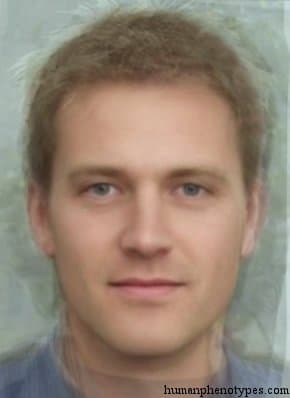
Composite source: Human Phenotypes — Trønder
Geographic Distribution
Geographically, Trønder anchors to 63.9° N, 10.2° E (Northern Europe). That is the point where historical anthropologists judged Trønder most concentrated, not a hard edge; modern migration and intermarriage have long since softened whatever boundaries once existed.
Physical Characteristics
Rosy-white skin, straight or wavy, often golden blonde, sometimes red or brown hair with light eyes.
- Tall, brachy- mesoskelic, ecto- to mesomorph
- Mesocephalic and orthocranic with craggier facial features, and a slightly steeper, more roundish forehead compared to Hallstatt
- Face is long, nose (hyper-)leptorrhine
- Head size is moderate, auricular height very high
- Orthognathic
- Body hair moderate to strong
- Rather small eyes, thin lips, sturdy chin
Historical Background
North European type, combines features of Paleo Atlantid, Hallstatt, and East Nordid. One of the main elements in the ancient Vikings. Their nucleus lies in the Norwegian Trøndelag region. It also dominates in other parts of Norway as well as Iceland and Central Sweden. Sometimes in other parts of Scandinavia, Scotland, and Northeastern England. Historic Viking migrations dispersed it across several other regions of Europe (e.g. France, Russia, and Italy).
Research History & Naming
The passage below traces who first defined Trønder, which rival names competed with it, and how later authors consolidated or disputed the classification — the raw material of any serious phenotype reference.
Bryn and Schreiner (1929) identified the type after studying military recruits. Based on that, Coon (1939) and Lundman ( 1940 , 1945 , 1967b ) defined the Trønder. Also mentioned by Torgersen (1976) .
Comparison With Nearby Phenotypes
Geography, not alphabet, ordered this table: the five phenotype centers closest to Trønder's, with the traits most likely to be mistaken for it (Paleo Atlantid leads at 367 km). In gameplay, these five account for most of the wrong-but-nearby pins against Trønder.
| Phenotype | Region | Distance | Distinguishing trait |
|---|---|---|---|
| Paleo Atlantid | Northern Europe | 367 km | Fair skin, curly or wavy, sometimes straight, usually brown-black, occasionally red or blonde hair, eyes mixed. |
| Strandid | Northern Europe | 373 km | Fair to light brown skin, straight or wavy, usually brown to black hair and mixed eyes. |
| Dalofaelid | Northern Europe | 375 km | Pale to fair skin. |
| Scando Lappid | Northern Europe | 655 km | Light greyish brown skin, straight, usually dark brown, sometimes blonde or red hair, and brown eyes that are sporadically slanted. |
| Savolaxid | Northern Europe | 754 km | Pale to fair skin, straight, dirty blonde or brown hair, often light eyes. |
Trønder in the Game
In gameplay terms, Trønder rewards region-level recall: the score is computed from the distance between your pin and 63.9° N, 10.2° E. Players often confuse Trønder with Paleo Atlantid (367 km out) in the comparison table above — those confusions are exactly what the distance penalty is designed to expose.
Trønder Phenotype FAQ
- Where does the Trønder phenotype come from?
- Historical sources center the Trønder phenotype on 63.9° N, 10.2° E (Northern Europe). Treat that as a rough anchor: the type appeared across a wider surrounding area — its nearest documented neighbors, Paleo Atlantid and Strandid, sit 367 and 373 km from the reference point — and its present-day distribution no longer matches the historical map.
- What does the Trønder phenotype look like?
- The composite emphasizes recurring traits: rosy-white skin, straight or wavy, often golden blonde, sometimes red or brown hair with light eyes. The full trait list for Trønder appears in the physical characteristics section above.
- Is the Trønder phenotype a race or a nationality?
- No — and the Trønder naming history above shows why. Trønder was defined, renamed, and regrouped repeatedly by different researchers, which is the opposite of how a fixed racial category would behave. A phenotype is a recurring bundle of visible traits recorded across a population; the Trønder label says nothing about where any individual's ancestors were born.
- How does Trønder appear in the game?
- When the Trønder face comes up in Classic Daily or Challenge Mode, you pin the world map where you believe the type is historically most common, and the score decays with your distance to 63.9° N, 10.2° E. Fair warning: the nearest other entry in our dataset, Paleo Atlantid, sits just 367 km away, so this face rewards precise placement — the right country alone is not always enough.
References & Literature
The Trønder phenotype entry above is compiled from the 6 academic references. Readers are encouraged to consult the original Trønder sources for verification and deeper context.
- Bryn, H. and Schreiner, K.E. 1929. Somatologie der Norweger nach Untersuchungen an Rekruten.
- Coon, C.S.. 1939.. The Races of Europe. The Macmillan Company. New York.
- Lundman, B. 1940. Nordens rastyper : geografi och historia. Albert Bonnier. Stockholm.
- Lundman, B. 1945. Dala-Allmogens Antropologi. Diss. Uppsala.
- Lundman, B. 1967b. L'Europa del Nord. Antropologia. In: Biasutti, R. Le Razze e i Popoli della terra. 4th Ed. Vol 1-4. U.T.E.T., Torino.
- Torgersen, J. 1976. Rassengeschichte von Skandinavien. in: Schwietzky, I.: Rassengeschichte der Menschheit 4. Oldenburg Verlag. München. Wien.
Related Phenotypes
More entries from the same region of the historical map as Trønder, each with its own composite and trait profile.
Paleo Atlantid
Northern Europe · 367 km away
Ancient type that is sporadically found in Northern and Western Europe, usually only in relict populations. A resemblance with Cro-Magnons h...
Strandid
Northern Europe · 373 km away
Alpinoid North European type most common in Southwestern Norway. The name derives from the Norwegian word for beach ("Strand"). Probably a r...
Dalofaelid
Northern Europe · 375 km away
Coarse, Cromagniform Nordid variety of Central and Northern Europe. Named after the Swedish province of Dalarna and the German region of Wes...
Scando Lappid
Northern Europe · 655 km away
Lappid proper - an ancient European type associated with Southern Saami people (formerly "Lapps"). Rare today, often mixed, typical in North...
Savolaxid
Northern Europe · 754 km away
East Baltid variety, named after the Savolaxia province of Finland, similar to Neo Danubian. Core population in Eastern Finland, Karelia, an...
Further Reading
Background articles from the blog that explain where the Trønder type fits, how these composites are built, and what a face can and cannot tell you.
What Is an Ethnicity Guesser? The Map Game Where Faces Are the Clues
Ethnicity guessers are the newest branch of geography gaming: a composite face appears, you pin the map. Here is the genre, where it...
How Average Face Composites Are Made
An average face is not a real face. It is a statistical average of hundreds of aligned photographs - and that is exactly why it is so...