Paleo Atlantid Phenotype - Face Features & Origin
Ancient type that is sporadically found in Northern and Western Europe, usually only in relict populations. Its reference coordinates sit near 61.1° N, 6.4° E in Northern Europe. Rather than a single portrait, the Paleo Atlantid composite below is a statistical average, and the surrounding sections — traits, distribution, research history, references — give that average its context.
Average Face
What you see below is a statistical construction of the Paleo Atlantid reference population. Faces recorded from the Paleo Atlantid sample were overlaid and merged; the result keeps the features most members shared and discards personal variation. It reads like a Paleo Atlantid portrait, but it works like a histogram.
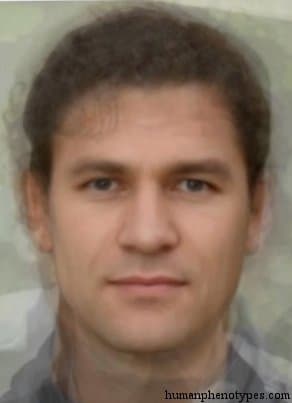
Composite source: Human Phenotypes — Paleo Atlantid
Geographic Distribution
The reference center for Paleo Atlantid sits near 61.1° N, 6.4° E in Northern Europe. Around that anchor, prevalence falls off gradually — the type is not confined to one valley or one modern border, and the historical map should be read as a gradient rather than a boundary.
Physical Characteristics
Fair skin, curly or wavy, sometimes straight, usually brown-black, occasionally red or blonde hair, eyes mixed.
- Tall, meso- sometimes macroskelic, meso- to endomorph, long arms
- Very large-headed, dolicho- sometimes mesocephalic, chamae- orthocranic
- Mildly leptorrhine, often concave nose
- More robust than Dalofaelids with heavy brow ridges, wider and lower noses and faces, darker pigmentation, and strong pilous growth
Historical Background
Ancient type that is sporadically found in Northern and Western Europe, usually only in relict populations. A resemblance with Cro-Magnons has been stressed by some authors. Strongest concentrations in Southern Norwegian mountain valleys (e.g. Tydal), Dalarna (Sweden), Western Scotland, and Ireland. Has a Tydal subvariety in Scandinavia.
Research History & Naming
The passage below traces who first defined Paleo Atlantid, which rival names competed with it, and how later authors consolidated or disputed the classification — the raw material of any serious phenotype reference.
Bryn and Schreiner (1929) identified it in the Tydal valley of Norway. Subsequently called Tydal type, e.g. by Vondernach (2008) and Lundman (1940) , who later united it with Irish types and Canarid in Paleo Atlantid (Lundman, 1951 , 1988 ). Includes Ripley's (1900) Black Breed type of Britain. Very similar to Coon's (1939) Brünn.
Comparison With Nearby Phenotypes
The five phenotypes whose documented centers lie closest to Paleo Atlantid, ranked by great-circle distance. They are the types players most often confuse with Paleo Atlantid in the quiz, precisely because their distributions overlap.
| Phenotype | Region | Distance | Distinguishing trait |
|---|---|---|---|
| Trønder | Northern Europe | 367 km | Rosy-white skin, straight or wavy, often golden blonde, sometimes red or brown hair with light eyes. |
| Dalofaelid | Northern Europe | 422 km | Pale to fair skin. |
| Borreby | Central Europe | 645 km | Pale to fair skin, straight or wavy blonde, sometimes red or brown hair, blue or mixed eyes. |
| Scando Lappid | Northern Europe | 676 km | Light greyish brown skin, straight, usually dark brown, sometimes blonde or red hair, and brown eyes that are sporadically slanted. |
| Proto Nordid | Northern Europe | 719 km | Pale to fair skin, straight or wavy, usually blonde, sometimes reddish hair with blue, green, or grey eyes. |
Paleo Atlantid in the Game
Paleo Atlantid is one of the faces that can appear in Classic Daily and Challenge Mode. When it does, the winning pin lands near 61.1° N, 6.4° E in Northern Europe — and because the scoring decays with distance, recognizing the region matters more than pixel-perfect placement.
Paleo Atlantid Phenotype FAQ
- Where does the Paleo Atlantid phenotype come from?
- Historical sources center the Paleo Atlantid phenotype on 61.1° N, 6.4° E (Northern Europe). Treat that as a rough anchor: the type appeared across a wider surrounding area — its nearest documented neighbors, Trønder and Dalofaelid, sit 367 and 422 km from the reference point — and its present-day distribution no longer matches the historical map.
- What does the Paleo Atlantid phenotype look like?
- The composite emphasizes recurring traits: fair skin, curly or wavy, sometimes straight, usually brown-black, occasionally red or blonde hair, eyes mixed. The full trait list for Paleo Atlantid appears in the physical characteristics section above.
- Is the Paleo Atlantid phenotype a race or a nationality?
- No. Phenotypes like Paleo Atlantid are descriptive averages, not ancestry groups. Paleo Atlantid is one of several types documented in and around Northern Europe — see the comparison table above — and the same individual can carry traits associated with several of them at once. The Paleo Atlantid entry describes a statistical pattern, not a group of people and not a nationality.
- How does Paleo Atlantid appear in the game?
- When the Paleo Atlantid face comes up in Classic Daily or Challenge Mode, you pin the world map where you believe the type is historically most common, and the score decays with your distance to 61.1° N, 6.4° E. Fair warning: the nearest other entry in our dataset, Trønder, sits just 367 km away, so this face rewards precise placement — the right country alone is not always enough.
References & Literature
The Paleo Atlantid phenotype entry above is compiled from the 7 academic references. Readers are encouraged to consult the original Paleo Atlantid sources for verification and deeper context.
- Bryn, H. and Schreiner, K.E. 1929. Somatologie der Norweger nach Untersuchungen an Rekruten.
- Vonderach, A. 2008. Anthropologie Europas. Völker, Typen und Gene vom Neandertaler bis zur Gegenwart. Ares Verlag. Graz.
- Lundman, B. 1940. Nordens rastyper : geografi och historia. Albert Bonnier. Stockholm.
- Lundman, B. 1951. Dunkelgemischte cromagnide Typen aus Dalarne, Schweden. Zeitschrift für Morphologie und Anthropologie. 43 (2), 222-226.
- Lundman, B. 1988. Jordens folkstammar. Huddinge.
- R00
- Coon, C.S.. 1939.. The Races of Europe. The Macmillan Company. New York.
Related Phenotypes
More entries from the same region of the historical map as Paleo Atlantid, each with its own composite and trait profile.
Trønder
Northern Europe · 367 km away
North European type, combines features of Paleo Atlantid, Hallstatt, and East Nordid. One of the main elements in the ancient Vikings. Their...
Dalofaelid
Northern Europe · 422 km away
Coarse, Cromagniform Nordid variety of Central and Northern Europe. Named after the Swedish province of Dalarna and the German region of Wes...
Borreby
Central Europe · 645 km away
Ancient Northern European variety. Named after some of the Neolithic Borreby skulls of Denmark (not all!). Some emphasised resemblance with ...
Scando Lappid
Northern Europe · 676 km away
Lappid proper - an ancient European type associated with Southern Saami people (formerly "Lapps"). Rare today, often mixed, typical in North...
Proto Nordid
Northern Europe · 719 km away
Ancient East Nordid variety, the eastern counterpart of the Aisto Nordids. Together with early Mediterranids it was widespread in prehistori...
Further Reading
Background articles from the blog that explain where the Paleo Atlantid type fits, how these composites are built, and what a face can and cannot tell you.
Guess the Nationality: What 48 Country Average Faces Actually Show
National average faces converge with geography - neighbors look alike because populations mix along the routes terrain allows.
What Is an Ethnicity Guesser? The Map Game Where Faces Are the Clues
Ethnicity guessers are the newest branch of geography gaming: a composite face appears, you pin the map. Here is the genre, where it...