Eurafricanid Phenotype - Face Features & Origin
Atlanto Mediterranid proper type. The entry below collects the Eurafricanid composite face, its documented distribution around 32.8° N, 35.6° E in Southern Europe, its physical characteristics, the research history behind the name, and the academic references that support all of it.
Average Face
The Eurafricanid composite below is not a photograph of a real person. Historical anthropologists aligned multiple individual portraits from the Eurafricanid reference population and averaged them into one image, so recurring structures — skull outline, nose form, lip thickness, brow position — dominate while individual idiosyncrasies cancel out.
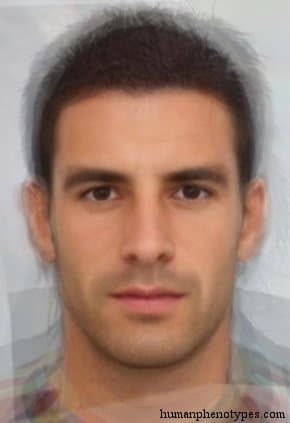
Composite source: Human Phenotypes — Eurafricanid
Geographic Distribution
Geographically, Eurafricanid anchors to 32.8° N, 35.6° E (Southern Europe). That is the point where historical anthropologists judged Eurafricanid most concentrated, not a hard edge; modern migration and intermarriage have long since softened whatever boundaries once existed.
Physical Characteristics
Light brown skin, straight to curly, usually dark brown hair.
- (Rather) tall, ecto- to mesomorph, brachy- mesoskelic
- Dolichocephalic, mildly hypsicranic with a straight, sometimes depressed and leptorrhine nose
- Face coarse and long, deep set eyes, cheekbones often wide
- Significant brow ridges, mild prognathy common
Historical Background
Atlanto Mediterranid proper type. Relatively old, present in early Natufians and European as well as North African megalith builders. Spread across the Mediterranean since the Mesolithic until Antiquity. Today common in Portugal, Eastern Spain (e.g. Valencia), Liguria, Western Switzerland, Wales, Croatia, North Algeria, Morocco, and Canary Islands. In Mesopotamia more diluted and transitional to Proto Iranid.
Research History & Naming
The passage below traces who first defined Eurafricanid, which rival names competed with it, and how later authors consolidated or disputed the classification — the raw material of any serious phenotype reference.
A similar type was originally described by Deniker (1900) (see Litorid). It was later regarded admixed and replaced by Eurafricanid ( Haddon, 1925 ), using the term of Sergi (1901) , who had applied it in a more generalistic way. Other names are Littoral ( Biasutti, 1967 ), Atlantid ( Škerlj, 1936 ) or Atlanto Mediterranid ( Coon, 1939 ; Hooton, 1946 ; Cole, 1965 ), who included the wider-faced types like Berberid. Definition here corresponds to long-faced Eurafricanid of Eickstedt ( 1934 , 1951 ), Alcobé (1936) , Ara (1957) and Knussmann (1996) .
Comparison With Nearby Phenotypes
The five phenotypes whose documented centers lie closest to Eurafricanid, ranked by great-circle distance. They are the types players most often confuse with Eurafricanid in the quiz, precisely because their distributions overlap.
| Phenotype | Region | Distance | Distinguishing trait |
|---|---|---|---|
| Gracile Mediterranid | Southern Europe | 66 km | Light brown skin, straight to wavy, rarely curly, usually abundant brown to brown-black hair. |
| Assyroid | Middle East | 819 km | Light brown, sometimes fair skin, straight or wavy, usually dark brown, sometimes blonde curly-wavy hair. |
| Anatolid | Middle East | 827 km | Light brown skin, wavy, dark brown hair. |
| Egyptid | North Africa | 839 km | Light brown skin, wavy or curly black hair. |
| Litorid | Middle East | 864 km | Light brown skin. |
Eurafricanid in the Game
Eurafricanid is one of the faces that can appear in Classic Daily and Challenge Mode. When it does, the winning pin lands near 32.8° N, 35.6° E in Southern Europe — and because the scoring decays with distance, recognizing the region matters more than pixel-perfect placement.
Eurafricanid Phenotype FAQ
- Where does the Eurafricanid phenotype come from?
- Historical sources center the Eurafricanid phenotype on 32.8° N, 35.6° E (Southern Europe). Treat that as a rough anchor: the type appeared across a wider surrounding area — its nearest documented neighbors, Gracile Mediterranid and Assyroid, sit 66 and 819 km from the reference point — and its present-day distribution no longer matches the historical map.
- What does the Eurafricanid phenotype look like?
- The composite emphasizes recurring traits: light brown skin, straight to curly, usually dark brown hair. The full trait list for Eurafricanid appears in the physical characteristics section above.
- Is the Eurafricanid phenotype a race or a nationality?
- No. Phenotypes like Eurafricanid are descriptive averages, not ancestry groups. Eurafricanid is one of several types documented in and around Southern Europe — see the comparison table above — and the same individual can carry traits associated with several of them at once. The Eurafricanid entry describes a statistical pattern, not a group of people and not a nationality.
- How does Eurafricanid appear in the game?
- When the Eurafricanid face comes up in Classic Daily or Challenge Mode, you pin the world map where you believe the type is historically most common, and the score decays with your distance to 32.8° N, 35.6° E. Fair warning: the nearest other entry in our dataset, Gracile Mediterranid, sits just 66 km away, so this face rewards precise placement — the right country alone is not always enough.
References & Literature
The Eurafricanid phenotype entry above is compiled from the 13 academic references. Readers are encouraged to consult the original Eurafricanid sources for verification and deeper context.
- D00
- Haddon, A.C.. 1925. The Races of Man and their distribution. Cambridge at the University Press. London.
- Sergi, G.. 1901. The Mediterranean Race: a study of the origin of the European peoples. London.
- Biasutti, R. 1967 (1941). Le Razze e i Popoli della terra. 4th Ed. Vol 1-4. U.T.E.T., Torino.
- Škerlj, B. 1936. Rasna slika Jugoslavije. Geografski vestnik: casopis za geografijo in sorodne vede 12-13. 156-169.
- Coon, C.S.. 1939.. The Races of Europe. The Macmillan Company. New York.
- Hooton, E.A. 1946. Up from the Ape. Rev. ed. Macmillan Company . New York.
- Cole, S. 1965. Races of Man. Butler & Tanner Ltd. Frome and London.
- Eickstedt, E. von. 1934. Rassenkunde und Rassengeschichte der Menschheit. Ferdinand Enke. Stuttgart.
- Eickstedt, E. von 1951. Die Träger der Afrikanischen Kulturen. In: Bernatzik, H. Afrika. Handbuch der angewandten Völkerkunde. F. Bruckmann. München.
- Alcobé, S. 1936. Die Eurafrikaniden und die Rassengliederung der Iberischen Halbinsel. Zeitschrift für Rassenkunde. Band 3, 30-76.
- Ara, M. F. 1957. Estudio antropologico de los pobladores neo-eneoliticos de la region Valenciana. Valenica.
- Knussmann, R. 1996. Vergleichende Biologie des Menschen: Lehrbuch der Anthropologie und Humangenetik. 2ed. Spektrum Akademischer Verlag.
Related Phenotypes
More entries from the same region of the historical map as Eurafricanid, each with its own composite and trait profile.
Gracile Mediterranid
Southern Europe · 66 km away
Mediterranid proper, smaller than other Mediterranids: the most gracile type of Europe. Appears first in Mesolithic groups of Palestine (Nat...
Assyroid
Middle East · 819 km away
Semitic type that unites Armenoid with Arabid features. Historically important in the ancient Hittite Kingdom and the Assyrian civilisation....
Anatolid
Middle East · 827 km away
Armenid subtype of Anatolia with Dinaroid features. The core population lives in West Anatolia. Probably the result of Armenid influx into a...
Egyptid
North Africa · 839 km away
Libyid variety, typical for the Nile Valley of Egypt. May result from ancient South/West Asian migrations that mixed with native Berberids. ...
Litorid
Middle East · 864 km away
Type of coastal European regions that contains Mediterranid and Dinaro-Armenid elements. Probably the result of ancient migrations from Asia...
Further Reading
Background articles from the blog that explain where the Eurafricanid type fits, how these composites are built, and what a face can and cannot tell you.
AI Ethnicity Guesser: What the Tools Really Return
An AI ethnicity guesser returns a label from a fixed list rather than a measurement of ancestry. Here is what the models are trained on...
Ethnicity Guesser vs DNA Test: Two Different Questions About Where You're From
A DNA test answers 'what fraction of my ancestors came from reference regions' - a face quiz answers 'what historical pattern does this...