Gracile Mediterranid Phenotype - Face Features & Origin
Mediterranid proper, smaller than other Mediterranids: the most gracile type of Europe. The entry below collects the Gracile Mediterranid composite face, its documented distribution around 32.3° N, 35.3° E in Southern Europe, its physical characteristics, the research history behind the name, and the academic references that support all of it.
Average Face
The Gracile Mediterranid composite below is not a photograph of a real person. Historical anthropologists aligned multiple individual portraits from the Gracile Mediterranid reference population and averaged them into one image, so recurring structures — skull outline, nose form, lip thickness, brow position — dominate while individual idiosyncrasies cancel out.
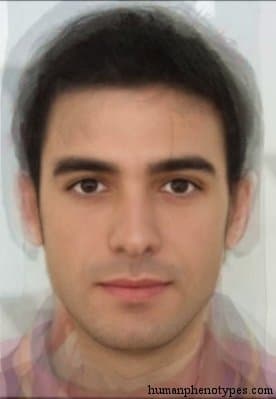
Composite source: Human Phenotypes — Gracile Mediterranid
Geographic Distribution
Gracile Mediterranid is documented across Southern Europe, with its historical reference center near 32.3° N, 35.3° E. The coordinates mark where the type was most characteristic roughly 1500 years ago; population movements since then have scattered and blended the distribution far beyond that point.
Physical Characteristics
Light brown skin, straight to wavy, rarely curly, usually abundant brown to brown-black hair.
- Rather short, meso- sometimes macroskelic, ectomorph with gracile bodily proportions, rather wide hips in women
- Mesocephalic, chamaecranic with a protruding occiput
- Oval, narrow face with refined and gracile features
- Straight, hyperleptorrhine, not very long nose
- Mildly rounded forehead
Historical Background
Mediterranid proper, smaller than other Mediterranids: the most gracile type of Europe. Appears first in Mesolithic groups of Palestine (Natufians). Common in Iberia, Southern Italy, Mediterranean islands, Western France, Southern Greece, Northern Tunisia. In low frequencies across Europe, e.g. Western Germany (esp. Rhineland-Palatinate), Ireland, Wales, Southern Bulgaria to the Black Sea and the Levant.
Research History & Naming
Every label in the historical catalogue has an author and a date, and Gracile Mediterranid has accumulated its share of competing attributions. For Gracile Mediterranid, the literature extract below shows the naming chain — from the first definition through the later revisions that shaped the current entry.
The type was described early by Deniker (1900) as Ibero Insular. Eickstedt ( 1934 , 1951 , 1952 ) named it Grazilmediterranid, so did later authors ( Knussmann, 1996 ; Vonderach, 2008 ). Coon (1939) called it Small Mediterranean, Biasutti (1967) Mediterranean proper, with an Italian "Pugliese" subvariety. In other systems it appears as Western ( Günther, 1942 ) or West Mediterranid ( Lundman, 1977 ).
Comparison With Nearby Phenotypes
Geography, not alphabet, ordered this table: the five phenotype centers closest to Gracile Mediterranid's, with the traits most likely to be mistaken for it (Eurafricanid leads at 66 km). In gameplay, these five account for most of the wrong-but-nearby pins against Gracile Mediterranid.
| Phenotype | Region | Distance | Distinguishing trait |
|---|---|---|---|
| Eurafricanid | Southern Europe | 66 km | Light brown skin, straight to curly, usually dark brown hair. |
| Egyptid | North Africa | 774 km | Light brown skin, wavy or curly black hair. |
| Assyroid | Middle East | 855 km | Light brown, sometimes fair skin, straight or wavy, usually dark brown, sometimes blonde curly-wavy hair. |
| Anatolid | Middle East | 878 km | Light brown skin, wavy, dark brown hair. |
| Litorid | Middle East | 889 km | Light brown skin. |
Gracile Mediterranid in the Game
In gameplay terms, Gracile Mediterranid rewards region-level recall: the score is computed from the distance between your pin and 32.3° N, 35.3° E. Players often confuse Gracile Mediterranid with Eurafricanid (66 km out) in the comparison table above — those confusions are exactly what the distance penalty is designed to expose.
Gracile Mediterranid Phenotype FAQ
- Where does the Gracile Mediterranid phenotype come from?
- The reference coordinates for the Gracile Mediterranid phenotype sit near 32.3° N, 35.3° E, in Southern Europe. That point marks the center of the Southern Europe distribution documented roughly 1500 years ago — actual prevalence spread well beyond it, toward entries such as Eurafricanid 66 km away, and modern migration has blurred those boundaries further.
- What does the Gracile Mediterranid phenotype look like?
- In the historical literature, light brown skin, straight to wavy, rarely curly, usually abundant brown to brown-black hair. For Gracile Mediterranid these are statistical tendencies across a population, not a checklist every individual matches.
- Is the Gracile Mediterranid phenotype a race or a nationality?
- No. A phenotype is a recurring bundle of visible traits documented by historical anthropologists across a population — for Gracile Mediterranid, patterns such as light brown skin, straight to wavy, rarely curly, usually abundant brown to brown-black hair. The Gracile Mediterranid entry is not a genetic ancestry, not a nationality, and not a statement about any individual person. Two people from the same country can match completely different phenotypes — one resembling Gracile Mediterranid, another closer to Eurafricanid — and one phenotype can span many modern borders.
- How does Gracile Mediterranid appear in the game?
- In Classic Daily and Challenge Mode, the Gracile Mediterranid composite face appears without a label. Your task is to drop a pin on the world map where you think that face is historically most common — the scoring uses the distance between your pin and the reference coordinates near 32.3° N, 35.3° E. The post-round review then shows the correct location, your distance error, and this Gracile Mediterranid entry.
References & Literature
Primary sources for the Gracile Mediterranid entry, listed as cited in the historical literature. The naming and classification debates around Gracile Mediterranid referenced above run through these works.
- D00
- Eickstedt, E. von. 1934. Rassenkunde und Rassengeschichte der Menschheit. Ferdinand Enke. Stuttgart.
- Eickstedt, E. von 1951. Die Träger der Afrikanischen Kulturen. In: Bernatzik, H. Afrika. Handbuch der angewandten Völkerkunde. F. Bruckmann. München.
- Eickstedt, E. von. 1952. Biodynamik der Europiden. In: Historia Mundi. Band 1, Munich, 115-134.
- Knussmann, R. 1996. Vergleichende Biologie des Menschen: Lehrbuch der Anthropologie und Humangenetik. 2ed. Spektrum Akademischer Verlag.
- Vonderach, A. 2008. Anthropologie Europas. Völker, Typen und Gene vom Neandertaler bis zur Gegenwart. Ares Verlag. Graz.
- Coon, C.S.. 1939.. The Races of Europe. The Macmillan Company. New York.
- Biasutti, R. 1967 (1941). Le Razze e i Popoli della terra. 4th Ed. Vol 1-4. U.T.E.T., Torino.
- Günther, H. 1942. Rassenkunde des deutschen Volkes. München.
- Lundman, B.J.. 1977. The Races And Peoples Of Europe. IAAEE. New York.
Related Phenotypes
More entries from the same region of the historical map as Gracile Mediterranid, each with its own composite and trait profile.
Eurafricanid
Southern Europe · 66 km away
Atlanto Mediterranid proper type. Relatively old, present in early Natufians and European as well as North African megalith builders. Spread...
Egyptid
North Africa · 774 km away
Libyid variety, typical for the Nile Valley of Egypt. May result from ancient South/West Asian migrations that mixed with native Berberids. ...
Assyroid
Middle East · 855 km away
Semitic type that unites Armenoid with Arabid features. Historically important in the ancient Hittite Kingdom and the Assyrian civilisation....
Anatolid
Middle East · 878 km away
Armenid subtype of Anatolia with Dinaroid features. The core population lives in West Anatolia. Probably the result of Armenid influx into a...
Litorid
Middle East · 889 km away
Type of coastal European regions that contains Mediterranid and Dinaro-Armenid elements. Probably the result of ancient migrations from Asia...
Further Reading
Background articles from the blog that explain where the Gracile Mediterranid type fits, how these composites are built, and what a face can and cannot tell you.
AI Ethnicity Guesser: What the Tools Really Return
An AI ethnicity guesser returns a label from a fixed list rather than a measurement of ancestry. Here is what the models are trained on...
Ethnicity Guesser vs DNA Test: Two Different Questions About Where You're From
A DNA test answers 'what fraction of my ancestors came from reference regions' - a face quiz answers 'what historical pattern does this...