Egyptid Phenotype - Face Features & Origin
Libyid variety, typical for the Nile Valley of Egypt. Its reference coordinates sit near 25.7° N, 32.6° E in North Africa. Rather than a single portrait, the Egyptid composite below is a statistical average, and the surrounding sections — traits, distribution, research history, references — give that average its context.
Average Face
What you see below is a statistical construction of the Egyptid reference population. Faces recorded from the Egyptid sample were overlaid and merged; the result keeps the features most members shared and discards personal variation. It reads like a Egyptid portrait, but it works like a histogram.
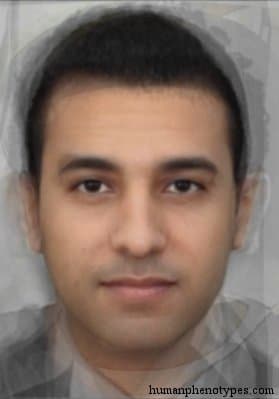
Composite source: Human Phenotypes — Egyptid
Geographic Distribution
Egyptid is documented across North Africa, with its historical reference center near 25.7° N, 32.6° E. The coordinates mark where the type was most characteristic roughly 1500 years ago; population movements since then have scattered and blended the distribution far beyond that point.
Physical Characteristics
Light brown skin, wavy or curly black hair.
- Medium height, mesomorph to ectomorph, mesoskelic
- Dolichocephalic, often orthocranic
- The eyes are big and the mouth relatively wide
- Leptorrhine, sometimes convex nose
- Features show some degree of robustness, often intermediate between Orientalid and Berberid
Historical Background
Libyid variety, typical for the Nile Valley of Egypt. May result from ancient South/West Asian migrations that mixed with native Berberids. In its purest form found in Egyptian Copts. In lower frequencies in Muslims of Egypt, North Sudanese, and Libyans. Relative frequency has been reduced during the last centuries, as the frequency of other types in Egypt has increased.
Research History & Naming
Every label in the historical catalogue has an author and a date, and Egyptid has accumulated its share of competing attributions. For Egyptid, the literature extract below shows the naming chain — from the first definition through the later revisions that shaped the current entry.
Lundman ( 1967 ) coined the term Aegyptid. Also used by Biasutti (1941, 1967) , who named it Coptic and regarded it a subtype of Libica, Eickstedt (1951) as Koptid - an Orientalid with affinities to Mediterranid. Coon (1939) described it as the "early Egyptian type". Anthropometric analysis by Strouhal (1975) .
Comparison With Nearby Phenotypes
The five phenotypes whose documented centers lie closest to Egyptid, ranked by great-circle distance. They are the types players most often confuse with Egyptid in the quiz, precisely because their distributions overlap.
| Phenotype | Region | Distance | Distinguishing trait |
|---|---|---|---|
| Gracile Mediterranid | Southern Europe | 774 km | Light brown skin, straight to wavy, rarely curly, usually abundant brown to brown-black hair. |
| Middle Nile | East Africa | 793 km | Medium to dark brown skin, relatively fair for the region - a result of Orientalid admixture. |
| Siwa | North Africa | 807 km | Light to medium brown skin, often wavy, sometimes tight-curly black hair. |
| Eurafricanid | Southern Europe | 839 km | Light brown skin, straight to curly, usually dark brown hair. |
| North Ethiopid | East Africa | 1,219 km | Dark, sometimes medium (bronze) brown skin, tight-curly hair. |
Egyptid in the Game
Egyptid is one of the faces that can appear in Classic Daily and Challenge Mode. When it does, the winning pin lands near 25.7° N, 32.6° E in North Africa — and because the scoring decays with distance, recognizing the region matters more than pixel-perfect placement.
Egyptid Phenotype FAQ
- Where does the Egyptid phenotype come from?
- The reference coordinates for the Egyptid phenotype sit near 25.7° N, 32.6° E, in North Africa. That point marks the center of the North Africa distribution documented roughly 1500 years ago — actual prevalence spread well beyond it, toward entries such as Gracile Mediterranid 774 km away, and modern migration has blurred those boundaries further.
- What does the Egyptid phenotype look like?
- In the historical literature, light brown skin, wavy or curly black hair. For Egyptid these are statistical tendencies across a population, not a checklist every individual matches.
- Is the Egyptid phenotype a race or a nationality?
- No — and the Egyptid naming history above shows why. Egyptid was defined, renamed, and regrouped repeatedly by different researchers, which is the opposite of how a fixed racial category would behave. A phenotype is a recurring bundle of visible traits recorded across a population; the Egyptid label says nothing about where any individual's ancestors were born.
- How does Egyptid appear in the game?
- In Classic Daily and Challenge Mode, the Egyptid composite face appears without a label. Your task is to drop a pin on the world map where you think that face is historically most common — the scoring uses the distance between your pin and the reference coordinates near 25.7° N, 32.6° E. The post-round review then shows the correct location, your distance error, and this Egyptid entry.
References & Literature
Primary sources for the Egyptid entry, listed as cited in the historical literature. The naming and classification debates around Egyptid referenced above run through these works.
- Lundman, B. 1967. Geographische Anthropologie. Rassen und Völker der Erde. G. Fischer, Stuttgart
- Biasutti, R. 1967 (1941). Le Razze e i Popoli della terra. 4th Ed. Vol 1-4. U.T.E.T., Torino.
- Eickstedt, E. von 1951. Die Träger der Afrikanischen Kulturen. In: Bernatzik, H. Afrika. Handbuch der angewandten Völkerkunde. F. Bruckmann. München.
- Coon, C.S.. 1939.. The Races of Europe. The Macmillan Company. New York.
- Strouhal, E.. 1975. Rassengeschichte Ägyptens. In: Schwietzky, I.: Rassengeschichte der Menschheit 3. Oldenburg Verlag. München. Wien.
Related Phenotypes
More entries from the same region of the historical map as Egyptid, each with its own composite and trait profile.
Gracile Mediterranid
Southern Europe · 774 km away
Mediterranid proper, smaller than other Mediterranids: the most gracile type of Europe. Appears first in Mesolithic groups of Palestine (Nat...
Middle Nile
East Africa · 793 km away
The Middle Nile type is a contact type of the Nile Valley located in Northern Sudan. Features are variable, although North African, West Asi...
Siwa
North Africa · 807 km away
Distinctive Berber type typical for the Eastern Sahara Desert. Typified by the population of the Siwa and Awjila oases of Northwestern Egypt...
Eurafricanid
Southern Europe · 839 km away
Atlanto Mediterranid proper type. Relatively old, present in early Natufians and European as well as North African megalith builders. Spread...
North Ethiopid
East Africa · 1,219 km away
Ethiopid subtype that is often regarded as a northern branch of East Ethiopid. Common along the Red Sea coast and the Nile Valley from Egypt...
Further Reading
Background articles from the blog that explain where the Egyptid type fits, how these composites are built, and what a face can and cannot tell you.
What Is My Ethnicity? Who Is Asking Changes the Answer
What the phrase assumes is that ethnicity is one thing a person has. Four registers answer it instead: a census form, a family record, a...
Ethnicity Guesser Game: How the Answer Space Shapes a Round
A face-mapping game scores an answer three ways: a point on the map, a named catalogue entry, or a modern country.