Berberid Phenotype - Face Features & Origin
A Proto Atlanto Mediterranean type, originally named after Berbers and the North African Barbary. Its reference coordinates sit near 36.3° N, 4.7° E in North Africa. Rather than a single portrait, the Berberid composite below is a statistical average, and the surrounding sections — traits, distribution, research history, references — give that average its context.
Average Face
What you see below is a statistical construction of the Berberid reference population. Faces recorded from the Berberid sample were overlaid and merged; the result keeps the features most members shared and discards personal variation. It reads like a Berberid portrait, but it works like a histogram.
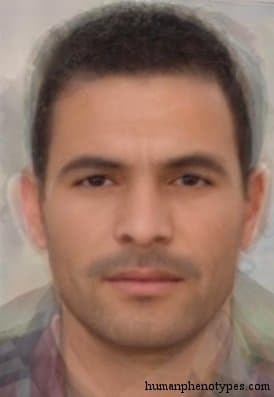
Composite source: Human Phenotypes — Berberid
Geographic Distribution
Geographically, Berberid anchors to 36.3° N, 4.7° E (North Africa). That is the point where historical anthropologists judged Berberid most concentrated, not a hard edge; modern migration and intermarriage have long since softened whatever boundaries once existed.
Physical Characteristics
Light to medium brown skin, curly-wavy, brown to black hair.
- Rather short, mesoskelic, meso- to endomorph
- Dolichocephalic, chamae- orthocranic
- Mildly leptorrhine, sometimes mesorrhine nose, often with a depressed bridge
- Face coarse and wide, significant zygomatic arches, interorbital distance great
- Sometimes slanting / pseudo-Mongoloid eyes
- Jaw heavy and angular, arches marked
Historical Background
A Proto Atlanto Mediterranean type, originally named after Berbers and the North African Barbary. Associated with Paleolithic types that once migrated from West Asia. Present in modern Berbers like Riffians, Kabyles, Shilha, Chaoui, also other North Africans, e.g. Tuareg (Imrads) and Natives of the Canary Islands. A minority type in other parts of Europe (esp. South Iberia, Perigord) and Turkey.
Research History & Naming
The passage below traces who first defined Berberid, which rival names competed with it, and how later authors consolidated or disputed the classification — the raw material of any serious phenotype reference.
Lundman ( 1942 , 1967 , 1988 ) named it Berid following Paudler (1917) . Eickstedt ( 1943 , 1951 , 1952b ) called it Berberid / Saharid. Peters (1940) Berber type. Some united it with Canarid to a taller, fairer Berberid ( Heberer et al. 1969 ; Knussmann, 1996 ). A Proto Eurafricanid ( Pace et al. 1951 ), Paleo Mediterrean ( Briggs, 1955 ) or simply Atlanto Mediterranean ( Coon, 1939 ; Cole, 1965 ).
Comparison With Nearby Phenotypes
The five phenotypes whose documented centers lie closest to Berberid, ranked by great-circle distance. They are the types players most often confuse with Berberid in the quiz, precisely because their distributions overlap.
| Phenotype | Region | Distance | Distinguishing trait |
|---|---|---|---|
| Paleo Sardinian | Southern Europe | 568 km | Light brown skin, straight to wavy dark, abundant hair. |
| Baskid | Southern Europe | 971 km | Fair skin. |
| West Alpinid | Central Europe | 1,116 km | Fair to light brown skin, straight or wavy, usually (light) brown hair with a blonde minority. |
| African Alpinoid | North Africa | 1,301 km | Light brown skin, straight or wavy brown to black hair, usually dark, sometimes mixed eyes. |
| Dinarid (proper) | Southeastern Europe | 1,342 km | Light brown skin. |
Berberid in the Game
Berberid is one of the faces that can appear in Classic Daily and Challenge Mode. When it does, the winning pin lands near 36.3° N, 4.7° E in North Africa — and because the scoring decays with distance, recognizing the region matters more than pixel-perfect placement.
Berberid Phenotype FAQ
- Where does the Berberid phenotype come from?
- Historical sources center the Berberid phenotype on 36.3° N, 4.7° E (North Africa). Treat that as a rough anchor: the type appeared across a wider surrounding area — its nearest documented neighbors, Paleo Sardinian and Baskid, sit 568 and 971 km from the reference point — and its present-day distribution no longer matches the historical map.
- What does the Berberid phenotype look like?
- The composite emphasizes recurring traits: light to medium brown skin, curly-wavy, brown to black hair. The full trait list for Berberid appears in the physical characteristics section above.
- Is the Berberid phenotype a race or a nationality?
- No — and the Berberid naming history above shows why. Berberid was defined, renamed, and regrouped repeatedly by different researchers, which is the opposite of how a fixed racial category would behave. A phenotype is a recurring bundle of visible traits recorded across a population; the Berberid label says nothing about where any individual's ancestors were born.
- How does Berberid appear in the game?
- When the Berberid face comes up in Classic Daily or Challenge Mode, you pin the world map where you believe the type is historically most common, and the score decays with your distance to 36.3° N, 4.7° E. The nearest documented type, Paleo Sardinian, lies about 568 km away, so regional placement usually carries most of the score.
References & Literature
The Berberid phenotype entry above is compiled from the 14 academic references. Readers are encouraged to consult the original Berberid sources for verification and deeper context.
- L42
- Lundman, B. 1967. Geographische Anthropologie. Rassen und Völker der Erde. G. Fischer, Stuttgart
- Lundman, B. 1988. Jordens folkstammar. Huddinge.
- Paudler, F. 1917. Cro-Magnon-Studien. Eine geschichtliche und programmatische Skizze. Anthropos 12/13 (3/4). 641-694.
- Eickstedt, E. von. 1943. Völkerbiologische Probleme der Sahara. In: Beiträge zur Kolonialforschung. Tagungsband I, 169-240.
- Eickstedt, E. von 1951. Die Träger der Afrikanischen Kulturen. In: Bernatzik, H. Afrika. Handbuch der angewandten Völkerkunde. F. Bruckmann. München.
- Eickstedt, E. von. 1952b. Die prioritätsgerechten Bezeichnungen der menschlichen Varitäten. In: Historia Mundi. Band 1, Munich, 223-226.
- Peters, H. 1940. Haustier und Mensch in Libyen: Wissenschaftliche Ergebnisse einer Reise nach Nordafrika. Hohenlohesche Verlagsbuchhandlung. Oehringen.
- Heberer, G., G. Kurth and I. Schwidetzky. 1969. Anthropologie. Das Fischer Lexikon.
- Knussmann, R. 1996. Vergleichende Biologie des Menschen: Lehrbuch der Anthropologie und Humangenetik. 2ed. Spektrum Akademischer Verlag.
- Pace, G. B., Sergi, S and G. Caputo. 1951. Scavi Sahariani. Ricerche nell'Uadi el-Agial e nell'Oasi di Gat. Monumenti. Antichi 41. Ac. Naz. dei Lincei. Rome.
- Briggs, L. C. 1955. The Stone Age Races of Northwest Africa. Peabody Mus. Bull. 18. Cambridge, USA.
- Coon, C.S.. 1939.. The Races of Europe. The Macmillan Company. New York.
- Cole, S. 1965. Races of Man. Butler & Tanner Ltd. Frome and London.
Related Phenotypes
If Berberid interested you, these neighboring phenotype entries cover adjacent parts of the map with distinctly different trait bundles.
Paleo Sardinian
Southern Europe · 568 km away
Ancient type, was widespread in Central Europe during the Neolithic, has survived as a minority element in the mountains of the Italian isla...
Baskid
Southern Europe · 971 km away
Ancient European type associated with the Basques. Found in its purest form in the Pyrénées-Atlantiques region of Southwestern France, altho...
West Alpinid
Central Europe · 1,116 km away
Alpinid proper, historically found in the mountain regions of Western Europe. Often a cohabitant of a second mountain type, the Dinarid. The...
African Alpinoid
North Africa · 1,301 km away
The most brachycephalic Maghrebi type, shows close morphological similarities to Alpines and in a lower degree to Armenids and Berberids. Pr...
Dinarid (proper)
Southeastern Europe · 1,342 km away
Central European type typical for mountain and forest regions. Presents the counterpart of Alpinids. The name derives from the Dinaric Alps ...
Further Reading
Background articles from the blog that explain where the Berberid type fits, how these composites are built, and what a face can and cannot tell you.
Is AI Ethnicity Guessing Accurate? Separating the Marketing From the Measurements
Published accuracies for AI face-based ancestry classification range from 80 to 99 percent - under lab conditions that real faces never...
What Is My Ethnicity? Who Is Asking Changes the Answer
What the phrase assumes is that ethnicity is one thing a person has. Four registers answer it instead: a census form, a family record, a...