Baskid Phenotype - Face Features & Origin
Ancient European type associated with the Basques. The entry below collects the Baskid composite face, its documented distribution around 43.0° N, 2.6° W in Southern Europe, its physical characteristics, the research history behind the name, and the academic references that support all of it.
Average Face
The Baskid composite below is not a photograph of a real person. Historical anthropologists aligned multiple individual portraits from the Baskid reference population and averaged them into one image, so recurring structures — skull outline, nose form, lip thickness, brow position — dominate while individual idiosyncrasies cancel out.
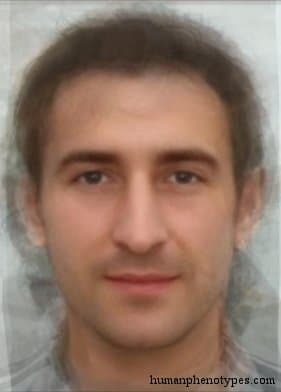
Composite source: Human Phenotypes — Baskid
Geographic Distribution
Baskid is documented across Southern Europe, with its historical reference center near 43.0° N, 2.6° W. The coordinates mark where the type was most characteristic roughly 1500 years ago; population movements since then have scattered and blended the distribution far beyond that point.
Physical Characteristics
Fair skin.
- Straight or wavy, often brown, sometimes red or blonde hair
- Mixed eyes
- Medium height, mesoskelic, mesomorph to ectomorph
- Brachycephalic, chamae- orthocranic with a round occiput
- Skull appears triangular as it is particularly wide near the temples
- Nose (hyper)leptorrhine, large and long, face narrow, chin pointed
Historical Background
Ancient European type associated with the Basques. Found in its purest form in the Pyrénées-Atlantiques region of Southwestern France, although many modern French Basques are West Alpinid. Also present in Northern Spain, where it is rather mixed with Mediterranid and thus less brachycephalic. Sometimes along the French Atlantic coast and in Wales. Linked to North Atlantid.
Research History & Naming
Typological names were coined, contested, and renamed repeatedly across the 20th century, and Baskid is no exception. The extract below records the researchers who defined Baskid, the alternative labels it accumulated, and where the modern consensus settled.
Early recognised as a distinctive type by Collignon (1894) , Montandon (1933) , and Aranzadi (1889) , who named it "West Pyrenean race", Cole (1965) as the Early Mediterranean type, Knussmann (1996) as an Alpinid subrace. Lundman (1967) named it Baskid. Studies indicate genetic distinctiveness ( Hurles et al., 1999 ).
Comparison With Nearby Phenotypes
Geography, not alphabet, ordered this table: the five phenotype centers closest to Baskid's, with the traits most likely to be mistaken for it (West Alpinid leads at 901 km). In gameplay, these five account for most of the wrong-but-nearby pins against Baskid.
| Phenotype | Region | Distance | Distinguishing trait |
|---|---|---|---|
| West Alpinid | Central Europe | 901 km | Fair to light brown skin, straight or wavy, usually (light) brown hair with a blonde minority. |
| Berberid | North Africa | 971 km | Light to medium brown skin, curly-wavy, brown to black hair. |
| Paleo Sardinian | Southern Europe | 1,016 km | Light brown skin, straight to wavy dark, abundant hair. |
| Anglo-Saxon | Northern Europe | 1,081 km | Pale skin, straight to curly, often blonde, sometimes red or brown hair with light(-mixed) eyes. |
| North Atlantid | Northern Europe | 1,169 km | Pale, sometimes ruddy or freckled skin. |
Baskid in the Game
In gameplay terms, Baskid rewards region-level recall: the score is computed from the distance between your pin and 43.0° N, 2.6° W. Players often confuse Baskid with West Alpinid (901 km out) in the comparison table above — those confusions are exactly what the distance penalty is designed to expose.
Baskid Phenotype FAQ
- Where does the Baskid phenotype come from?
- The reference coordinates for the Baskid phenotype sit near 43.0° N, 2.6° W, in Southern Europe. That point marks the center of the Southern Europe distribution documented roughly 1500 years ago — actual prevalence spread well beyond it, toward entries such as West Alpinid 901 km away, and modern migration has blurred those boundaries further.
- What does the Baskid phenotype look like?
- In the historical literature, fair skin. For Baskid these are statistical tendencies across a population, not a checklist every individual matches.
- Is the Baskid phenotype a race or a nationality?
- No. A phenotype is a recurring bundle of visible traits documented by historical anthropologists across a population — for Baskid, patterns such as fair skin. The Baskid entry is not a genetic ancestry, not a nationality, and not a statement about any individual person. Two people from the same country can match completely different phenotypes — one resembling Baskid, another closer to West Alpinid — and one phenotype can span many modern borders.
- How does Baskid appear in the game?
- In Classic Daily and Challenge Mode, the Baskid composite face appears without a label. Your task is to drop a pin on the world map where you think that face is historically most common — the scoring uses the distance between your pin and the reference coordinates near 43.0° N, 2.6° W. The post-round review then shows the correct location, your distance error, and this Baskid entry.
References & Literature
Every claim on this page traces back to the sources below — the researchers who defined, measured, and argued over the Baskid type. The originals behind the Baskid entry are worth consulting directly.
- C84
- Montandon, G. 1933. La race, les races: mise au point d éthnologie somatique. Payot. Paris.
- Aranzadi, T. de. 1889. El pueblo euskalduna. Estridio de Antropologia. San Sebastian.
- Cole, S. 1965. Races of Man. Butler & Tanner Ltd. Frome and London.
- Knussmann, R. 1996. Vergleichende Biologie des Menschen: Lehrbuch der Anthropologie und Humangenetik. 2ed. Spektrum Akademischer Verlag.
- Lundman, B. 1967. Geographische Anthropologie. Rassen und Völker der Erde. G. Fischer, Stuttgart
- Hurles M.E. et al. 1999. Recent male-mediated gene flow over a linguistic barrier in Iberia, suggested by analysis of a Y-chromosomal DNA polymorphism. Am. J. Hum. Genet. 65:14371448.
Related Phenotypes
More entries from the same region of the historical map as Baskid, each with its own composite and trait profile.
West Alpinid
Central Europe · 901 km away
Alpinid proper, historically found in the mountain regions of Western Europe. Often a cohabitant of a second mountain type, the Dinarid. The...
Berberid
North Africa · 971 km away
A Proto Atlanto Mediterranean type, originally named after Berbers and the North African Barbary. Associated with Paleolithic types that onc...
Paleo Sardinian
Southern Europe · 1,016 km away
Ancient type, was widespread in Central Europe during the Neolithic, has survived as a minority element in the mountains of the Italian isla...
Anglo-Saxon
Northern Europe · 1,081 km away
North-West European type, similar to Trønder, but with a stronger Hallstatt component. Was typified by the ancient Germanic tribes of Angles...
North Atlantid
Northern Europe · 1,169 km away
Western European type that combines features of Nordid and Mediterranid in a unique way. Resembles British Iron Age Celts. The principal ele...
Further Reading
Background articles from the blog that explain where the Baskid type fits, how these composites are built, and what a face can and cannot tell you.
Ethnicity Guesser vs DNA Test: Two Different Questions About Where You're From
A DNA test answers 'what fraction of my ancestors came from reference regions' - a face quiz answers 'what historical pattern does this...
Race Guesser: Why the Word Does Not Fit a Face Quiz
The phrase is a search term before it is a tool. Here is where the word race came from as a sorting device, why a century of measuring...