North Atlantid Phenotype - Face Features & Origin
Western European type that combines features of Nordid and Mediterranid in a unique way. The entry below collects the North Atlantid composite face, its documented distribution around 52.9° N, 8.0° W in Northern Europe, its physical characteristics, the research history behind the name, and the academic references that support all of it.
Average Face
The North Atlantid composite below is not a photograph of a real person. Historical anthropologists aligned multiple individual portraits from the North Atlantid reference population and averaged them into one image, so recurring structures — skull outline, nose form, lip thickness, brow position — dominate while individual idiosyncrasies cancel out.
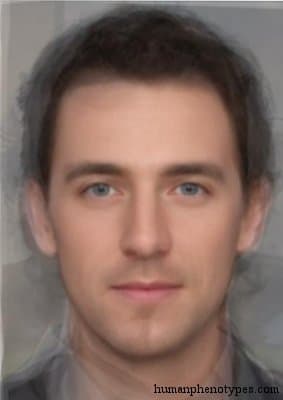
Composite source: Human Phenotypes — North Atlantid
Geographic Distribution
Geographically, North Atlantid anchors to 52.9° N, 8.0° W (Northern Europe). That is the point where historical anthropologists judged North Atlantid most concentrated, not a hard edge; modern migration and intermarriage have long since softened whatever boundaries once existed.
Physical Characteristics
Pale, sometimes ruddy or freckled skin.
- Brown, sometimes black or reddish hair with light, often blue eyes
- Rather tall, mesoskelic, sometimes brachyskelic, ectomorph, slightly mesomorph with relatively long arms
- Mesocephalic, chamae- orthocranic
- Prominent, hyperleptorrhine, long-tipped nose that may be convex or concave
- Forehead is narrow and sloping, mandible small, malars compressed
Historical Background
Western European type that combines features of Nordid and Mediterranid in a unique way. Resembles British Iron Age Celts. The principal element in Ireland and parts of Britain, especially Western Scotland and Wales. Common in Northwestern France, sometimes Belgium, Switzerland, Liguria, Western Germany, and Norway. Sporadically from Portugal and Galicia to Austria and Sweden. Not to be confused with British Eurafricanids altered by Nordid admixture.
Research History & Naming
The passage below traces who first defined North Atlantid, which rival names competed with it, and how later authors consolidated or disputed the classification — the raw material of any serious phenotype reference.
Deniker (1900) first described it as North Western. Lundman ( 1952 , 1967 ) coined the term North Atlantid, Bunak (1931) North Atlantic. Hooton ( 1946 , 1955 ) and Cole (1965) call it Keltic. Scheidt (1931) and Eickstedt (1935) define it as the Atlantid variety of Mediterranid, Vondernach (2008) even as Atlanto Mediterranid. Biasutti (1967) , who called it Irish, placed it in Nordic (like Lundman).
Comparison With Nearby Phenotypes
The five phenotypes whose documented centers lie closest to North Atlantid, ranked by great-circle distance. They are the types players most often confuse with North Atlantid in the quiz, precisely because their distributions overlap.
| Phenotype | Region | Distance | Distinguishing trait |
|---|---|---|---|
| Anglo-Saxon | Northern Europe | 587 km | Pale skin, straight to curly, often blonde, sometimes red or brown hair with light(-mixed) eyes. |
| Baskid | Southern Europe | 1,169 km | Fair skin. |
| Borreby | Central Europe | 1,225 km | Pale to fair skin, straight or wavy blonde, sometimes red or brown hair, blue or mixed eyes. |
| Paleo Atlantid | Northern Europe | 1,257 km | Fair skin, curly or wavy, sometimes straight, usually brown-black, occasionally red or blonde hair, eyes mixed. |
| Central Brachid | Central Europe | 1,272 km | Medium brown skin, straight or wavy hair, rather tall, mesoskelic, endomorph to ectomorph. |
North Atlantid in the Game
North Atlantid is one of the faces that can appear in Classic Daily and Challenge Mode. When it does, the winning pin lands near 52.9° N, 8.0° W in Northern Europe — and because the scoring decays with distance, recognizing the region matters more than pixel-perfect placement.
North Atlantid Phenotype FAQ
- Where does the North Atlantid phenotype come from?
- Historical sources center the North Atlantid phenotype on 52.9° N, 8.0° W (Northern Europe). Treat that as a rough anchor: the type appeared across a wider surrounding area — its nearest documented neighbors, Anglo-Saxon and Baskid, sit 587 and 1,169 km from the reference point — and its present-day distribution no longer matches the historical map.
- What does the North Atlantid phenotype look like?
- The composite emphasizes recurring traits: pale, sometimes ruddy or freckled skin. The full trait list for North Atlantid appears in the physical characteristics section above.
- Is the North Atlantid phenotype a race or a nationality?
- No — and the North Atlantid naming history above shows why. North Atlantid was defined, renamed, and regrouped repeatedly by different researchers, which is the opposite of how a fixed racial category would behave. A phenotype is a recurring bundle of visible traits recorded across a population; the North Atlantid label says nothing about where any individual's ancestors were born.
- How does North Atlantid appear in the game?
- When the North Atlantid face comes up in Classic Daily or Challenge Mode, you pin the world map where you believe the type is historically most common, and the score decays with your distance to 52.9° N, 8.0° W. The nearest documented type, Anglo-Saxon, lies about 587 km away, so regional placement usually carries most of the score.
References & Literature
The North Atlantid phenotype entry above is compiled from the 11 academic references. Readers are encouraged to consult the original North Atlantid sources for verification and deeper context.
- D00
- Lundman, B. 1952. Umriss der Rassenkunde des Menschen in geschichtlicher Zeit. Ejnar Munksgaard. Kopenhagen.
- Lundman, B. 1967. Geographische Anthropologie. Rassen und Völker der Erde. G. Fischer, Stuttgart
- Bunak V. V. 1931. Method of anthropometric studies. Gosmedizdat. Moscow.
- Hooton, E.A. 1946. Up from the Ape. Rev. ed. Macmillan Company . New York.
- Hooton, E. A., Dupertuis, C. W. and H. L. Dawson. 1955. The Physical Anthropology of Ireland. Harvard University.
- Cole, S. 1965. Races of Man. Butler & Tanner Ltd. Frome and London.
- S31b
- Eickstedt, E. von. 1935. Die Mediterranen in Wales. In: Zeitschrift für Rassenkunde. Band 1, 19-64.
- Vonderach, A. 2008. Anthropologie Europas. Völker, Typen und Gene vom Neandertaler bis zur Gegenwart. Ares Verlag. Graz.
- Biasutti, R. 1967 (1941). Le Razze e i Popoli della terra. 4th Ed. Vol 1-4. U.T.E.T., Torino.
Related Phenotypes
If North Atlantid interested you, these neighboring phenotype entries cover adjacent parts of the map with distinctly different trait bundles.
Anglo-Saxon
Northern Europe · 587 km away
North-West European type, similar to Trønder, but with a stronger Hallstatt component. Was typified by the ancient Germanic tribes of Angles...
Baskid
Southern Europe · 1,169 km away
Ancient European type associated with the Basques. Found in its purest form in the Pyrénées-Atlantiques region of Southwestern France, altho...
Borreby
Central Europe · 1,225 km away
Ancient Northern European variety. Named after some of the Neolithic Borreby skulls of Denmark (not all!). Some emphasised resemblance with ...
Paleo Atlantid
Northern Europe · 1,257 km away
Ancient type that is sporadically found in Northern and Western Europe, usually only in relict populations. A resemblance with Cro-Magnons h...
Central Brachid
Central Europe · 1,272 km away
Indo Brachid variety, with a morphological and geographical position between West and East (Indo) Brachids, but possibly resulting from diff...
Further Reading
Background articles from the blog that explain where the North Atlantid type fits, how these composites are built, and what a face can and cannot tell you.
Ethnicity From a Face: Which Layer Carries the Signal
A face is not one trait but a stack of layers, and asking a photograph for ethnicity from face assumes every one of those layers tells...
Guess the Nationality: What 48 Country Average Faces Actually Show
National average faces converge with geography - neighbors look alike because populations mix along the routes terrain allows.