Canarid Phenotype - Face Features & Origin
Maghrebi type with similarities to Cromagnids and North Europeans - probably in part a result of convergent evolution of pre-Neolithic North Africans adapting to cloudy mountain regions, and partially of prehistoric migrations from Europe. Its reference coordinates sit near 28.3° N, 16.6° W in Southern Europe. Rather than a single portrait, the Canarid composite below is a statistical average, and the surrounding sections — traits, distribution, research history, references — give that average its context.
Average Face
What you see below is a statistical construction of the Canarid reference population. Faces recorded from the Canarid sample were overlaid and merged; the result keeps the features most members shared and discards personal variation. It reads like a Canarid portrait, but it works like a histogram.
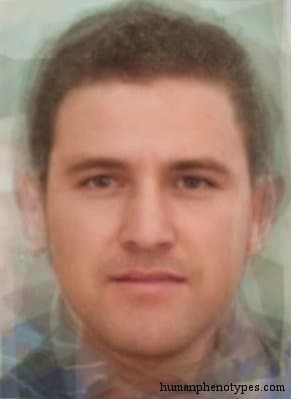
Composite source: Human Phenotypes — Canarid
Geographic Distribution
Geographically, Canarid anchors to 28.3° N, 16.6° W (Southern Europe). That is the point where historical anthropologists judged Canarid most concentrated, not a hard edge; modern migration and intermarriage have long since softened whatever boundaries once existed.
Physical Characteristics
Fair skin, wavy reddish, brown or blonde hair.
- Mixed eyes
- Tall, mesoskelic, ectomorph to mesomorph
- Mesocephalic, chamae- orthocranic, relatively large-headed
- Mildly leptorrhine
- Face broad, sometimes a bit low, large jaw, significant supraorbital arches, occasional mild prognathy, occiput round
- Body hair modest
Historical Background
Maghrebi type with similarities to Cromagnids and North Europeans - probably in part a result of convergent evolution of pre-Neolithic North Africans adapting to cloudy mountain regions, and partially of prehistoric migrations from Europe. Historically in some areas of the Canary Islands, especially in Gomera, Tenerife (Guanches), and Gran Canaria, heavily mixed on the islands today. Also in Berbers (Riffians, Kabyles), Tunisians, and Western Libya (Giado, Nalut).
Research History & Naming
Typological names were coined, contested, and renamed repeatedly across the 20th century, and Canarid is no exception. The extract below records the researchers who defined Canarid, the alternative labels it accumulated, and where the modern consensus settled.
Named Canarid by Lundman (1943) , a Paleo Atlantid subvariety (c.p. Lundman, 1951) . Hooton (1925) defined it as the Guanche type, Coon (1939) as part of Brünn, Eickstedt (1934) part of Dalic. Peters (1940) , Fischer (1943) and Schwidetzky (1963) as Cromagnid, Briggs (1955) as Type D. Heberer et al. (1969) and Knussmann (1996) later united it with Berberid. Michalski's (1964) Riffian is similar. Genetically, Guanches and Berbers are linked ( Pino-Yanes et al. 2011 ).
Comparison With Nearby Phenotypes
Ranked by great-circle distance from Canarid's reference center, these are the five nearest documented phenotypes — the closest being Trans Mediterranid at 612 km. Overlapping distributions like these are exactly what makes the quiz hard, and the Trans Mediterranid row is where to start looking.
| Phenotype | Region | Distance | Distinguishing trait |
|---|---|---|---|
| Trans Mediterranid | North Africa | 612 km | Light, sometimes medium (yellowish) brown skin, straight to curly brown/black hair, often curlier than in European Mediterranids. |
| African Alpinoid | North Africa | 897 km | Light brown skin, straight or wavy brown to black hair, usually dark, sometimes mixed eyes. |
| Moorish | North Africa | 1,165 km | Bronze brown skin, wavy to tight-curly hair. |
| West Ethiopid | West Africa | 1,364 km | Reddish medium to dark brown skin, wavy to tight-curly hair. |
| Senegalid | West Africa | 1,553 km | Black skin, even darker than other Sudanids. |
Canarid in the Game
When the Canarid composite shows up in the quiz, players who know the Southern Europe distribution pattern have the edge. The reference answer sits near 28.3° N, 16.6° W; pins on the wrong continent score close to zero, so even a rough regional instinct beats a precise but misdirected pin.
Canarid Phenotype FAQ
- Where does the Canarid phenotype come from?
- The reference coordinates for the Canarid phenotype sit near 28.3° N, 16.6° W, in Southern Europe. That point marks the center of the Southern Europe distribution documented roughly 1500 years ago — actual prevalence spread well beyond it, toward entries such as Trans Mediterranid 612 km away, and modern migration has blurred those boundaries further.
- What does the Canarid phenotype look like?
- In the historical literature, fair skin, wavy reddish, brown or blonde hair. For Canarid these are statistical tendencies across a population, not a checklist every individual matches.
- Is the Canarid phenotype a race or a nationality?
- No. Phenotypes like Canarid are descriptive averages, not ancestry groups. Canarid is one of several types documented in and around Southern Europe — see the comparison table above — and the same individual can carry traits associated with several of them at once. The Canarid entry describes a statistical pattern, not a group of people and not a nationality.
- How does Canarid appear in the game?
- In Classic Daily and Challenge Mode, the Canarid composite face appears without a label. Your task is to drop a pin on the world map where you think that face is historically most common — the scoring uses the distance between your pin and the reference coordinates near 28.3° N, 16.6° W. The post-round review then shows the correct location, your distance error, and this Canarid entry.
References & Literature
Every claim on this page traces back to the sources below — the researchers who defined, measured, and argued over the Canarid type. The originals behind the Canarid entry are worth consulting directly.
- Lundman, B. 1943. Jordens Människoraser och Folkstammar. Nybloms Förlag, Uppsala.
- Lundman, B. 1951. Dunkelgemischte cromagnide Typen aus Dalarne, Schweden. Zeitschrift für Morphologie und Anthropologie. 43 (2), 222-226.
- Hooton, E. A. 1925. The ancient inhabitants of the Canary Islands. Cambridge/Mass..
- Coon, C.S.. 1939.. The Races of Europe. The Macmillan Company. New York.
- Eickstedt, E. von. 1934. Rassenkunde und Rassengeschichte der Menschheit. Ferdinand Enke. Stuttgart.
- Peters, H. 1940. Haustier und Mensch in Libyen: Wissenschaftliche Ergebnisse einer Reise nach Nordafrika. Hohenlohesche Verlagsbuchhandlung. Oehringen.
- Fischer, E. 1943. Rassenkundliche Probleme in Weißafrika. In: Beiträge zur Kolonialforschung. Tagungsband I, 130-139.
- Schwidetzky, I. 1963. Die vorspanische Bevölkerung der Kanarischen Inseln; anthropologische Untersuchungen.Musterschmidt. Göttingen.
- Briggs, L. C. 1955. The Stone Age Races of Northwest Africa. Peabody Mus. Bull. 18. Cambridge, USA.
- Heberer, G., G. Kurth and I. Schwidetzky. 1969. Anthropologie. Das Fischer Lexikon.
- Knussmann, R. 1996. Vergleichende Biologie des Menschen: Lehrbuch der Anthropologie und Humangenetik. 2ed. Spektrum Akademischer Verlag.
- Michalski, I. 1964. Remarks about the anthropological structure of Egypt, Publicatons of the joint arabic-polish anthropological expedition, 2. 209-238.
- P11
Related Phenotypes
More entries from the same region of the historical map as Canarid, each with its own composite and trait profile.
Trans Mediterranid
North Africa · 612 km away
Widespread Mediterranid subtype with many morphological features intermediate between Eurafricanid and Gracile Mediterranid. Possibly a grac...
African Alpinoid
North Africa · 897 km away
The most brachycephalic Maghrebi type, shows close morphological similarities to Alpines and in a lower degree to Armenids and Berberids. Pr...
Moorish
North Africa · 1,165 km away
Relatively recent contact type of the Western Sahara. Probably formed during Antiquity when aboriginal Berber populations mixed with older W...
West Ethiopid
West Africa · 1,364 km away
Ethiopid subtype that was more widespread across the Western Saharan regions during the Neolithic when the area was still a green savannah. ...
Senegalid
West Africa · 1,553 km away
Gracile Sudanid variety, named after the country of Senegal, where it is found in its purest form among Wolof, more mixed in Serer. Occasion...
Further Reading
Background articles from the blog that explain where the Canarid type fits, how these composites are built, and what a face can and cannot tell you.
AI Ethnicity Guesser: What the Tools Really Return
An AI ethnicity guesser returns a label from a fixed list rather than a measurement of ancestry. Here is what the models are trained on...
Ethnicity Guesser vs DNA Test: Two Different Questions About Where You're From
A DNA test answers 'what fraction of my ancestors came from reference regions' - a face quiz answers 'what historical pattern does this...