Senegalid Phenotype - Face Features & Origin
Gracile Sudanid variety, named after the country of Senegal, where it is found in its purest form among Wolof, more mixed in Serer. Its reference coordinates sit near 14.5° N, 14.5° W in West Africa. Rather than a single portrait, the Senegalid composite below is a statistical average, and the surrounding sections — traits, distribution, research history, references — give that average its context.
Average Face
What you see below is a statistical construction of the Senegalid reference population. Faces recorded from the Senegalid sample were overlaid and merged; the result keeps the features most members shared and discards personal variation. It reads like a Senegalid portrait, but it works like a histogram.
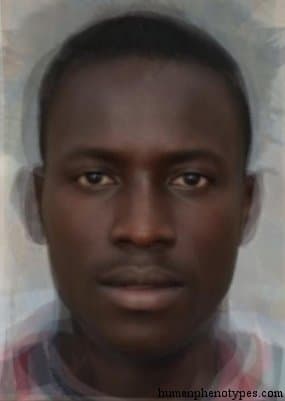
Composite source: Human Phenotypes — Senegalid
Geographic Distribution
Senegalid is documented across West Africa, with its historical reference center near 14.5° N, 14.5° W. The coordinates mark where the type was most characteristic roughly 1500 years ago; population movements since then have scattered and blended the distribution far beyond that point.
Physical Characteristics
Black skin, even darker than other Sudanids.
- Often kinky, sometimes tight-curly hair
- Tall, (hyper-)brachyskelic, ectomorph to mesomorph
- Dolichocephalic, orthocranic with more gracile facial features than other Sudanids, narrower and smaller faces
- (Mildly) platyrrhine nose
- The hands are big, body hair extremely weak
- Prognathy pronounced
Historical Background
Gracile Sudanid variety, named after the country of Senegal, where it is found in its purest form among Wolof, more mixed in Serer. Occasionally in Fulani, Mande speakers, and across the Sahel zone. Connections to Fulani are much stronger than for other Sudanid varieties, some Ethiopid influence is possible.
Research History & Naming
Every label in the historical catalogue has an author and a date, and Senegalid has accumulated its share of competing attributions. For Senegalid, the literature extract below shows the naming chain — from the first definition through the later revisions that shaped the current entry.
The type was named Senegalid by Lundman ( 1952 , 1967 ), who regarded it as a Sudanid subtype. Vallois ( 1950 , 1951 ) describes it as type or sous-race "sénégalais". Often included in Sudanid, or even regarded as a typical representative ( Eickstedt, 1934 ; Biasutti, 1967 ; Vallois, 1971 ), sometimes due to the very dark pigmentation of Wolof ( Alcobé y Noguer, 1952 ). Early investigations by Chantre (1917) .
Comparison With Nearby Phenotypes
The five phenotypes whose documented centers lie closest to Senegalid, ranked by great-circle distance. They are the types players most often confuse with Senegalid in the quiz, precisely because their distributions overlap.
| Phenotype | Region | Distance | Distinguishing trait |
|---|---|---|---|
| Casamance | West Africa | 192 km | Dark brown, sometimes black skin, usually kinky hair. |
| West Ethiopid | West Africa | 280 km | Reddish medium to dark brown skin, wavy to tight-curly hair. |
| Moorish | North Africa | 848 km | Bronze brown skin, wavy to tight-curly hair. |
| Bobo | West Africa | 1,160 km | Dark brown, sometimes black skin, usually kinky hair. |
| Guineo Camerunian | West Africa | 1,207 km | Usually dark, sometimes medium brown skin. |
Senegalid in the Game
Senegalid is one of the faces that can appear in Classic Daily and Challenge Mode. When it does, the winning pin lands near 14.5° N, 14.5° W in West Africa — and because the scoring decays with distance, recognizing the region matters more than pixel-perfect placement.
Senegalid Phenotype FAQ
- Where does the Senegalid phenotype come from?
- The reference coordinates for the Senegalid phenotype sit near 14.5° N, 14.5° W, in West Africa. That point marks the center of the West Africa distribution documented roughly 1500 years ago — actual prevalence spread well beyond it, toward entries such as Casamance 192 km away, and modern migration has blurred those boundaries further.
- What does the Senegalid phenotype look like?
- In the historical literature, black skin, even darker than other Sudanids. For Senegalid these are statistical tendencies across a population, not a checklist every individual matches.
- Is the Senegalid phenotype a race or a nationality?
- No. Phenotypes like Senegalid are descriptive averages, not ancestry groups. Senegalid is one of several types documented in and around West Africa — see the comparison table above — and the same individual can carry traits associated with several of them at once. The Senegalid entry describes a statistical pattern, not a group of people and not a nationality.
- How does Senegalid appear in the game?
- In Classic Daily and Challenge Mode, the Senegalid composite face appears without a label. Your task is to drop a pin on the world map where you think that face is historically most common — the scoring uses the distance between your pin and the reference coordinates near 14.5° N, 14.5° W. The post-round review then shows the correct location, your distance error, and this Senegalid entry.
References & Literature
Primary sources for the Senegalid entry, listed as cited in the historical literature. The naming and classification debates around Senegalid referenced above run through these works.
- Lundman, B. 1952. Umriss der Rassenkunde des Menschen in geschichtlicher Zeit. Ejnar Munksgaard. Kopenhagen.
- Lundman, B. 1967. Geographische Anthropologie. Rassen und Völker der Erde. G. Fischer, Stuttgart
- Vallois, H. 1950. Les Badjoué du Sud-Cameroun. Étude anthropologique Bulletins et Mémoires de la Société d'anthropologie de Paris, 1-1-3, 18-59.
- Vallois, H. 1951. Las races humaines. 3 Ed. Paris.
- A67
- Biasutti, R. 1967 (1941). Le Razze e i Popoli della terra. 4th Ed. Vol 1-4. U.T.E.T., Torino.
- Vallois, H. V. 1971. Las races humaines. 8 Ed. Grammont.
- Alcobé y Noguer, S.. 1952. Die Biodynamik des Afrikanischen Kontinentes. In: Historia Mundi. Band 1, Munich, 175-187.
- Chantre, E. 1917. Contribution à l'étude des races humaines du Soudan occidental (Sénégal et Haut-Niger). Bull. Soc. Anthr. Lyon 32.
Related Phenotypes
If Senegalid interested you, these neighboring phenotype entries cover adjacent parts of the map with distinctly different trait bundles.
Casamance
West Africa · 192 km away
Type of the Sudanid-Guinesid contact belt with a variety of unique features that set it apart from other groups. Most common in the lower Ca...
West Ethiopid
West Africa · 280 km away
Ethiopid subtype that was more widespread across the Western Saharan regions during the Neolithic when the area was still a green savannah. ...
Moorish
North Africa · 848 km away
Relatively recent contact type of the Western Sahara. Probably formed during Antiquity when aboriginal Berber populations mixed with older W...
Bobo
West Africa · 1,160 km away
Sudanid variety with shorter skulls than Sudanids proper, and several other unique features that set it apart from other neighbouring groups...
Guineo Camerunian
West Africa · 1,207 km away
West African type, the shorter-skulled counterpart of Guinesids. May constitute the transition to Congolesids. Common in forest regions of C...
Further Reading
Background articles from the blog that explain where the Senegalid type fits, how these composites are built, and what a face can and cannot tell you.
Ethnicity Quiz: Five Question Types Behind the Label
A face quiz, a census form, a reaction-time experiment, a surname model and an ancestry report all answer to the same phrase.
What Nationality Do I Look Like? A Legal Status, Not a Face
Nationality is a status that states assign and reassign. A face can resemble a documented regional pattern; it cannot resemble a...