West Ethiopid Phenotype - Face Features & Origin
Historical anthropology places the West Ethiopid phenotype in West Africa, with a documented center near 16.0° N, 16.5° W. Ethiopid subtype that was more widespread across the Western Saharan regions during the Neolithic when the area was still a green savannah. The sections that follow unpack the West Ethiopid entry in practice: the composite face, the traits it summarizes, the naming history, and the sources.
Average Face
Averaging the portraits behind West Ethiopid leaves the features that repeat and erases the ones that do not. That is exactly how the West Ethiopid composite below was built: individual photographs were aligned and statistically merged, exaggerating shared structure into a single reference face that no actual person looks like.
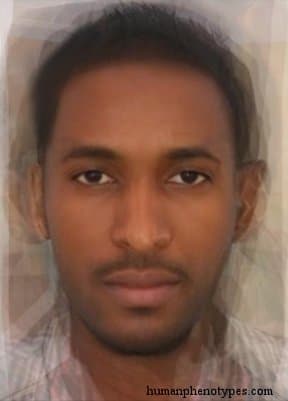
Composite source: Human Phenotypes — West Ethiopid
Geographic Distribution
Geographically, West Ethiopid anchors to 16.0° N, 16.5° W (West Africa). That is the point where historical anthropologists judged West Ethiopid most concentrated, not a hard edge; modern migration and intermarriage have long since softened whatever boundaries once existed.
Physical Characteristics
Reddish medium to dark brown skin, wavy to tight-curly hair.
- (Rather) tall, ectomorph, brachyskelic
- Dolichocephalic with a mesorrhine, long, often convex nose
- Lips are neither thin nor thick
- Pseudo-Semitic features may appear in some individuals
- Somewhat prognathous
Historical Background
Ethiopid subtype that was more widespread across the Western Saharan regions during the Neolithic when the area was still a green savannah. Found from Mauritania to Senegal and from Guinea to Northern Cameroon. Common in Western Fulani, especially Pular speakers of mountain regions. Mixed in other Fulani, Moors, Hausa, and related people. From the 15th century on, Islamisation, migration, and wars caused many of these groups to become heavily admixed.
Research History & Naming
Typological names were coined, contested, and renamed repeatedly across the 20th century, and West Ethiopid is no exception. The extract below records the researchers who defined West Ethiopid, the alternative labels it accumulated, and where the modern consensus settled.
Often described as West Ethiopid ( Eickstedt, 1943 ; Pales, 1953 ; Alcobé y Noguer, 1952 ) or Ethiopid ( Knussmann, 1996 ). In the modern groups, West African genetic influence dominates ( Baker, 1981 ; Henn et al., 2012 ), Vogel (1974) even placed Ful and Hausa in Sudanid.
Comparison With Nearby Phenotypes
Geography, not alphabet, ordered this table: the five phenotype centers closest to West Ethiopid's, with the traits most likely to be mistaken for it (Senegalid leads at 280 km). In gameplay, these five account for most of the wrong-but-nearby pins against West Ethiopid.
| Phenotype | Region | Distance | Distinguishing trait |
|---|---|---|---|
| Senegalid | West Africa | 280 km | Black skin, even darker than other Sudanids. |
| Casamance | West Africa | 372 km | Dark brown, sometimes black skin, usually kinky hair. |
| Moorish | North Africa | 900 km | Bronze brown skin, wavy to tight-curly hair. |
| Canarid | Southern Europe | 1,364 km | Fair skin, wavy reddish, brown or blonde hair. |
| Bobo | West Africa | 1,425 km | Dark brown, sometimes black skin, usually kinky hair. |
West Ethiopid in the Game
In gameplay terms, West Ethiopid rewards region-level recall: the score is computed from the distance between your pin and 16.0° N, 16.5° W. Players often confuse West Ethiopid with Senegalid (280 km out) in the comparison table above — those confusions are exactly what the distance penalty is designed to expose.
West Ethiopid Phenotype FAQ
- Where does the West Ethiopid phenotype come from?
- The reference coordinates for the West Ethiopid phenotype sit near 16.0° N, 16.5° W, in West Africa. That point marks the center of the West Africa distribution documented roughly 1500 years ago — actual prevalence spread well beyond it, toward entries such as Senegalid 280 km away, and modern migration has blurred those boundaries further.
- What does the West Ethiopid phenotype look like?
- In the historical literature, reddish medium to dark brown skin, wavy to tight-curly hair. For West Ethiopid these are statistical tendencies across a population, not a checklist every individual matches.
- Is the West Ethiopid phenotype a race or a nationality?
- No — and the West Ethiopid naming history above shows why. West Ethiopid was defined, renamed, and regrouped repeatedly by different researchers, which is the opposite of how a fixed racial category would behave. A phenotype is a recurring bundle of visible traits recorded across a population; the West Ethiopid label says nothing about where any individual's ancestors were born.
- How does West Ethiopid appear in the game?
- In Classic Daily and Challenge Mode, the West Ethiopid composite face appears without a label. Your task is to drop a pin on the world map where you think that face is historically most common — the scoring uses the distance between your pin and the reference coordinates near 16.0° N, 16.5° W. The post-round review then shows the correct location, your distance error, and this West Ethiopid entry.
References & Literature
Every claim on this page traces back to the sources below — the researchers who defined, measured, and argued over the West Ethiopid type. The originals behind the West Ethiopid entry are worth consulting directly.
- Eickstedt, E. von. 1943. Völkerbiologische Probleme der Sahara. In: Beiträge zur Kolonialforschung. Tagungsband I, 169-240.
- Pales, L. and T. de St-Péreuse. 1953. Raciologie comparative des populations de l'Afrique occidentale.Bull. et Mém. de la Société d'anthropologie de Paris X. 185-497.
- Alcobé y Noguer, S.. 1952. Die Biodynamik des Afrikanischen Kontinentes. In: Historia Mundi. Band 1, Munich, 175-187.
- Knussmann, R. 1996. Vergleichende Biologie des Menschen: Lehrbuch der Anthropologie und Humangenetik. 2ed. Spektrum Akademischer Verlag.
- Baker, J.R.. 1981. Race. Oxford Univ. Press. London.
- H12
- Virchow, R. 1874. Die physische Anthropologie der Finnen. Verh. Berliner Ges. Anthr. Ethnol. Urg. VI. 185-189.
Related Phenotypes
Other human phenotypes whose documented centers lie in the same part of the map as West Ethiopid.
Senegalid
West Africa · 280 km away
Gracile Sudanid variety, named after the country of Senegal, where it is found in its purest form among Wolof, more mixed in Serer. Occasion...
Casamance
West Africa · 372 km away
Type of the Sudanid-Guinesid contact belt with a variety of unique features that set it apart from other groups. Most common in the lower Ca...
Moorish
North Africa · 900 km away
Relatively recent contact type of the Western Sahara. Probably formed during Antiquity when aboriginal Berber populations mixed with older W...
Canarid
Southern Europe · 1,364 km away
Maghrebi type with similarities to Cromagnids and North Europeans - probably in part a result of convergent evolution of pre-Neolithic North...
Bobo
West Africa · 1,425 km away
Sudanid variety with shorter skulls than Sudanids proper, and several other unique features that set it apart from other neighbouring groups...
Further Reading
Background articles from the blog that explain where the West Ethiopid type fits, how these composites are built, and what a face can and cannot tell you.
What Is My Ethnicity? Who Is Asking Changes the Answer
What the phrase assumes is that ethnicity is one thing a person has. Four registers answer it instead: a census form, a family record, a...
Ethnicity Guesser vs Ethnoguessr: What Each One Counts
Two products answer to nearly the same name in a search box, and the totals they advertise count two kinds of object that do not...