Trans Mediterranid Phenotype - Face Features & Origin
Widespread Mediterranid subtype with many morphological features intermediate between Eurafricanid and Gracile Mediterranid. The entry below collects the Trans Mediterranid composite face, its documented distribution around 28.3° N, 10.4° W in North Africa, its physical characteristics, the research history behind the name, and the academic references that support all of it.
Average Face
The Trans Mediterranid composite below is not a photograph of a real person. Historical anthropologists aligned multiple individual portraits from the Trans Mediterranid reference population and averaged them into one image, so recurring structures — skull outline, nose form, lip thickness, brow position — dominate while individual idiosyncrasies cancel out.
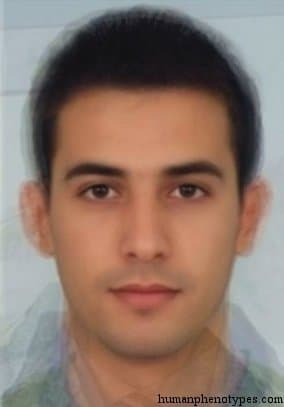
Composite source: Human Phenotypes — Trans Mediterranid
Geographic Distribution
The reference center for Trans Mediterranid sits near 28.3° N, 10.4° W in North Africa. Around that anchor, prevalence falls off gradually — the type is not confined to one valley or one modern border, and the historical map should be read as a gradient rather than a boundary.
Physical Characteristics
Light, sometimes medium (yellowish) brown skin, straight to curly brown/black hair, often curlier than in European Mediterranids.
- Medium height, mesoskelic, ectomorph
- Dolicho- mesocephalic, mildly hypsicranic with an oval, often long face, big eyes and a straight, (hyper-)leptorrhine, high-bridged nose
- Facial features relatively soft, forehead slightly sloping
Historical Background
Widespread Mediterranid subtype with many morphological features intermediate between Eurafricanid and Gracile Mediterranid. Possibly a gracilised Eurafricanid that spread west through ancient migrations that lasted up to Antiquity (e.g. Phoenicians). Today common in North Africa from Morocco to Egypt with high concentrations in Tunisia and Algeria. Also in Western Arabia and Southern Iberia, sometimes Sicily, Sardinia, Canary Islands, and other parts of Southern Europe.
Research History & Naming
Every label in the historical catalogue has an author and a date, and Trans Mediterranid has accumulated its share of competing attributions. For Trans Mediterranid, the literature extract below shows the naming chain — from the first definition through the later revisions that shaped the current entry.
Eickstedt (1934) named and defined the type. Corresponds to Lundman's (1967) South Mediterranid / Saharid, who added Targid. Many reported typical, gracile Mediterranids (or East Mediterranids, because they are higher-skulled) from North Africa ( Coon, 1939 ; Peters, 1940 ; Fischer, 1943 ; Heberer et al. 1969 ). Genetically they can be separated from pred. European Mediterranids ( Paschou et al. 2014 )
Comparison With Nearby Phenotypes
Ranked by great-circle distance from Trans Mediterranid's reference center, these are the five nearest documented phenotypes — the closest being African Alpinoid at 386 km. Overlapping distributions like these are exactly what makes the quiz hard, and the African Alpinoid row is where to start looking.
| Phenotype | Region | Distance | Distinguishing trait |
|---|---|---|---|
| African Alpinoid | North Africa | 386 km | Light brown skin, straight or wavy brown to black hair, usually dark, sometimes mixed eyes. |
| Canarid | Southern Europe | 612 km | Fair skin, wavy reddish, brown or blonde hair. |
| Moorish | North Africa | 906 km | Bronze brown skin, wavy to tight-curly hair. |
| West Ethiopid | West Africa | 1,506 km | Reddish medium to dark brown skin, wavy to tight-curly hair. |
| Senegalid | West Africa | 1,598 km | Black skin, even darker than other Sudanids. |
Trans Mediterranid in the Game
When the Trans Mediterranid composite shows up in the quiz, players who know the North Africa distribution pattern have the edge. The reference answer sits near 28.3° N, 10.4° W; pins on the wrong continent score close to zero, so even a rough regional instinct beats a precise but misdirected pin.
Trans Mediterranid Phenotype FAQ
- Where does the Trans Mediterranid phenotype come from?
- Historical sources center the Trans Mediterranid phenotype on 28.3° N, 10.4° W (North Africa). Treat that as a rough anchor: the type appeared across a wider surrounding area — its nearest documented neighbors, African Alpinoid and Canarid, sit 386 and 612 km from the reference point — and its present-day distribution no longer matches the historical map.
- What does the Trans Mediterranid phenotype look like?
- The composite emphasizes recurring traits: light, sometimes medium (yellowish) brown skin, straight to curly brown/black hair, often curlier than in European Mediterranids. The full trait list for Trans Mediterranid appears in the physical characteristics section above.
- Is the Trans Mediterranid phenotype a race or a nationality?
- No. A phenotype is a recurring bundle of visible traits documented by historical anthropologists across a population — for Trans Mediterranid, patterns such as light, sometimes medium (yellowish) brown skin, straight to curly brown/black hair, often curlier than in European Mediterranids. The Trans Mediterranid entry is not a genetic ancestry, not a nationality, and not a statement about any individual person. Two people from the same country can match completely different phenotypes — one resembling Trans Mediterranid, another closer to African Alpinoid — and one phenotype can span many modern borders.
- How does Trans Mediterranid appear in the game?
- When the Trans Mediterranid face comes up in Classic Daily or Challenge Mode, you pin the world map where you believe the type is historically most common, and the score decays with your distance to 28.3° N, 10.4° W. Fair warning: the nearest other entry in our dataset, African Alpinoid, sits just 386 km away, so this face rewards precise placement — the right country alone is not always enough.
References & Literature
Primary sources for the Trans Mediterranid entry, listed as cited in the historical literature. The naming and classification debates around Trans Mediterranid referenced above run through these works.
- Eickstedt, E. von. 1934. Rassenkunde und Rassengeschichte der Menschheit. Ferdinand Enke. Stuttgart.
- Biasutti, R. 1967 (1941). Le Razze e i Popoli della terra. 4th Ed. Vol 1-4. U.T.E.T., Torino.
- Coon, C.S.. 1939.. The Races of Europe. The Macmillan Company. New York.
- Peters, H. 1940. Haustier und Mensch in Libyen: Wissenschaftliche Ergebnisse einer Reise nach Nordafrika. Hohenlohesche Verlagsbuchhandlung. Oehringen.
- Fischer, E. 1943. Rassenkundliche Probleme in Weißafrika. In: Beiträge zur Kolonialforschung. Tagungsband I, 130-139.
- Heberer, G., G. Kurth and I. Schwidetzky. 1969. Anthropologie. Das Fischer Lexikon.
- Paschou et al. 2014. Maritime route of colonization of Europe. PNAS.
Related Phenotypes
More entries from the same region of the historical map as Trans Mediterranid, each with its own composite and trait profile.
African Alpinoid
North Africa · 386 km away
The most brachycephalic Maghrebi type, shows close morphological similarities to Alpines and in a lower degree to Armenids and Berberids. Pr...
Canarid
Southern Europe · 612 km away
Maghrebi type with similarities to Cromagnids and North Europeans - probably in part a result of convergent evolution of pre-Neolithic North...
Moorish
North Africa · 906 km away
Relatively recent contact type of the Western Sahara. Probably formed during Antiquity when aboriginal Berber populations mixed with older W...
West Ethiopid
West Africa · 1,506 km away
Ethiopid subtype that was more widespread across the Western Saharan regions during the Neolithic when the area was still a green savannah. ...
Senegalid
West Africa · 1,598 km away
Gracile Sudanid variety, named after the country of Senegal, where it is found in its purest form among Wolof, more mixed in Serer. Occasion...
Further Reading
Background articles from the blog that explain where the Trans Mediterranid type fits, how these composites are built, and what a face can and cannot tell you.
Is AI Ethnicity Guessing Accurate? Separating the Marketing From the Measurements
Published accuracies for AI face-based ancestry classification range from 80 to 99 percent - under lab conditions that real faces never...
Ethnicity From a Face: Which Layer Carries the Signal
A face is not one trait but a stack of layers, and asking a photograph for ethnicity from face assumes every one of those layers tells...