African Alpinoid Phenotype - Face Features & Origin
The most brachycephalic Maghrebi type, shows close morphological similarities to Alpines and in a lower degree to Armenids and Berberids. Its reference coordinates sit near 31.1° N, 7.9° W in North Africa. Rather than a single portrait, the African Alpinoid composite below is a statistical average, and the surrounding sections — traits, distribution, research history, references — give that average its context.
Average Face
What you see below is a statistical construction of the African Alpinoid reference population. Faces recorded from the African Alpinoid sample were overlaid and merged; the result keeps the features most members shared and discards personal variation. It reads like a African Alpinoid portrait, but it works like a histogram.
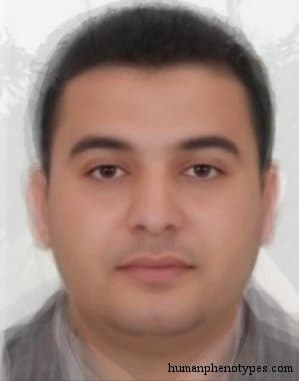
Composite source: Human Phenotypes — African Alpinoid
Geographic Distribution
The reference center for African Alpinoid sits near 31.1° N, 7.9° W in North Africa. Around that anchor, prevalence falls off gradually — the type is not confined to one valley or one modern border, and the historical map should be read as a gradient rather than a boundary.
Physical Characteristics
Light brown skin, straight or wavy brown to black hair, usually dark, sometimes mixed eyes.
- Medium height, mesoskelic, endomorph
- Rather brachycephalic, orthocranic with a leptorrhine, straight or convex nose
- Features more angular than in other Alpinids, deep set eyes
Historical Background
The most brachycephalic Maghrebi type, shows close morphological similarities to Alpines and in a lower degree to Armenids and Berberids. Probably not directly related to other Alpines, but the result of a similar adaption. Common in the Atlas Mountains of Algeria and Tunisia. A subvariety exists on the island of Djerba. Extends in lower frequencies across Libya, Egypt, and Morocco.
Research History & Naming
The passage below traces who first defined African Alpinoid, which rival names competed with it, and how later authors consolidated or disputed the classification — the raw material of any serious phenotype reference.
The name "African Alpines" was coined by Briggs (1955) . Vallois (1971) and Eickstedt (1934) ,who reported them especially in Berber populations, called them Alpinid. Gerhardt (1957) used the name "Brachymorph Cromagnids"and Biasutti (1967) "Brachymorphs". Bertholon and Chantre's (1913) Gerba type can be included.
Comparison With Nearby Phenotypes
The five phenotypes whose documented centers lie closest to African Alpinoid, ranked by great-circle distance. They are the types players most often confuse with African Alpinoid in the quiz, precisely because their distributions overlap.
| Phenotype | Region | Distance | Distinguishing trait |
|---|---|---|---|
| Trans Mediterranid | North Africa | 386 km | Light, sometimes medium (yellowish) brown skin, straight to curly brown/black hair, often curlier than in European Mediterranids. |
| Canarid | Southern Europe | 897 km | Fair skin, wavy reddish, brown or blonde hair. |
| Moorish | North Africa | 1,209 km | Bronze brown skin, wavy to tight-curly hair. |
| Berberid | North Africa | 1,301 km | Light to medium brown skin, curly-wavy, brown to black hair. |
| Baskid | Southern Europe | 1,408 km | Fair skin. |
African Alpinoid in the Game
African Alpinoid is one of the faces that can appear in Classic Daily and Challenge Mode. When it does, the winning pin lands near 31.1° N, 7.9° W in North Africa — and because the scoring decays with distance, recognizing the region matters more than pixel-perfect placement.
African Alpinoid Phenotype FAQ
- Where does the African Alpinoid phenotype come from?
- Historical sources center the African Alpinoid phenotype on 31.1° N, 7.9° W (North Africa). Treat that as a rough anchor: the type appeared across a wider surrounding area — its nearest documented neighbors, Trans Mediterranid and Canarid, sit 386 and 897 km from the reference point — and its present-day distribution no longer matches the historical map.
- What does the African Alpinoid phenotype look like?
- The composite emphasizes recurring traits: light brown skin, straight or wavy brown to black hair, usually dark, sometimes mixed eyes. The full trait list for African Alpinoid appears in the physical characteristics section above.
- Is the African Alpinoid phenotype a race or a nationality?
- No — and the African Alpinoid naming history above shows why. African Alpinoid was defined, renamed, and regrouped repeatedly by different researchers, which is the opposite of how a fixed racial category would behave. A phenotype is a recurring bundle of visible traits recorded across a population; the African Alpinoid label says nothing about where any individual's ancestors were born.
- How does African Alpinoid appear in the game?
- When the African Alpinoid face comes up in Classic Daily or Challenge Mode, you pin the world map where you believe the type is historically most common, and the score decays with your distance to 31.1° N, 7.9° W. Fair warning: the nearest other entry in our dataset, Trans Mediterranid, sits just 386 km away, so this face rewards precise placement — the right country alone is not always enough.
References & Literature
The African Alpinoid phenotype entry above is compiled from the 6 academic references. Readers are encouraged to consult the original African Alpinoid sources for verification and deeper context.
- Briggs, L. C. 1955. The Stone Age Races of Northwest Africa. Peabody Mus. Bull. 18. Cambridge, USA.
- Vallois, H. V. 1971. Las races humaines. 8 Ed. Grammont.
- Eickstedt, E. von. 1934. Rassenkunde und Rassengeschichte der Menschheit. Ferdinand Enke. Stuttgart.
- Gerhardt, K. 1957. Paläanthrologische Probleme der alten Mediterraneis und Weißafrikas. Verh. Dt. Ges. Anthropologie, 5. Tagung. 84-96.
- Biasutti, R. 1967 (1941). Le Razze e i Popoli della terra. 4th Ed. Vol 1-4. U.T.E.T., Torino.
- Bertholon, L. and E. Chantre. 1913. Recherches anthropologiques dans la Berbérie orientale. Lyon.
Related Phenotypes
Other human phenotypes whose documented centers lie in the same part of the map as African Alpinoid.
Trans Mediterranid
North Africa · 386 km away
Widespread Mediterranid subtype with many morphological features intermediate between Eurafricanid and Gracile Mediterranid. Possibly a grac...
Canarid
Southern Europe · 897 km away
Maghrebi type with similarities to Cromagnids and North Europeans - probably in part a result of convergent evolution of pre-Neolithic North...
Moorish
North Africa · 1,209 km away
Relatively recent contact type of the Western Sahara. Probably formed during Antiquity when aboriginal Berber populations mixed with older W...
Berberid
North Africa · 1,301 km away
A Proto Atlanto Mediterranean type, originally named after Berbers and the North African Barbary. Associated with Paleolithic types that onc...
Baskid
Southern Europe · 1,408 km away
Ancient European type associated with the Basques. Found in its purest form in the Pyrénées-Atlantiques region of Southwestern France, altho...
Further Reading
Background articles from the blog that explain where the African Alpinoid type fits, how these composites are built, and what a face can and cannot tell you.
Ethnicity Guesser Photo: What Happens to the File First
A photo handed to a face tool stops being a photograph almost at once: the file is decoded, rotated, colour-converted and resized before...
Ethnicity From a Face: Which Layer Carries the Signal
A face is not one trait but a stack of layers, and asking a photograph for ethnicity from face assumes every one of those layers tells...