Alpinid Phenotype: One Shape in Three Mountain Ranges
Three catalogue rows carry the Alpinid name, sit in three separate mountain systems, and one of them states outright that the resemblance is not descent.
Three rows in three mountain systems
The catalogue holds exactly three entries with Alpin in the name: West Alpinid in Central Europe, East Alpinid in the Middle East, and African Alpinoid in North Africa. Twelve entries mention the word somewhere in their text, but only these three are named for it. Their descriptions place them in three separate mountain systems. West Alpinid's nucleus is the Western Alps and the French Massif Central, with Disentis, Savoy and the Auvergne named. East Alpinid covers the mountain zones of Anatolia into northern Iraq and western Iran. African Alpinoid is the Atlas range of Algeria and Tunisia.
The three pins sit 3,041 kilometres apart from west to east, and 2,153 kilometres from the Alps to the Atlas. The silhouette they describe is much the same: a wide round face, a brachycephalic skull, a short leptorrhine nose, a steep forehead. West Alpinid is called Alpinid proper and is hyperbrachycephalic and low-vaulted. East Alpinid is brachycephalic and high-vaulted, with slightly darker skin and slightly greater height noted in the entry. African Alpinoid is described as the most brachycephalic Maghrebi type, with features more angular than the other two.
Two of the rows disclaim each other
The naming is far less stable than the shape. West Alpinid began as Keltoid, in a usage the entry traces to Broca in 1868, and was renamed Alpinid by Gros and Lapouge in 1897. Ripley's The Races of Europe, published in 1899, divided the continent into three races, Teutonic, Alpine and Mediterranean, largely on head measurements. Deniker took up the term in 1900, and Coon, Eickstedt, Biasutti and Knussmann followed. Lundman later separated the western low-skulled forms as Cevennid.
East Alpinid carries a worse tangle. The entry credits the term to Senyürek in 1950 for Anatolian Alpinids, records that Coon called the same people Asiatic Alpines and Field called them Proto Alpine, then notes that Lundman used East Alpinid as a synonym for Gorid, a different variety. The Gorid entry states the reverse in nearly the same words: Gorid was defined by Lundman in 1946 and 1967 synonymously with East Alpinid, while others reserved East Alpinid for the more eastern varieties. Two rows, each reporting that the other one took its name.
The sentence that names the mechanism
African Alpinoid's entry contains a sentence that answers the question the other two raise. After noting close morphological similarities to Alpines and, less closely, to Armenids and Berberids, it states that the type is probably not directly related to other Alpines but the result of a similar adaption. That is convergence, written plainly, in a catalogue usually read as a list of lineages. The same silhouette reached the Atlas by a different route, or by no shared route at all, and whoever wrote the entry said so instead of smoothing it over.
The naming history of that row makes the point a second time. Briggs coined African Alpines in 1955. Vallois and Eickstedt had already called the same people Alpinid. Gerhardt used Brachymorph Cromagnids in 1957, Biasutti used Brachymorphs, and Bertholon and Chantre had described a Gerba type from Djerba in 1913. Five authors, four names, one silhouette, and an explicit note that the resemblance may be superficial. The literature was confident about what it saw and uncertain about what it meant, which is a more useful inheritance than a settled answer would have been.
The trait arrives on its own schedule
Brachycephaly is not a fixed package that travels with a population. It is a measurable tendency that moves within a century. Weidenreich described the secular shift toward rounder heads in 1945, and the record since has included both the shift and its reversal. Kouchi's 2000 paper in the American Journal of Physical Anthropology pooled 9,008 men and 3,430 women measured between 1942 and 1998 and found head breadth rising while head length stayed roughly constant, following a curve very close to the rise in stature.
Her explanation was nutritional: faster growth in childhood produces both taller bodies and broader heads, and when the growth rate stops climbing the index stops with it. Then comes the part that matters here. Over the same hundred years, height rose in Japan and Korea and heads grew rounder; height rose in many European populations and heads grew longer. The same improvement pushed the index in opposite directions. Whatever brachycephaly is tracking, it is not a single inherited bundle that a population carries intact across continents.
Shape can be made by hand
The clearest evidence that skull shape is not a lineage marker is that people have altered it on purpose. Boards, bindings and pads applied in infancy change the growing vault permanently, and the practice is documented across the Andes, Mesoamerica, parts of Europe and the Pacific. At the Paracas Cavernas cemetery on the Peruvian coast, a reanalysis of 159 crania found intentional modification in roughly 98 percent of them, which makes it a social norm rather than an eccentricity. A round or a long head, read that way, is partly a record of what was done to a baby.
Boas's immigrant study of 1912 belongs to the same argument from the other side. He measured 17,821 people across seven groups and reported that children born in the United States differed in head form from siblings born in Europe, with the largest differences among those born soon after their mother arrived. Sparks and Jantz reopened the data in 2002 and argued the differences were small and not biologically meaningful. Gravlee, Bernard and Leonard reanalysed it in 2003 and concluded Boas had been largely right. Sparks and Jantz themselves later suggested the effect could come from changed infant-carrying practice.
What heritability does and does not say
None of this makes head shape arbitrary. Twin and family studies find substantial genetic contributions, and one study of 369 twin pairs aged 7 to 12 estimated head-breadth heritability at 26 percent in boys and 82 percent in girls. The spread is the lesson. Heritability is a ratio of variance inside a population at one moment: it describes how much of the difference between individuals tracks genes, and it makes no claim about whether a population average can move. A trait can be strongly heritable and still shift by a centimetre over three generations.
The catalogue's own vocabulary keeps those levels apart. Of the 209 entries, 85 use the word brachycephalic, 103 use mesocephalic and 50 use dolichocephalic, and many use more than one, because the trait is written as a range rather than a switch. An entry will say rather brachycephalic, or mildly brachycephalic, or in the Dinarid case hyperbrachycephalic with a flat occiput. None of these rows is a biological category of the kind race claims to be; the variation underneath is clinal, which is why the rows overlap and cross-reference one another so heavily.
Where the map stopped matching
The first mismatch is modern movement. The Alpine arc, the Anatolian plateau and the Maghreb have all been corridors rather than containers, and the last century added labour migration, tourism and urban growth to the older traffic. A description of a shape recorded in the Auvergne describes the Auvergne of the measurement, not the person waiting at a bus stop there. The entries do not claim otherwise. Readers supply that step themselves, and it is the step that converts a documented pattern into a judgement about a stranger.
The second mismatch is quieter. If European heads have been growing longer as nutrition improved, then the trait that named this family has been drifting away from its own baseline for a century. West Alpinid's pin sits at 46 degrees north, 8 degrees east, in the western Alps, on a range that carried trade before the Romans arrived. The label survives because the word remains useful for describing a recorded shape. The population it once pointed at has kept moving, and so has the shape itself.
Frequently Asked Questions
- What is an Alpinid phenotype?
- It is a term from the historical typological literature for a documented appearance pattern: a broad round face, a brachycephalic skull, a short and often concave nose, a steep forehead. The catalogue carries three rows named for it, in the Western Alps and Massif Central, in the mountains of Anatolia and western Iran, and in the Atlas range of North Africa. The term describes a recorded shape at a recorded place and time, not a living person and not a nationality.
- Are Alpinids a race?
- No. Race is not used here as a biological category, and the entries are not units of descent. The variation they describe is clinal, which is why the rows overlap and cross-reference each other so heavily. The name itself came from a mountain range and was borrowed three times for three separate populations, and the African row says the resemblance is probably not shared ancestry but a similar adaptation.
- Why are round heads common in mountain regions?
- The catalogue's authors suspected adaptation to mountain climates, and the African Alpinoid entry calls the resemblance a similar adaptation rather than a shared origin. Measured records complicate the story in a useful way: cephalic index rose in Japan and Korea across the twentieth century and fell in many European populations over the same period, tracking growth and nutrition rather than altitude. Convergence is documented; a specific mountain cause is not.
Related Phenotypes
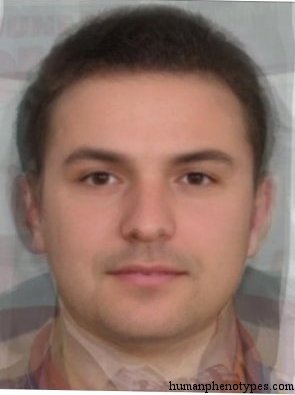
Faces from the encyclopedia that appear in this article. Open any entry for its full description, distribution, and references.
West Alpinid
Central Europe
Alpinid proper, historically found in the mountain regions of Western Europe. Often a cohabitant of a second mountain type, the Dinarid. The...
East Alpinid
Middle East
West Asian type that is anthropometrically and morphologically very similar to European Alpinids. Most common in the mountain zones of Anato...
African Alpinoid
North Africa
The most brachycephalic Maghrebi type, shows close morphological similarities to Alpines and in a lower degree to Armenids and Berberids. Pr...
Gorid
Central Europe
East Alpinid variety, named after the Polish word for mountain (Gora). Metrically intermediate between West Alpinid and East Europid. The nu...
Test what you learned
Put your eye for regional faces to work in the daily quiz — a composite face, a world map, and your best guess.