East Alpinid Phenotype - Face Features & Origin
Historical anthropology places the East Alpinid phenotype in Middle East, with a documented center near 39.7° N, 44.7° E. West Asian type that is anthropometrically and morphologically very similar to European Alpinids. The sections that follow unpack the East Alpinid entry in practice: the composite face, the traits it summarizes, the naming history, and the sources.
Average Face
Averaging the portraits behind East Alpinid leaves the features that repeat and erases the ones that do not. That is exactly how the East Alpinid composite below was built: individual photographs were aligned and statistically merged, exaggerating shared structure into a single reference face that no actual person looks like.
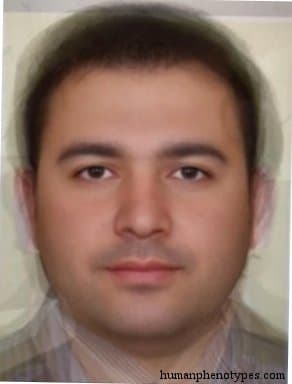
Composite source: Human Phenotypes — East Alpinid
Geographic Distribution
The reference center for East Alpinid sits near 39.7° N, 44.7° E in Middle East. Around that anchor, prevalence falls off gradually — the type is not confined to one valley or one modern border, and the historical map should be read as a gradient rather than a boundary.
Physical Characteristics
Light brown skin, straight or wavy, light brown to black hair.
- Medium height to rather tall, mesoskelic, endomorph
- Brachycephalic, ortho- hypsicranic
- Face is round, nose leptorrhine with a roundish tip, Mouth rather thin
- The skin is slightly darker than in their European counterparts, the height slightly taller
Historical Background
West Asian type that is anthropometrically and morphologically very similar to European Alpinids. Most common in the mountain zones of Anatolia, to Northern Syria and Iraq. Also found in West Iran, Caucasus, Palestine, and Lebanon. Extends in lower frequencies up to Tajikistan, across Arabia and to Southwestern Europe. The type can easily be confused with similar looking Turanid-admixed individuals.
Research History & Naming
Every label in the historical catalogue has an author and a date, and East Alpinid has accumulated its share of competing attributions. For East Alpinid, the literature extract below shows the naming chain — from the first definition through the later revisions that shaped the current entry.
The term East Alpinid was originally used by Senyürek (1950) to describe Anatolian Alpinids. It was later adopted by Eickstedt (1961) . Coon (1939) called them Asiatic Alpines. Field ( 1939 , 1946 ) describes the type from Iran and Iraq and calls it Proto Alpine, Gloor (1951) finds it in Palestine. Lundman (1967) uses East Alpinid synonymous with Gorid, a different variety.
Comparison With Nearby Phenotypes
The five phenotypes whose documented centers lie closest to East Alpinid, ranked by great-circle distance. They are the types players most often confuse with East Alpinid in the quiz, precisely because their distributions overlap.
| Phenotype | Region | Distance | Distinguishing trait |
|---|---|---|---|
| Armenid | Caucasus | 171 km | Light brown skin, wavy, dark brown hair. |
| Mtebid | Caucasus | 310 km | Light brown skin, straight or wavy, usually brown hair. |
| Assyroid | Middle East | 711 km | Light brown, sometimes fair skin, straight or wavy, usually dark brown, sometimes blonde curly-wavy hair. |
| Anatolid | Middle East | 1,008 km | Light brown skin, wavy, dark brown hair. |
| Eurafricanid | Southern Europe | 1,119 km | Light brown skin, straight to curly, usually dark brown hair. |
East Alpinid in the Game
East Alpinid is one of the faces that can appear in Classic Daily and Challenge Mode. When it does, the winning pin lands near 39.7° N, 44.7° E in Middle East — and because the scoring decays with distance, recognizing the region matters more than pixel-perfect placement.
East Alpinid Phenotype FAQ
- Where does the East Alpinid phenotype come from?
- Historical sources center the East Alpinid phenotype on 39.7° N, 44.7° E (Middle East). Treat that as a rough anchor: the type appeared across a wider surrounding area — its nearest documented neighbors, Armenid and Mtebid, sit 171 and 310 km from the reference point — and its present-day distribution no longer matches the historical map.
- What does the East Alpinid phenotype look like?
- The composite emphasizes recurring traits: light brown skin, straight or wavy, light brown to black hair. The full trait list for East Alpinid appears in the physical characteristics section above.
- Is the East Alpinid phenotype a race or a nationality?
- No — and the East Alpinid naming history above shows why. East Alpinid was defined, renamed, and regrouped repeatedly by different researchers, which is the opposite of how a fixed racial category would behave. A phenotype is a recurring bundle of visible traits recorded across a population; the East Alpinid label says nothing about where any individual's ancestors were born.
- How does East Alpinid appear in the game?
- When the East Alpinid face comes up in Classic Daily or Challenge Mode, you pin the world map where you believe the type is historically most common, and the score decays with your distance to 39.7° N, 44.7° E. Fair warning: the nearest other entry in our dataset, Armenid, sits just 171 km away, so this face rewards precise placement — the right country alone is not always enough.
References & Literature
Primary sources for the East Alpinid entry, listed as cited in the historical literature. The naming and classification debates around East Alpinid referenced above run through these works.
- Schwidetzky, I. 1950. Turaniden-Studien. Verl. d. Akademie d. Wissenschaften u.d. Literatur.
- Eickstedt, E. von. 1961. Türken, Kurden und Iraner seit dem Altertum: Probleme einer anthropologischen Reise. Gustav Fischer Verlag, Stuttgart.
- Coon, C.S.. 1939.. The Races of Europe. The Macmillan Company. New York.
- Field, H. 1939. Contributions to the anthropology of Iran. Field Museum of National History, 29(1).
- F46
- Gloor, P. A. 1950/52. Recherches anthropologiques en Palestine méridonale. Arch. Suiss. Anthrop. Gén. 15, 107-142, 17, 1-17.
- Lundman, B. 1967. Geographische Anthropologie. Rassen und Völker der Erde. G. Fischer, Stuttgart
Related Phenotypes
Other human phenotypes whose documented centers lie in the same part of the map as East Alpinid.
Armenid
Caucasus · 171 km away
Widespread type, found in its most specialised form in the mountains of Asia Minor. Associated with the ancient Cypriots and the Hittite Kin...
Mtebid
Caucasus · 310 km away
Regional type of the Caucasus Mountains. Probably an Alpinised Dinaro-Armenid adapted to life in mountainous regions. Mtebids are typical of...
Assyroid
Middle East · 711 km away
Semitic type that unites Armenoid with Arabid features. Historically important in the ancient Hittite Kingdom and the Assyrian civilisation....
Anatolid
Middle East · 1,008 km away
Armenid subtype of Anatolia with Dinaroid features. The core population lives in West Anatolia. Probably the result of Armenid influx into a...
Eurafricanid
Southern Europe · 1,119 km away
Atlanto Mediterranid proper type. Relatively old, present in early Natufians and European as well as North African megalith builders. Spread...
Further Reading
Background articles from the blog that explain where the East Alpinid type fits, how these composites are built, and what a face can and cannot tell you.
Ethnicity Guesser Tools: Three Methods, Three Answers
One search term covers three unrelated tools: genetic ancestry estimation, photo classifiers, and documented phenotype catalogues.
Can You Really Guess Ethnicity From a Face? What the Research Says
Humans beat chance at coarse region-guessing from faces - but fall apart at anything finer. The other-race effect, confusable neighbors...