Anatolid Phenotype - Face Features & Origin
Armenid subtype of Anatolia with Dinaroid features. Its reference coordinates sit near 39.9° N, 32.9° E in Middle East. Rather than a single portrait, the Anatolid composite below is a statistical average, and the surrounding sections — traits, distribution, research history, references — give that average its context.
Average Face
What you see below is a statistical construction of the Anatolid reference population. Faces recorded from the Anatolid sample were overlaid and merged; the result keeps the features most members shared and discards personal variation. It reads like a Anatolid portrait, but it works like a histogram.
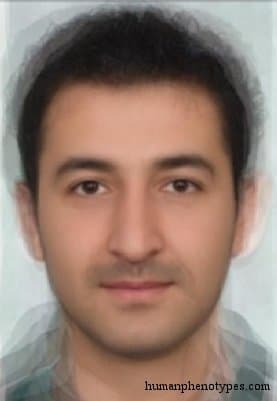
Composite source: Human Phenotypes — Anatolid
Geographic Distribution
Geographically, Anatolid anchors to 39.9° N, 32.9° E (Middle East). That is the point where historical anthropologists judged Anatolid most concentrated, not a hard edge; modern migration and intermarriage have long since softened whatever boundaries once existed.
Physical Characteristics
Light brown skin, wavy, dark brown hair.
- Medium height, mesoskelic, ectomorph to endomorph
- Brachycephalic and hypsicranic
- Facial features and body proportions are finer than in Dinarids and Armenids
- The (hyper)leptorrhine nose is not fleshy, but hooked, the occiput is mildly flattened
- Eyebrows and body hair usually heavy
Historical Background
Armenid subtype of Anatolia with Dinaroid features. The core population lives in West Anatolia. Probably the result of Armenid influx into a Mediterranid population. Anatolids are the dominant element in Turkey today, but may also be found among Alawites, Lebanese, Greeks, in the Balkans, Crimea, among Caucasians, and sometimes even Iran.
Research History & Naming
Typological names were coined, contested, and renamed repeatedly across the 20th century, and Anatolid is no exception. The extract below records the researchers who defined Anatolid, the alternative labels it accumulated, and where the modern consensus settled.
Originally integrated in Armenid ( Luschan, 1889 , Eickstedt, 1934 ). During his travelings in Anatolia, Eickstedt (1961) split the type off from Armenid in accordance with Biasutti (1941, 1967) . The type was kept by later authors ( Bernhard, 1993 , Knussmann, 1996 ). An eastern variety of Coon's (1939) Dinaricised Mediterranean.
Comparison With Nearby Phenotypes
The five phenotypes whose documented centers lie closest to Anatolid, ranked by great-circle distance. They are the types players most often confuse with Anatolid in the quiz, precisely because their distributions overlap.
| Phenotype | Region | Distance | Distinguishing trait |
|---|---|---|---|
| Litorid | Middle East | 425 km | Light brown skin. |
| Pontid | Southern Europe | 685 km | Light brown skin, straight or wavy, brown to black hair, pigmentation sometimes somewhat lighter than in other Mediterranids. |
| Eurafricanid | Southern Europe | 827 km | Light brown skin, straight to curly, usually dark brown hair. |
| Armenid | Caucasus | 838 km | Light brown skin, wavy, dark brown hair. |
| Gracile Mediterranid | Southern Europe | 878 km | Light brown skin, straight to wavy, rarely curly, usually abundant brown to brown-black hair. |
Anatolid in the Game
Anatolid is one of the faces that can appear in Classic Daily and Challenge Mode. When it does, the winning pin lands near 39.9° N, 32.9° E in Middle East — and because the scoring decays with distance, recognizing the region matters more than pixel-perfect placement.
Anatolid Phenotype FAQ
- Where does the Anatolid phenotype come from?
- The reference coordinates for the Anatolid phenotype sit near 39.9° N, 32.9° E, in Middle East. That point marks the center of the Middle East distribution documented roughly 1500 years ago — actual prevalence spread well beyond it, toward entries such as Litorid 425 km away, and modern migration has blurred those boundaries further.
- What does the Anatolid phenotype look like?
- In the historical literature, light brown skin, wavy, dark brown hair. For Anatolid these are statistical tendencies across a population, not a checklist every individual matches.
- Is the Anatolid phenotype a race or a nationality?
- No. Phenotypes like Anatolid are descriptive averages, not ancestry groups. Anatolid is one of several types documented in and around Middle East — see the comparison table above — and the same individual can carry traits associated with several of them at once. The Anatolid entry describes a statistical pattern, not a group of people and not a nationality.
- How does Anatolid appear in the game?
- In Classic Daily and Challenge Mode, the Anatolid composite face appears without a label. Your task is to drop a pin on the world map where you think that face is historically most common — the scoring uses the distance between your pin and the reference coordinates near 39.9° N, 32.9° E. The post-round review then shows the correct location, your distance error, and this Anatolid entry.
References & Literature
Every claim on this page traces back to the sources below — the researchers who defined, measured, and argued over the Anatolid type. The originals behind the Anatolid entry are worth consulting directly.
- Petersen, E. and F v. Luschan. 1889. Reisen in Lykien. Milyas und Kibyratis. Wien.
- Eickstedt, E. von. 1934. Rassenkunde und Rassengeschichte der Menschheit. Ferdinand Enke. Stuttgart.
- Eickstedt, E. von. 1961. Türken, Kurden und Iraner seit dem Altertum: Probleme einer anthropologischen Reise. Gustav Fischer Verlag, Stuttgart.
- E67
- Bernhard, W. 1993. Anthropologie von Südwestasien. In.: Schwidetzky, I.: Rassengeschichte der Menschheit 14, Asien 4. Oldenbourg.
- Knussmann, R. 1996. Vergleichende Biologie des Menschen: Lehrbuch der Anthropologie und Humangenetik. 2ed. Spektrum Akademischer Verlag.
- Coon, C.S.. 1939.. The Races of Europe. The Macmillan Company. New York.
Related Phenotypes
More entries from the same region of the historical map as Anatolid, each with its own composite and trait profile.
Litorid
Middle East · 425 km away
Type of coastal European regions that contains Mediterranid and Dinaro-Armenid elements. Probably the result of ancient migrations from Asia...
Pontid
Southern Europe · 685 km away
East Mediterranid type, sometimes associated with ancient Scythians, Kurgans, and other steppe peoples. Common in the Balkans, especially Bu...
Eurafricanid
Southern Europe · 827 km away
Atlanto Mediterranid proper type. Relatively old, present in early Natufians and European as well as North African megalith builders. Spread...
Armenid
Caucasus · 838 km away
Widespread type, found in its most specialised form in the mountains of Asia Minor. Associated with the ancient Cypriots and the Hittite Kin...
Gracile Mediterranid
Southern Europe · 878 km away
Mediterranid proper, smaller than other Mediterranids: the most gracile type of Europe. Appears first in Mesolithic groups of Palestine (Nat...
Further Reading
Background articles from the blog that explain where the Anatolid type fits, how these composites are built, and what a face can and cannot tell you.
Can You Really Guess Ethnicity From a Face? What the Research Says
Humans beat chance at coarse region-guessing from faces - but fall apart at anything finer. The other-race effect, confusable neighbors...
Ethnicity Guesser AI: Two Model Families, Two Kinds of Error
Tools sold under the same name behave nothing alike. One prints a label from a fixed list; the other writes a sentence.