Dinaric Phenotype: The Type Named After a Mountain Range
The Dinaric entry was assembled from caliper measurements taken across upland southeastern Europe, and it describes proportions in a sample, not a people.
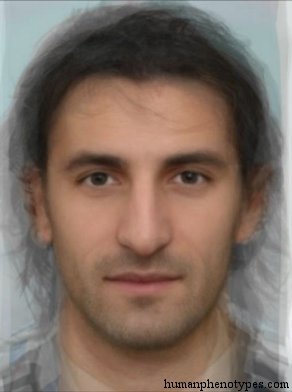
The name came from a range, not a people
The Dinaric Alps run roughly 645 kilometres along the eastern shore of the Adriatic, from Slovenia through Croatia, Bosnia and Herzegovina and Montenegro into northern Albania, where Maja Jezercë reaches 2,694 metres. The catalogue places its Dinarid entry at 43.8 degrees north, 17.1 degrees east, close to the middle of that arc. The label is geographical because the type was never a people. Biasutti's synthesis, first published in 1941 and revised through 1967, lists it among the standard European types, and Coon's The Races of Europe, published in 1939, treats it at length. Both inherited a name fixed around 1900, when Deniker's survey of European races carried a Dinaric entry beside Nordic and Alpine ones.
What the entry describes is a set of measurements taken on samples. The catalogue's text gives light brown skin, wavy or sometimes straight dark brown hair, brown eyes, tall stature, a mesomorphic build with short arms, and a head that is brachycephalic to hyperbrachycephalic, high-vaulted, with a flattened occiput and a prominent, long, convex nose. Those are the traits the observers recorded, in the vocabulary available to them. The samples came from Serbs, Croats, Montenegrins and Bosniaks in the Dinaric region, and from Tyroleans, Bavarians and Austrians further north. The entry claims nothing about those people as persons. It describes the shape of a sample.
What the entry measures, and with what
Two indices carry most of the description. The cephalic index, introduced by Anders Retzius in the 1840s, divides head breadth by head length and multiplies by a hundred. Under the usual bands, a value below 75 is dolichocephalic, 75 to 80 mesocephalic, 80 to 85 brachycephalic, and above 85 hyperbrachycephalic; the Dinarid entry sits in the last band. The nasal index divides nasal breadth by height, and Topinard's scale calls anything under 70 leptorrhine. A hyperbrachycephalic head with a leptorrhine, convex nose is the combination the entry describes, and it is a combination rather than a single trait.
The third element is the occiput, and it is the one that made the type recognisable at a distance. A flattened back of the head, planoccipital in the older terminology, together with a high vault, hypsicranic in Eickstedt's vocabulary, produces a profile that looks almost vertically cut behind the crown. Such features were measurable because instruments and landmarks had been standardised: the Frankfurt agreement of 1882 fixed which points on the skull the calipers should touch, so that a measurement taken in Vienna could be compared with one taken in Zagreb. Without that convention there is no type, only impressions.
The four neighbours that share the profile
No entry stands alone, and the Dinarid one is defined partly against its neighbours. The Norid, named after the Roman province of Noricum in what is now Austria, is the same build with lighter pigmentation: pale to fair skin, ash-blonde or occasionally red hair, blue or grey eyes, and a brachycephalic head that is only mildly high-vaulted. Montandon described it in 1933, and the catalogue follows later authors in reading it as a Nordid element folded into an East Europid base. The difference between the two entries is pigment and vault height, not the architecture of the face.
To the southeast the comparison changes. The Armenid entry, documented from Asia Minor and the Hittite heartland, is hyperbrachycephalic and endomorphic, with broad shoulders and a nose the sources call long, convex and fleshy; Hooton's 1946 textbook and Bernhard's 1993 survey of southwest Asian anthropology both work from that description. The Anatolid is an Armenid subtype with Dinaroid features, concentrated in western Anatolia and probably the product of Armenid movement into a Mediterranid population, a reading that goes back to Petersen and von Luschan's 1889 travels in Lycia. Pontid, by contrast, is mesocephalic, which makes it the useful control: same region, different vault.
Where the samples were taken
The distribution list in the entry is long: the eastern Alps and especially Tyrol, the Carpathians, southern Germany, Austria, Albania, western Ukraine, with extensions into France, western Greece, the Bulgarian mountains and Italy. Read as biology, that is a claim about a belt of upland Europe. Read as a record of fieldwork, it is also a map of where anthropologists went. Škerlj's 1936 study of Yugoslav regional variation, published in Geografski vestnik, drew on subjects reachable from university cities, and Coon's 1939 synthesis reorganised material gathered by others across two generations.
That asymmetry has consequences for how the entry should be read. Regions with dense measuring programmes, such as Bavaria, Bohemia or the Austrian Alps, produced fine-grained descriptions; regions without them produced either a coarse entry or none at all. The catalogue's 209 entries are therefore uneven in resolution, and the unevenness tracks institutions rather than biology. An entry's silence about a place is not evidence that no pattern existed there. It is evidence that nobody set up a table, a lamp and a set of calipers.
The mountain pattern and the brachycephalization debate
Both mountain types in the European section, Alpinid and Dinarid, were recorded in upland regions, and the correlation held in the samples. Its cause remains unresolved. Cephalic indices measured in European cemetery series rise from the medieval period into the twentieth century, a trend usually called brachycephalization. Eickstedt, in his 1952 essay on the biodynamics of European types, treated it as evidence of successive waves of round-headed populations spreading from upland refuges. Others have argued for selection, for changed childhood nutrition, or for the simple effect of populations moving and mixing. The literature has never settled the question.
Franz Boas had already undercut the simplest reading in 1912, when his report to the United States Immigration Commission compared the head forms of immigrants with those of their American-born children. The measurements, taken on more than seventeen thousand people, showed the index shifting within a single generation. A cranial index is not a fixed inheritance; it responds to conditions during growth. That finding does not abolish the Dinaric entry, but it removes the interpretation that made the entry sound like a permanent marker of descent.
What the twentieth century did to the distribution
The catalogue's baseline sits roughly 1500 years ago, and a great deal has happened to the region since. Recruitment agreements brought Yugoslav workers to West Germany from 1968, and industrialisation pulled much of the upland population into cities. Then the wars of the 1990s displaced more than two million people within the former Yugoslavia, moving populations across exactly the boundaries the entry lists. A type recorded from mountain villages in 1930 describes people who, in large numbers, no longer live in those villages.
None of this makes the entry wrong; it makes it dated, which the entry already concedes. The description is of a sample at a coordinate and a period, and the period is the point. Reading it as a statement about the Balkans now, or about any person walking through them, mistakes a historical record for a current census. The honest use of the Dinarid entry is narrow and useful: it gives a name to a documented pattern of proportions, and it locates that pattern in a range that can still be visited.
Frequently Asked Questions
- Is the Dinaric phenotype the same as a nationality?
- No. The entry is named after a mountain range and describes a set of proportions recorded in samples from upland southeastern Europe and the eastern Alps. Nationality is a legal and political status, and the people measured for the entry belonged to several states that did not exist in their present form when the measurements were taken. The catalogue uses the label to organise historical descriptions, not to assign anyone to a country, an ancestry or a group.
- Why does the entry say the back of the head is flat?
- Because a flattened occiput, planoccipital in the older vocabulary, was one of the features observers used to separate this type from neighbouring ones. Combined with a high, hyperbrachycephalic vault, it produces a profile that looks abruptly cut behind the crown. The observation is a description of skull shape in a measured sample, taken with calipers at standardised points fixed by the 1882 Frankfurt agreement. It does not predict the shape of any particular living person's head.
- Where does the name Dinaric come from?
- From the Dinaric Alps, the range that runs about 645 kilometres along the Adriatic coast from Slovenia into northern Albania. The type name was fixed around 1900, when Deniker's survey of European races listed a Dinaric entry alongside Nordic and Alpine ones. Biasutti's synthesis of 1941 and Coon's The Races of Europe of 1939 carried the label into the standard literature this catalogue draws on. The geography came first; the people were named afterwards.
Related Phenotypes
Faces from the encyclopedia that appear in this article. Open any entry for its full description, distribution, and references.
Dinarid (proper)
Southeastern Europe
Central European type typical for mountain and forest regions. Presents the counterpart of Alpinids. The name derives from the Dinaric Alps ...
Norid
Southeastern Europe
Central European type that closely resembles Dinarids except for lighter pigmentation. Authors interpret this to be the result of Nordid and...
Armenid
Caucasus
Widespread type, found in its most specialised form in the mountains of Asia Minor. Associated with the ancient Cypriots and the Hittite Kin...
Anatolid
Middle East
Armenid subtype of Anatolia with Dinaroid features. The core population lives in West Anatolia. Probably the result of Armenid influx into a...
Test what you learned
Put your eye for regional faces to work in the daily quiz — a composite face, a world map, and your best guess.