Dinarid (proper) Phenotype - Face Features & Origin
Central European type typical for mountain and forest regions. The entry below collects the Dinarid (proper) composite face, its documented distribution around 43.8° N, 17.1° E in Southeastern Europe, its physical characteristics, the research history behind the name, and the academic references that support all of it.
Average Face
The Dinarid (proper) composite below is not a photograph of a real person. Historical anthropologists aligned multiple individual portraits from the Dinarid (proper) reference population and averaged them into one image, so recurring structures — skull outline, nose form, lip thickness, brow position — dominate while individual idiosyncrasies cancel out.
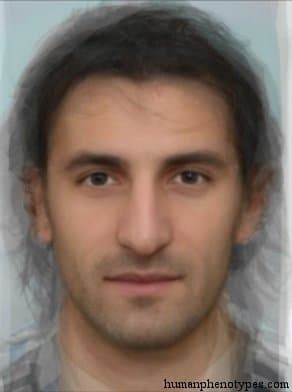
Composite source: Human Phenotypes — Dinarid (proper)
Geographic Distribution
The reference center for Dinarid (proper) sits near 43.8° N, 17.1° E in Southeastern Europe. Around that anchor, prevalence falls off gradually — the type is not confined to one valley or one modern border, and the historical map should be read as a gradient rather than a boundary.
Physical Characteristics
Light brown skin.
- Wavy, sometimes straight, dark brown hair and brown eyes
- Tall, meso- sometimes brachyskelic, mesomorph with short arms
- (Hyper-)brachycephalic, hypsicranic with a flat occiput
- The nose is prominent, long, convex and hyperleptorrhine
- Face long with bony and coarse features
- Chin strong, but round, lips rather thin, hair abundant
- Forehead broad, sloping, and high
Historical Background
Central European type typical for mountain and forest regions. Presents the counterpart of Alpinids. The name derives from the Dinaric Alps in former Yugoslavia, where the type is commonly found among Serbs, Croats, Montenegrins, Bosniaks, and their relatives. Also typical for the Eastern Alps (esp. Tyrol), Carpathians, South Germany, Austria, Albania, West Ukraine. Extends to France, Western Greece, Bulgarian mountains, Italy, and other regions of Europe.
Research History & Naming
Every label in the historical catalogue has an author and a date, and Dinarid (proper) has accumulated its share of competing attributions. For Dinarid (proper), the literature extract below shows the naming chain — from the first definition through the later revisions that shaped the current entry.
First described by Deniker (1900) as Adriatic. Biasutti (1967) regarded Dinarid an Adriatic subtype. The type appears in most systems ( Škerlj, 1936 ; Coon, 1939 ; Eickstedt, 1952 ; Biasutti, 1967 ; Lundman, 1988 ; Knussmann, 1996 ; Vondernach, 2008 ). Škerlj's (1936) Savids may be regarded as a light-eyed variety.
Comparison With Nearby Phenotypes
Ranked by great-circle distance from Dinarid (proper)'s reference center, these are the five nearest documented phenotypes — the closest being Alföld at 407 km. Overlapping distributions like these are exactly what makes the quiz hard, and the Alföld row is where to start looking.
| Phenotype | Region | Distance | Distinguishing trait |
|---|---|---|---|
| Alföld | Central Europe | 407 km | Fair to light reddish-brown skin with straight brown or black hair and yellowish-brown eyes. |
| Norid | Southeastern Europe | 413 km | Pale to fair skin. |
| Hallstatt | Central Europe | 494 km | Pinkish pale skin. |
| Carpathid | Eastern Europe | 668 km | Pale to light brown skin, straight or wavy, often brown hair and dark-mixed eyes. |
| Gorid | Central Europe | 671 km | Fair to light brown skin, straight to wavy brown, sometimes blonde hair. |
Dinarid (proper) in the Game
When the Dinarid (proper) composite shows up in the quiz, players who know the Southeastern Europe distribution pattern have the edge. The reference answer sits near 43.8° N, 17.1° E; pins on the wrong continent score close to zero, so even a rough regional instinct beats a precise but misdirected pin.
Dinarid (proper) Phenotype FAQ
- Where does the Dinarid (proper) phenotype come from?
- The reference coordinates for the Dinarid (proper) phenotype sit near 43.8° N, 17.1° E, in Southeastern Europe. That point marks the center of the Southeastern Europe distribution documented roughly 1500 years ago — actual prevalence spread well beyond it, toward entries such as Alföld 407 km away, and modern migration has blurred those boundaries further.
- What does the Dinarid (proper) phenotype look like?
- In the historical literature, light brown skin. For Dinarid (proper) these are statistical tendencies across a population, not a checklist every individual matches.
- Is the Dinarid (proper) phenotype a race or a nationality?
- No. Phenotypes like Dinarid (proper) are descriptive averages, not ancestry groups. Dinarid (proper) is one of several types documented in and around Southeastern Europe — see the comparison table above — and the same individual can carry traits associated with several of them at once. The Dinarid (proper) entry describes a statistical pattern, not a group of people and not a nationality.
- How does Dinarid (proper) appear in the game?
- In Classic Daily and Challenge Mode, the Dinarid (proper) composite face appears without a label. Your task is to drop a pin on the world map where you think that face is historically most common — the scoring uses the distance between your pin and the reference coordinates near 43.8° N, 17.1° E. The post-round review then shows the correct location, your distance error, and this Dinarid (proper) entry.
References & Literature
Primary sources for the Dinarid (proper) entry, listed as cited in the historical literature. The naming and classification debates around Dinarid (proper) referenced above run through these works.
- D00
- Biasutti, R. 1967 (1941). Le Razze e i Popoli della terra. 4th Ed. Vol 1-4. U.T.E.T., Torino.
- Škerlj, B. 1936. Rasna slika Jugoslavije. Geografski vestnik: casopis za geografijo in sorodne vede 12-13. 156-169.
- Coon, C.S.. 1939.. The Races of Europe. The Macmillan Company. New York.
- Eickstedt, E. von. 1952. Biodynamik der Europiden. In: Historia Mundi. Band 1, Munich, 115-134.
- Lundman, B. 1988. Jordens folkstammar. Huddinge.
- Knussmann, R. 1996. Vergleichende Biologie des Menschen: Lehrbuch der Anthropologie und Humangenetik. 2ed. Spektrum Akademischer Verlag.
- Vonderach, A. 2008. Anthropologie Europas. Völker, Typen und Gene vom Neandertaler bis zur Gegenwart. Ares Verlag. Graz.
Related Phenotypes
More entries from the same region of the historical map as Dinarid (proper), each with its own composite and trait profile.
Alföld
Central Europe · 407 km away
Western Turanid subtype, named after the Alföld (Great Hungarian Plain). It developed when Huns and Magyars entered the area during the earl...
Norid
Southeastern Europe · 413 km away
Central European type that closely resembles Dinarids except for lighter pigmentation. Authors interpret this to be the result of Nordid and...
Hallstatt
Central Europe · 494 km away
Nordid proper, resembles the Iron Age remains of the Austrian village of Hallstatt. Most common among Swedes and South Norwegians. Frequent ...
Carpathid
Eastern Europe · 668 km away
European type with Gorid and Dinaro-Armenid elements. Common around the Carpathian Mountains of Central Eastern Europe, e.g. in Huzulis and ...
Gorid
Central Europe · 671 km away
East Alpinid variety, named after the Polish word for mountain (Gora). Metrically intermediate between West Alpinid and East Europid. The nu...
Further Reading
Background articles from the blog that explain where the Dinarid (proper) type fits, how these composites are built, and what a face can and cannot tell you.
What Country Do I Look Like: The Count Comes Before the Face
Which country a face resembles depends on which official list you are using, and the world publishes several that disagree on how many...
What Nationality Do I Look Like? A Legal Status, Not a Face
Nationality is a status that states assign and reassign. A face can resemble a documented regional pattern; it cannot resemble a...