Alföld Phenotype - Face Features & Origin
Western Turanid subtype, named after the Alföld (Great Hungarian Plain). Its reference coordinates sit near 46.8° N, 20.1° E in Central Europe. Rather than a single portrait, the Alföld composite below is a statistical average, and the surrounding sections — traits, distribution, research history, references — give that average its context.
Average Face
What you see below is a statistical construction of the Alföld reference population. Faces recorded from the Alföld sample were overlaid and merged; the result keeps the features most members shared and discards personal variation. It reads like a Alföld portrait, but it works like a histogram.
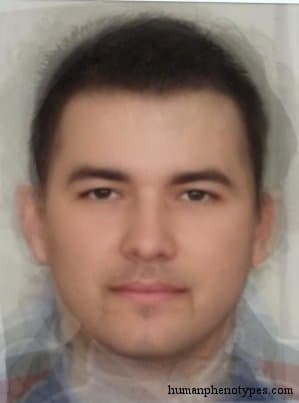
Composite source: Human Phenotypes — Alföld
Geographic Distribution
The reference center for Alföld sits near 46.8° N, 20.1° E in Central Europe. Around that anchor, prevalence falls off gradually — the type is not confined to one valley or one modern border, and the historical map should be read as a gradient rather than a boundary.
Physical Characteristics
Fair to light reddish-brown skin with straight brown or black hair and yellowish-brown eyes.
- Medium height, macro- mesoskelic, endo- to ectomorph
- Brachycephalic, orthocranic with a relatively large head
- Large, angular skulls and a leptorrhine nose
- Face not very flat, facial lines soft, but determined
- Eyes mildly slanting
Historical Background
Western Turanid subtype, named after the Alföld (Great Hungarian Plain). It developed when Huns and Magyars entered the area during the early Middle Ages and caused a blending of several regional types. Most common in Hungary, especially the Alföld plain and Transdanubia. In lower frequencies it extends across the Balkans and to Ukraine, even Northern Greece.
Research History & Naming
Every label in the historical catalogue has an author and a date, and Alföld has accumulated its share of competing attributions. For Alföld, the literature extract below shows the naming chain — from the first definition through the later revisions that shaped the current entry.
The type was mainly described by Hungarian authors (Bartucz, 1935 , 1938 ; Kiszely, 1979 ; Botos, 1999 ). Others ( Eickstedt, 1952 ; Lundman, 1943 ; Biasutti, 1967 ) explained it by Turanid/Aralid influence. Vondernach (2008) suggests it to be the blend of indigenous Europeans and Mongoloid migrants from Asia.
Comparison With Nearby Phenotypes
The five phenotypes whose documented centers lie closest to Alföld, ranked by great-circle distance. They are the types players most often confuse with Alföld in the quiz, precisely because their distributions overlap.
| Phenotype | Region | Distance | Distinguishing trait |
|---|---|---|---|
| Gorid | Central Europe | 305 km | Fair to light brown skin, straight to wavy brown, sometimes blonde hair. |
| Carpathid | Eastern Europe | 334 km | Pale to light brown skin, straight or wavy, often brown hair and dark-mixed eyes. |
| Dinarid (proper) | Southeastern Europe | 407 km | Light brown skin. |
| Norid | Southeastern Europe | 481 km | Pale to fair skin. |
| Hallstatt | Central Europe | 503 km | Pinkish pale skin. |
Alföld in the Game
Alföld is one of the faces that can appear in Classic Daily and Challenge Mode. When it does, the winning pin lands near 46.8° N, 20.1° E in Central Europe — and because the scoring decays with distance, recognizing the region matters more than pixel-perfect placement.
Alföld Phenotype FAQ
- Where does the Alföld phenotype come from?
- Historical sources center the Alföld phenotype on 46.8° N, 20.1° E (Central Europe). Treat that as a rough anchor: the type appeared across a wider surrounding area — its nearest documented neighbors, Gorid and Carpathid, sit 305 and 334 km from the reference point — and its present-day distribution no longer matches the historical map.
- What does the Alföld phenotype look like?
- The composite emphasizes recurring traits: fair to light reddish-brown skin with straight brown or black hair and yellowish-brown eyes. The full trait list for Alföld appears in the physical characteristics section above.
- Is the Alföld phenotype a race or a nationality?
- No — and the Alföld naming history above shows why. Alföld was defined, renamed, and regrouped repeatedly by different researchers, which is the opposite of how a fixed racial category would behave. A phenotype is a recurring bundle of visible traits recorded across a population; the Alföld label says nothing about where any individual's ancestors were born.
- How does Alföld appear in the game?
- When the Alföld face comes up in Classic Daily or Challenge Mode, you pin the world map where you believe the type is historically most common, and the score decays with your distance to 46.8° N, 20.1° E. Fair warning: the nearest other entry in our dataset, Gorid, sits just 305 km away, so this face rewards precise placement — the right country alone is not always enough.
References & Literature
Primary sources for the Alföld entry, listed as cited in the historical literature. The naming and classification debates around Alföld referenced above run through these works.
- Bartucz, L. 1935. Ein Abriß der Rassengeschichte in Ungarn. Zeitschrift für Rassenkunde, Band 1, 225-240.
- Bartucz, L. 1938. A Magyar Ember. Budapest.
- Kiszely, I. 1979-2006. A föld népei. Vol. 1-6. Gondolat K. / Püski. Budapest.
- Botos, L. 1999. The road to the dictated peace. Árpád Publishing Company, Cleveland, Ohio.
- Eickstedt, E. von. 1952. Biodynamik der Europiden. In: Historia Mundi. Band 1, Munich, 115-134.
- Lundman, B. 1943. Jordens Människoraser och Folkstammar. Nybloms Förlag, Uppsala.
- Biasutti, R. 1967 (1941). Le Razze e i Popoli della terra. 4th Ed. Vol 1-4. U.T.E.T., Torino.
- Vonderach, A. 2008. Anthropologie Europas. Völker, Typen und Gene vom Neandertaler bis zur Gegenwart. Ares Verlag. Graz.
Related Phenotypes
More entries from the same region of the historical map as Alföld, each with its own composite and trait profile.
Gorid
Central Europe · 305 km away
East Alpinid variety, named after the Polish word for mountain (Gora). Metrically intermediate between West Alpinid and East Europid. The nu...
Carpathid
Eastern Europe · 334 km away
European type with Gorid and Dinaro-Armenid elements. Common around the Carpathian Mountains of Central Eastern Europe, e.g. in Huzulis and ...
Dinarid (proper)
Southeastern Europe · 407 km away
Central European type typical for mountain and forest regions. Presents the counterpart of Alpinids. The name derives from the Dinaric Alps ...
Norid
Southeastern Europe · 481 km away
Central European type that closely resembles Dinarids except for lighter pigmentation. Authors interpret this to be the result of Nordid and...
Hallstatt
Central Europe · 503 km away
Nordid proper, resembles the Iron Age remains of the Austrian village of Hallstatt. Most common among Swedes and South Norwegians. Frequent ...
Further Reading
Background articles from the blog that explain where the Alföld type fits, how these composites are built, and what a face can and cannot tell you.
AI Ethnicity Guesser: What the Tools Really Return
An AI ethnicity guesser returns a label from a fixed list rather than a measurement of ancestry. Here is what the models are trained on...
What Nationality Do I Look Like? A Legal Status, Not a Face
Nationality is a status that states assign and reassign. A face can resemble a documented regional pattern; it cannot resemble a...