Hallstatt Phenotype - Face Features & Origin
Historical anthropology places the Hallstatt phenotype in Central Europe, with a documented center near 47.5° N, 13.6° E. Nordid proper, resembles the Iron Age remains of the Austrian village of Hallstatt. The sections that follow unpack the Hallstatt entry in practice: the composite face, the traits it summarizes, the naming history, and the sources.
Average Face
Averaging the portraits behind Hallstatt leaves the features that repeat and erases the ones that do not. That is exactly how the Hallstatt composite below was built: individual photographs were aligned and statistically merged, exaggerating shared structure into a single reference face that no actual person looks like.
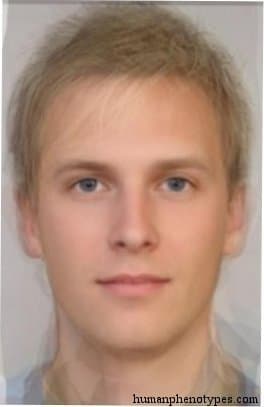
Composite source: Human Phenotypes — Hallstatt
Geographic Distribution
Hallstatt is documented across Central Europe, with its historical reference center near 47.5° N, 13.6° E. The coordinates mark where the type was most characteristic roughly 1500 years ago; population movements since then have scattered and blended the distribution far beyond that point.
Physical Characteristics
Pinkish pale skin.
- Straight to wavy, golden blonde, sometimes red or light brown hair
- (Grey-)blue eyes
- Tall, ectomorph or mildly mesomorph with wide shoulders and narrow hips (even in women), meso- sometimes brachyskelic
- Mesocephalic, dolichocephalic at times, mildly chamaecranic with a curved occiput
- Hyperleptorrhine, straight or mildly convex, high-bridged nose
- Face high and narrow with marked features, mildly sloping forehead, thin lips, sturdy chin
Historical Background
Nordid proper, resembles the Iron Age remains of the Austrian village of Hallstatt. Most common among Swedes and South Norwegians. Frequent in England, Northern Germany, Netherlands, Northern France, Iceland, Northern Poland, along Daugava, Vistula, and Po rivers, sometimes Austria, Switzerland, Northern Italy. Germanic tribes (Goths, Vandals) brought traces to Spain, Greece, North Africa, and Russia.
Research History & Naming
Every label in the historical catalogue has an author and a date, and Hallstatt has accumulated its share of competing attributions. For Hallstatt, the literature extract below shows the naming chain — from the first definition through the later revisions that shaped the current entry.
Coon (1939) separated it from other Nordid varieties as Hallstatt or Østerdal. Kunssmann (1996) , Vondernach (2008) , Eickstedt (1952) named it Teuto Nordid, Lundman (1988) Göta or Skando Nordid, Deniker (1900) and Biasutti (1967) as the Nordic proper type.
Comparison With Nearby Phenotypes
The five phenotypes whose documented centers lie closest to Hallstatt, ranked by great-circle distance. They are the types players most often confuse with Hallstatt in the quiz, precisely because their distributions overlap.
| Phenotype | Region | Distance | Distinguishing trait |
|---|---|---|---|
| Norid | Southeastern Europe | 89 km | Pale to fair skin. |
| West Alpinid | Central Europe | 459 km | Fair to light brown skin, straight or wavy, usually (light) brown hair with a blonde minority. |
| Central Brachid | Central Europe | 464 km | Medium brown skin, straight or wavy hair, rather tall, mesoskelic, endomorph to ectomorph. |
| Dinarid (proper) | Southeastern Europe | 494 km | Light brown skin. |
| Alföld | Central Europe | 503 km | Fair to light reddish-brown skin with straight brown or black hair and yellowish-brown eyes. |
Hallstatt in the Game
Hallstatt is one of the faces that can appear in Classic Daily and Challenge Mode. When it does, the winning pin lands near 47.5° N, 13.6° E in Central Europe — and because the scoring decays with distance, recognizing the region matters more than pixel-perfect placement.
Hallstatt Phenotype FAQ
- Where does the Hallstatt phenotype come from?
- Historical sources center the Hallstatt phenotype on 47.5° N, 13.6° E (Central Europe). Treat that as a rough anchor: the type appeared across a wider surrounding area — its nearest documented neighbors, Norid and West Alpinid, sit 89 and 459 km from the reference point — and its present-day distribution no longer matches the historical map.
- What does the Hallstatt phenotype look like?
- The composite emphasizes recurring traits: pinkish pale skin. The full trait list for Hallstatt appears in the physical characteristics section above.
- Is the Hallstatt phenotype a race or a nationality?
- No — and the Hallstatt naming history above shows why. Hallstatt was defined, renamed, and regrouped repeatedly by different researchers, which is the opposite of how a fixed racial category would behave. A phenotype is a recurring bundle of visible traits recorded across a population; the Hallstatt label says nothing about where any individual's ancestors were born.
- How does Hallstatt appear in the game?
- When the Hallstatt face comes up in Classic Daily or Challenge Mode, you pin the world map where you believe the type is historically most common, and the score decays with your distance to 47.5° N, 13.6° E. Fair warning: the nearest other entry in our dataset, Norid, sits just 89 km away, so this face rewards precise placement — the right country alone is not always enough.
References & Literature
Primary sources for the Hallstatt entry, listed as cited in the historical literature. The naming and classification debates around Hallstatt referenced above run through these works.
- Coon, C.S.. 1939.. The Races of Europe. The Macmillan Company. New York.
- Knussmann, R. 1996. Vergleichende Biologie des Menschen: Lehrbuch der Anthropologie und Humangenetik. 2ed. Spektrum Akademischer Verlag.
- Eickstedt, E. von. 1952. Biodynamik der Europiden. In: Historia Mundi. Band 1, Munich, 115-134.
- Lundman, B. 1967. Geographische Anthropologie. Rassen und Völker der Erde. G. Fischer, Stuttgart
- D00
- Biasutti, R. 1967 (1941). Le Razze e i Popoli della terra. 4th Ed. Vol 1-4. U.T.E.T., Torino.
Related Phenotypes
Other human phenotypes whose documented centers lie in the same part of the map as Hallstatt.
Norid
Southeastern Europe · 89 km away
Central European type that closely resembles Dinarids except for lighter pigmentation. Authors interpret this to be the result of Nordid and...
West Alpinid
Central Europe · 459 km away
Alpinid proper, historically found in the mountain regions of Western Europe. Often a cohabitant of a second mountain type, the Dinarid. The...
Central Brachid
Central Europe · 464 km away
Indo Brachid variety, with a morphological and geographical position between West and East (Indo) Brachids, but possibly resulting from diff...
Dinarid (proper)
Southeastern Europe · 494 km away
Central European type typical for mountain and forest regions. Presents the counterpart of Alpinids. The name derives from the Dinaric Alps ...
Alföld
Central Europe · 503 km away
Western Turanid subtype, named after the Alföld (Great Hungarian Plain). It developed when Huns and Magyars entered the area during the earl...
Further Reading
Background articles from the blog that explain where the Hallstatt type fits, how these composites are built, and what a face can and cannot tell you.
How Average Face Composites Are Made
An average face is not a real face. It is a statistical average of hundreds of aligned photographs - and that is exactly why it is so...
Why Do Northern Europeans Have Light Eyes?
Every blue-eyed person alive today descends from one ancestor who carried a single mutation 6,000-10,000 years ago.