Why Do Scandinavians Have Blonde Hair? A Variant, Not a Kind
Blond hair in Scandinavia traces to a variant far upstream of KITLG, carried north by ancient Siberian ancestry, not made locally. The catalogue records it as a documented trait, not as a marker of anyone alive.
The switch sits far from the gene
Blond hair in northern Europe does not come from a damaged pigment gene. It comes from a dimmer switch attached to a gene that works perfectly well. In 2014 Catherine Guenther and colleagues at Stanford dissected a stretch of DNA more than 350 kilobases upstream of KITLG, the gene encoding KIT ligand, and found a regulatory enhancer that drives expression in the developing hair follicle. A single substitution inside that enhancer, rs12821256, swaps an A for a G and weakens the binding site for the transcription factor LEF1. Less LEF1 binding means less enhancer activity, and less KITLG in the follicle means the melanocytes arriving there deposit less eumelanin. The same paper settled the point experimentally: mice engineered to carry the derived human enhancer variant grew measurably lighter coats than mice carrying the ancestral version.
The effect is real but modest on its own. The derived allele raises the odds of blond over brown hair by roughly 1.9 to 2.4 times per copy, and it explains only a few percent of the variance in categorical hair colour scores. KITLG is also a growth factor with essential roles in blood and germ cell development, which is why a common variant this consequential had to land in a regulatory region instead of inside the coding sequence.
Six regions, not one gene
The 2014 study resolved one locus. The wider map of hair colour had arrived earlier, from a genome-wide association scan run by Patrick Sulem and colleagues at deCODE genetics. They scanned 2,986 Icelanders, took the strongest signals from six genomic regions, and followed those signals into a further 2,718 Icelanders and 1,214 Dutch participants. All six regions reached genome-wide significance. A variant near KITLG tracked hair colour, one in SLC24A4 tracked both hair and eye colour, two coding changes in TYR tracked eye colour and freckling, a region on 6p25.3 tracked freckling, and the last two refined existing signals at OCA2 and MC1R.
Blond is therefore a polygenic outcome, and the KITLG variant is a major contributor rather than the cause. Two further details matter. The derived allele is common in northern Europe and close to absent in African and Asian populations, which is what makes it a marker of a region rather than of a person. And an analysis of recent positive selection in the human genome, published by Williamson and colleagues in 2007, had already placed the KITLG region among the strongest candidates in Europeans, years before anyone traced the enhancer itself.
The allele travelled in from the east
Where the variant came from is now reasonably well documented, and the answer is not Scandinavia. Iain Mathieson and colleagues reported in 2018 that the earliest known individual carrying the derived rs12821256 allele is a young woman buried at Afontova Gora in central Siberia, directly dated to between 16,130 and 15,749 calibrated years BCE. She belonged to the Ancient North Eurasian population, a lineage with no living counterpart. The same study found the allele in eastern hunter-gatherers but not western ones, pointing to an origin in that northern Eurasian population and a route into Europe alongside later steppe ancestry.
That route explains the modern map better than latitude does. Frequencies of light hair fall away from the Baltic in most directions, and the regions where the variant is common today sit along the path that steppe pastoralists and their descendants took across the continent. Blond hair, in other words, is not something the far north manufactured locally. It is something that kept arriving there, carried by people who already had it.
Mesolithic Scandinavia was already light
Scandinavia was among the last parts of Europe to be reoccupied after the ice, and the genomes of its first inhabitants are unusually informative. Torsten Günther and colleagues sequenced seven hunter-gatherers excavated across the peninsula, dated between 9,500 and 6,000 years before present and reaching 57-fold coverage. They found two separate post-glacial migrations, an earlier one from the south and a later one running up the ice-free Norwegian Atlantic coast. Where the two streams met they mixed, and the resulting population carried higher frequencies of low-pigmentation variants than either source population, a pattern the authors read as adaptation to low light.
Pigment prediction applied to the best-preserved individuals makes this concrete without overreaching. Four of the seven yielded usable eye and hair estimates: two carried high probabilities of blue eyes and light-shaded hair, while the others came out darker. That is a small sample drawn from a vast span of time, and the authors were careful about it. What it establishes is timing rather than a clean portrait. Light hair was present in Scandinavia thousands of years before any written source described it, and it varied between individuals from the start.
Why it stayed is still argued
High frequency at high latitude invites a tidy explanation, and the tidy one does not work. Vitamin D is synthesised in skin, not in hair. The pigment inside a hair shaft cannot change how much ultraviolet B a person makes, because the shaft is metabolically inert keratin by the time it leaves the follicle. The environmental argument that fits skin pigmentation therefore does not transfer to hair. Blond hair in the north is more plausibly a byproduct: selection acting on pigmentation genes that skin and hair share, with hair colour following along for the ride.
Two other candidates remain live. Sexual selection, argued most persistently by Peter Frost, holds that in small populations with skewed sex ratios an eye-catching variant can spread through mate choice, and that this is why Europe carries an unusual amount of hair and eye colour diversity for a single region. Drift is the third candidate. Post-glacial populations were small and partly isolated, and small populations can carry a low-frequency allele to surprising heights by chance alone. Most current work treats drift as a helper and mate choice as possible but unproven, and nobody has a decisive answer.
A range, not a category
The phenotype catalogue records hair colour not as an identity but as one line in a trait list attached to a distribution with a named source. Four entries show the range. Hallstatt, separated out by Carleton Coon in 1939 and named after the Iron Age cemetery in Austria, is recorded with golden blonde hair and grey-blue eyes, most common among Swedes and southern Norwegians. Aisto Nordid, named by Lundman in 1943, is described with usually blonde hair and blue or grey eyes, purest today among western Finns and west Estonians, with a Hälsingland subvariety in Sweden.
Borreby takes its name from Neolithic skulls excavated in Denmark and was defined by Coon in 1939; its trait list gives blonde, sometimes red or brown hair, and records the pattern as most common in Denmark, in Jæren in southern Norway and in northern Germany, with a skull described as extraordinarily large. Fenno Nordid, named by Eickstedt in 1934, is recorded with red to white-blonde hair and light eyes, associated with Finno-Ugric populations and today a minority element among eastern Finns, Mordvins, Komi, Mari and Udmurts. Every one of these is a record of what was described, where, and by whom, at roughly a 1,500-year baseline.
Where the map no longer fits
Two things have changed since that baseline. The first is age. Blond hair darkens over time in most people who have it, so the frequency in adults runs lower than the frequency in children, and figures gathered from adults describe something different from what a school photograph suggests. The second is migration. Sweden recorded 2,200,238 residents born abroad in 2024, or 20.8 percent of its population, and among those residents the largest regional shares came from Asia and from Africa rather than from the other Nordic countries.
A catalogue assembled from nineteenth and twentieth century anthropometry, with a baseline of roughly 1,500 years, cannot be a description of a Stockholm street in the present. It does not claim to be. What it can do is state where a pattern was documented, by whom, and with which traits. That is a narrower claim than the question implies, and it is the only claim the evidence supports.
Frequently Asked Questions
- Is blond hair disappearing from Scandinavia?
- No, and the prediction has failed for a century. The derived allele is common in the region and behaves largely additively, so it does not vanish when carriers have children with people who lack it, though its frequency does shift. Migration into Nordic cities dilutes regional frequencies over time. That is a demographic change in a population, not the extinction of a variant, and the two get confused constantly in press coverage.
- Can two dark-haired parents have a blond child?
- Yes, though it takes the right combination. Blond is polygenic, so both parents can each carry one copy of the derived KITLG allele and pass on two copies, one, or none at all, and other loci in the pigmentation network can push a child toward blond or away from it. Because every contributing variant has a modest effect, the outcome in any single family is genuinely uncertain. Blond children born to dark-haired parents are ordinary.
- Does blond hair indicate Scandinavian ancestry?
- No. The same appearance arises from different genetic causes in different places, and the clearest case runs the other way. Eimear Kenny and colleagues reported in 2012 that blond hair in the Solomon Islands comes from a recessive amino acid change in TYRP1, at a frequency of 26 percent there and absent outside Oceania. Appearance is a set of visible traits; ancestry is a genealogical statement. A photograph cannot close the gap between them.
Related Phenotypes
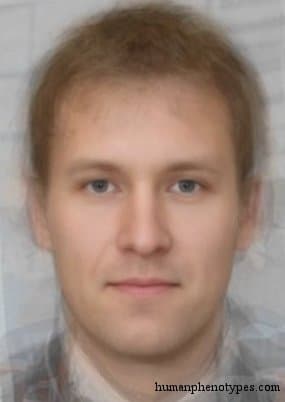
Faces from the encyclopedia that appear in this article. Open any entry for its full description, distribution, and references.
Aisto Nordid
Northern Europe
East Nordid subvariety, common in coastal regions of Baltic countries. One of the last strongholds of East Nordids that are only a minority ...
Hallstatt
Central Europe
Nordid proper, resembles the Iron Age remains of the Austrian village of Hallstatt. Most common among Swedes and South Norwegians. Frequent ...
Borreby
Central Europe
Ancient Northern European variety. Named after some of the Neolithic Borreby skulls of Denmark (not all!). Some emphasised resemblance with ...
Fenno Nordid
Northern Europe
Ancient type of Northeastern Europe, sometimes placed in Nordid, sometimes East Baltid. Associated with Finno-Ugric people, once widespread ...
Test what you learned
Put your eye for regional faces to work in the daily quiz — a composite face, a world map, and your best guess.