Aisto Nordid Phenotype - Face Features & Origin
East Nordid subvariety, common in coastal regions of Baltic countries. The entry below collects the Aisto Nordid composite face, its documented distribution around 58.8° N, 25.3° E in Northern Europe, its physical characteristics, the research history behind the name, and the academic references that support all of it.
Average Face
The Aisto Nordid composite below is not a photograph of a real person. Historical anthropologists aligned multiple individual portraits from the Aisto Nordid reference population and averaged them into one image, so recurring structures — skull outline, nose form, lip thickness, brow position — dominate while individual idiosyncrasies cancel out.
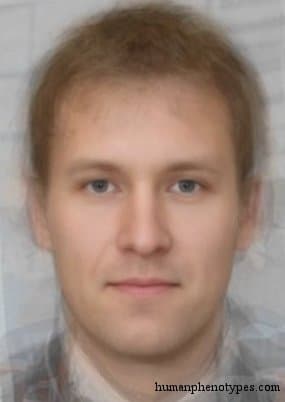
Composite source: Human Phenotypes — Aisto Nordid
Geographic Distribution
The reference center for Aisto Nordid sits near 58.8° N, 25.3° E in Northern Europe. Around that anchor, prevalence falls off gradually — the type is not confined to one valley or one modern border, and the historical map should be read as a gradient rather than a boundary.
Physical Characteristics
Pale skin, straight, usually blonde hair with blue or grey eyes.
- Tall, mesoskelic, rarely brachyskelic, mesomorph
- Mesocephalic, mildly hypsicranic with a higher and larger skull than Hallstatt Nordid
- The face and head appear a little wider, noses tend to be long, high, prominent, straight, and hyperleptorrhine, forehead high, chin sturdy
- Overall marked features
Historical Background
East Nordid subvariety, common in coastal regions of Baltic countries. One of the last strongholds of East Nordids that are only a minority type in most of their distribution today. Played a role in the formation of Tavastid and Trønder. Purest in Western Finns and West Estonians, also Latvians, Lithuanians, Russians, Poles, Belarusians, and in Sweden, where it has a Hälsingland subvariety.
Research History & Naming
Every label in the historical catalogue has an author and a date, and Aisto Nordid has accumulated its share of competing attributions. For Aisto Nordid, the literature extract below shows the naming chain — from the first definition through the later revisions that shaped the current entry.
Named and defined by Lundman ( 1943 , 1946b ). The Estonian West Baltic complex of East European authors ( Vitov et al, 1959 ; Aul, 1964 ; Heapost and Viikmaa, 1999 ; Heapost, 2000 ) is very similar. Others ( Eickstedt, 1934 ; Biasutti, 1967 ) included it in Nordid proper.
Comparison With Nearby Phenotypes
Ranked by great-circle distance from Aisto Nordid's reference center, these are the five nearest documented phenotypes — the closest being Savolaxid at 305 km. Overlapping distributions like these are exactly what makes the quiz hard, and the Savolaxid row is where to start looking.
| Phenotype | Region | Distance | Distinguishing trait |
|---|---|---|---|
| Savolaxid | Northern Europe | 305 km | Pale to fair skin, straight, dirty blonde or brown hair, often light eyes. |
| Scando Lappid | Northern Europe | 418 km | Light greyish brown skin, straight, usually dark brown, sometimes blonde or red hair, and brown eyes that are sporadically slanted. |
| Ladogan | Eastern Europe | 426 km | Pale to fair skin, usually straight, sometimes wavy, blonde to dark brown hair, mixed eyes. |
| Fenno Nordid | Northern Europe | 501 km | Pale skin, straight, red to white-blonde sometimes reddish-brown hair. |
| Neo Danubian | Eastern Europe | 610 km | Pale to fair skin. |
Aisto Nordid in the Game
When the Aisto Nordid composite shows up in the quiz, players who know the Northern Europe distribution pattern have the edge. The reference answer sits near 58.8° N, 25.3° E; pins on the wrong continent score close to zero, so even a rough regional instinct beats a precise but misdirected pin.
Aisto Nordid Phenotype FAQ
- Where does the Aisto Nordid phenotype come from?
- Historical sources center the Aisto Nordid phenotype on 58.8° N, 25.3° E (Northern Europe). Treat that as a rough anchor: the type appeared across a wider surrounding area — its nearest documented neighbors, Savolaxid and Scando Lappid, sit 305 and 418 km from the reference point — and its present-day distribution no longer matches the historical map.
- What does the Aisto Nordid phenotype look like?
- The composite emphasizes recurring traits: pale skin, straight, usually blonde hair with blue or grey eyes. The full trait list for Aisto Nordid appears in the physical characteristics section above.
- Is the Aisto Nordid phenotype a race or a nationality?
- No. Phenotypes like Aisto Nordid are descriptive averages, not ancestry groups. Aisto Nordid is one of several types documented in and around Northern Europe — see the comparison table above — and the same individual can carry traits associated with several of them at once. The Aisto Nordid entry describes a statistical pattern, not a group of people and not a nationality.
- How does Aisto Nordid appear in the game?
- When the Aisto Nordid face comes up in Classic Daily or Challenge Mode, you pin the world map where you believe the type is historically most common, and the score decays with your distance to 58.8° N, 25.3° E. Fair warning: the nearest other entry in our dataset, Savolaxid, sits just 305 km away, so this face rewards precise placement — the right country alone is not always enough.
References & Literature
Primary sources for the Aisto Nordid entry, listed as cited in the historical literature. The naming and classification debates around Aisto Nordid referenced above run through these works.
- Lundman, B. 1943. Jordens Människoraser och Folkstammar. Nybloms Förlag, Uppsala.
- L4g
- Vitov, M.V., Mark, K.J. and N.N. Cheboksarov. 1959. Emiceskaja antropologija vostocnoj. Pribaltiki. Moskva.
- Aul, J. 1964. Antropologija Estoncev. Tartu.
- Heapost, L and M. Viikmaa. 1999. Anthropological and population genetic characterisation of the Estonians. Folia Baeriana . Tartu.
- Heapost, L. 2000. On the anthropology and genetics of Estonians. In: Künnap: The Roots of peoples and Languages of Northern Eurasia 2, 3. 93-114.
- Eickstedt, E. von. 1934. Rassenkunde und Rassengeschichte der Menschheit. Ferdinand Enke. Stuttgart.
- Biasutti, R. 1967 (1941). Le Razze e i Popoli della terra. 4th Ed. Vol 1-4. U.T.E.T., Torino.
Related Phenotypes
Other human phenotypes whose documented centers lie in the same part of the map as Aisto Nordid.
Savolaxid
Northern Europe · 305 km away
East Baltid variety, named after the Savolaxia province of Finland, similar to Neo Danubian. Core population in Eastern Finland, Karelia, an...
Scando Lappid
Northern Europe · 418 km away
Lappid proper - an ancient European type associated with Southern Saami people (formerly "Lapps"). Rare today, often mixed, typical in North...
Ladogan
Eastern Europe · 426 km away
Ancient, mostly Europid type of Northeastern Europe and Western Siberia associated with the ancient Kammkeramik culture. Probably played a r...
Fenno Nordid
Northern Europe · 501 km away
Ancient type of Northeastern Europe, sometimes placed in Nordid, sometimes East Baltid. Associated with Finno-Ugric people, once widespread ...
Neo Danubian
Eastern Europe · 610 km away
East Europid variety with Nordic and Ladogan elements, associated with Slavs. Became more populous during the last centuries, increasing bra...
Further Reading
Background articles from the blog that explain where the Aisto Nordid type fits, how these composites are built, and what a face can and cannot tell you.
AI Phenotype Scanner: What a Scanner Cannot Do for a Face
The phrase names a face classifier, not a device that reads a stored record. What the scanner metaphor hides, what the 209-entry...
What Is an Ethnicity Guesser? The Map Game Where Faces Are the Clues
Ethnicity guessers are the newest branch of geography gaming: a composite face appears, you pin the map. Here is the genre, where it...