Ladogan Phenotype - Face Features & Origin
Ancient, mostly Europid type of Northeastern Europe and Western Siberia associated with the ancient Kammkeramik culture. Its reference coordinates sit near 60.8° N, 31.7° E in Eastern Europe. Rather than a single portrait, the Ladogan composite below is a statistical average, and the surrounding sections — traits, distribution, research history, references — give that average its context.
Average Face
What you see below is a statistical construction of the Ladogan reference population. Faces recorded from the Ladogan sample were overlaid and merged; the result keeps the features most members shared and discards personal variation. It reads like a Ladogan portrait, but it works like a histogram.
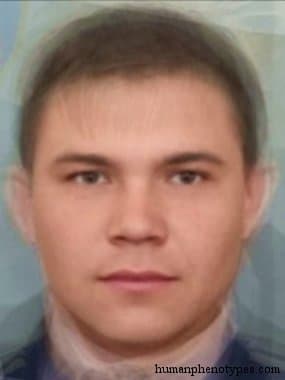
Composite source: Human Phenotypes — Ladogan
Geographic Distribution
Geographically, Ladogan anchors to 60.8° N, 31.7° E (Eastern Europe). That is the point where historical anthropologists judged Ladogan most concentrated, not a hard edge; modern migration and intermarriage have long since softened whatever boundaries once existed.
Physical Characteristics
Pale to fair skin, usually straight, sometimes wavy, blonde to dark brown hair, mixed eyes.
- Medium height, meso- macroskelic, endomorph to mesomorph
- Meso- brachycephalic, mildly hypsicranic
- Mildly leptorrhine, often round-tipped nose
- Relatively low, very wide face with a great interorbital distance and a wide, heavy mandible
Historical Background
Ancient, mostly Europid type of Northeastern Europe and Western Siberia associated with the ancient Kammkeramik culture. Probably played a role in the formation of modern Uralids and Baltids. Survives in people of the Ural region, especially Khanty, Mansi, and Chuvash. In low frequencies it extends west to Europe and east to the Altai.
Research History & Naming
Typological names were coined, contested, and renamed repeatedly across the 20th century, and Ladogan is no exception. The extract below records the researchers who defined Ladogan, the alternative labels it accumulated, and where the modern consensus settled.
Coon (1939) named the type after Neolithic crania from Lake Ladoga. Biasutti (1967) mentions a similar Proto Europid type related to Uralid. Lundman (1967) regarded it as part of Volgid. Eickstedt (1934) regarded it as Proto Alpinid, similar to Lappid.
Comparison With Nearby Phenotypes
Geography, not alphabet, ordered this table: the five phenotype centers closest to Ladogan's, with the traits most likely to be mistaken for it (Fenno Nordid leads at 403 km). In gameplay, these five account for most of the wrong-but-nearby pins against Ladogan.
| Phenotype | Region | Distance | Distinguishing trait |
|---|---|---|---|
| Fenno Nordid | Northern Europe | 403 km | Pale skin, straight, red to white-blonde sometimes reddish-brown hair. |
| Savolaxid | Northern Europe | 420 km | Pale to fair skin, straight, dirty blonde or brown hair, often light eyes. |
| Aisto Nordid | Northern Europe | 426 km | Pale skin, straight, usually blonde hair with blue or grey eyes. |
| Tavastid | Northern Europe | 433 km | Pale skin, straight, usually blonde hair, light eyes. |
| Scando Lappid | Northern Europe | 771 km | Light greyish brown skin, straight, usually dark brown, sometimes blonde or red hair, and brown eyes that are sporadically slanted. |
Ladogan in the Game
In gameplay terms, Ladogan rewards region-level recall: the score is computed from the distance between your pin and 60.8° N, 31.7° E. Players often confuse Ladogan with Fenno Nordid (403 km out) in the comparison table above — those confusions are exactly what the distance penalty is designed to expose.
Ladogan Phenotype FAQ
- Where does the Ladogan phenotype come from?
- The reference coordinates for the Ladogan phenotype sit near 60.8° N, 31.7° E, in Eastern Europe. That point marks the center of the Eastern Europe distribution documented roughly 1500 years ago — actual prevalence spread well beyond it, toward entries such as Fenno Nordid 403 km away, and modern migration has blurred those boundaries further.
- What does the Ladogan phenotype look like?
- In the historical literature, pale to fair skin, usually straight, sometimes wavy, blonde to dark brown hair, mixed eyes. For Ladogan these are statistical tendencies across a population, not a checklist every individual matches.
- Is the Ladogan phenotype a race or a nationality?
- No. A phenotype is a recurring bundle of visible traits documented by historical anthropologists across a population — for Ladogan, patterns such as pale to fair skin, usually straight, sometimes wavy, blonde to dark brown hair, mixed eyes. The Ladogan entry is not a genetic ancestry, not a nationality, and not a statement about any individual person. Two people from the same country can match completely different phenotypes — one resembling Ladogan, another closer to Fenno Nordid — and one phenotype can span many modern borders.
- How does Ladogan appear in the game?
- In Classic Daily and Challenge Mode, the Ladogan composite face appears without a label. Your task is to drop a pin on the world map where you think that face is historically most common — the scoring uses the distance between your pin and the reference coordinates near 60.8° N, 31.7° E. The post-round review then shows the correct location, your distance error, and this Ladogan entry.
References & Literature
Every claim on this page traces back to the sources below — the researchers who defined, measured, and argued over the Ladogan type. The originals behind the Ladogan entry are worth consulting directly.
- Coon, C.S.. 1939.. The Races of Europe. The Macmillan Company. New York.
- Biasutti, R. 1967 (1941). Le Razze e i Popoli della terra. 4th Ed. Vol 1-4. U.T.E.T., Torino.
- Lundman, B. 1967. Geographische Anthropologie. Rassen und Völker der Erde. G. Fischer, Stuttgart
- Eickstedt, E. von. 1934. Rassenkunde und Rassengeschichte der Menschheit. Ferdinand Enke. Stuttgart.
Related Phenotypes
If Ladogan interested you, these neighboring phenotype entries cover adjacent parts of the map with distinctly different trait bundles.
Fenno Nordid
Northern Europe · 403 km away
Ancient type of Northeastern Europe, sometimes placed in Nordid, sometimes East Baltid. Associated with Finno-Ugric people, once widespread ...
Savolaxid
Northern Europe · 420 km away
East Baltid variety, named after the Savolaxia province of Finland, similar to Neo Danubian. Core population in Eastern Finland, Karelia, an...
Aisto Nordid
Northern Europe · 426 km away
East Nordid subvariety, common in coastal regions of Baltic countries. One of the last strongholds of East Nordids that are only a minority ...
Tavastid
Northern Europe · 433 km away
East Baltid variety, typical for the eastern shores of the Baltic sea, similar to Neo Danubian and Borreby. Named after the Tavastia provinc...
Scando Lappid
Northern Europe · 771 km away
Lappid proper - an ancient European type associated with Southern Saami people (formerly "Lapps"). Rare today, often mixed, typical in North...
Further Reading
Background articles from the blog that explain where the Ladogan type fits, how these composites are built, and what a face can and cannot tell you.
Ethnicity From a Face: Which Layer Carries the Signal
A face is not one trait but a stack of layers, and asking a photograph for ethnicity from face assumes every one of those layers tells...
Ethnicity Guesser Tools: Three Methods, Three Answers
One search term covers three unrelated tools: genetic ancestry estimation, photo classifiers, and documented phenotype catalogues.