Ethnicity From a Face: Which Layer Carries the Signal
A face is not one trait but a stack of layers, and asking a photograph for ethnicity from face assumes every one of those layers tells the same story. It separates those layers and asks what each one can report.
Half the record is bone you cannot see
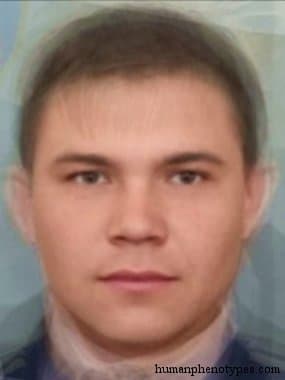
The anthropometric literature the catalogue draws on measured the head as often as the face, and much of that work was done on bone. The cranial index, the ratio of head breadth to head length, needs calipers on a skull or a firm grip on a living head, and a camera cannot retrieve it. Several catalogue records lean on features sitting under the skin. Ladogan is recorded across northeastern Europe and western Siberia, associated with the ancient Kammkeramik culture, and described with a low, very wide face, a great interorbital distance and a wide, heavy mandible. A mandible is not a surface feature. It shapes the surface from underneath.
That creates a mismatch between what was recorded and what a photograph is asked to report. A camera registers the integument first, then the soft tissue shaping it, and only the silhouette of whatever lies beneath. Bone is legible from outside mainly where it comes close to the surface: the brow, the cheekbone, the jaw line, the bridge of the nose. Everything the older literature took from a skull is therefore partly inferred when it is read off a face, and the inference does not show up in the output.
What the surface layer actually reports
The integument is an optical system with layers in it. Melanin sits in the epidermis, haemoglobin in the dermis shifts the hue toward red, and collagen scatters short wavelengths, which is part of why skin reads as paler where the dermis is thick and more translucent where it is thin. Two pigments carry most of the visible variation. Eumelanin is brown to black and absorbs broadly; pheomelanin is yellow to red and less photostable. Their ratio sets the tone, and the tone is heritable, which is why it follows a global gradient of ultraviolet radiation.
The genetics behind that ratio are unevenly distributed, and the exceptions are the interesting part. Red hair and the freckling that travels with it are mostly the work of loss-of-function variants in MC1R, a receptor on chromosome 16. Valverde and colleagues reported in 1995 that three of those variants, Arg151Cys, Arg160Trp and Asp294His, appeared in the great majority of red-haired people in the British and Irish samples they screened. Later surveys found MC1R unusually conserved across African populations, where disabling it carries a real cost under strong ultraviolet. Red hair shows up where that constraint has been relaxed rather than where a new advantage was selected. North Atlantid, a western European record, describes the same system in other words: pale skin that is sometimes ruddy or freckled, hair that is sometimes reddish, and eyes that are often light. Those are worth reading as one cluster rather than four separate clues.
The cartilage in the middle
The nose is the layer that has been measured hardest, and it is also where the climate signal comes through most clearly. Arslan Zaidi and colleagues reported in PLOS Genetics in 2017 on 476 volunteers of South Asian, East Asian, West African and Northern European ancestry, using three-dimensional imaging to separate seven aspects of nose shape. The width of the nares and the width of the alar base were more differentiated between populations than genetic drift alone would predict, and nares width correlated with temperature and absolute humidity: wider nostrils in warm, humid places, narrower ones in cold, dry ones.
The result is usually read as support for Thomson's rule, the older observation that cold, dry climates favour longer and thinner noses, which Arthur Thomson set out from skull measurements in the early twentieth century. The finding is narrower than its coverage implies. Only two of the seven traits departed from neutrality, the correlation did not hold for relative humidity, and one critique observed that dropping the Northern European sample removed the relationship altogether. Nasal shape is genuine evidence about climate. It is weak evidence about a region, because unrelated regions are cold and dry at the same time.
Fat is the layer that moves
Soft tissue is the least stable layer in the stack and the one a camera sees most directly. Subcutaneous fat in the face is not spread evenly; it sits in compartments separated by retaining ligaments, and its volume responds to weight, age and hormonal state over months rather than generations. It also resorbs unevenly, so the cheeks flatten while other regions hold their fullness. Two photographs of one person taken eighteen months apart can differ in exactly the quantity a resemblance model is measuring, while the bone underneath has not moved at all.
Where two layers disagree
A single trait pulled from a single layer can point to the wrong region, and the catalogue holds records where that happens. Fezzanid is described in the Sahara as a combination of ancient elements, including Berberid, with sub-Saharan elements that often entered the region during the Middle Ages, and its record notes that occasional epicanthic folds can give a pseudo-Mongoloid impression. The fold is a real feature of that record and a poor clue about the Sahara. Reading it alone sends a guess thousands of kilometres eastward, because the eyelid is not a package that travels with pigment, stature or skull shape.
Gobid shows the other side of the same problem. It is recorded across the Central Asian deserts and steppes as a Tungid variety, with a flat, large, broad face, strong cheekbones and a pronounced epicanthus. There the fold, the flat facial plane and the cheekbones do arrive together, which is what makes a Central Asian guess workable in a quiz. The difference between the two records is not the trait itself. It is whether the trait is bundled with others, and whether the guesser checked the second and third feature before committing to an answer.
What the crop leaves outside the frame
Every pipeline decides in advance how much of the person counts. A model takes an aligned square crop, which leaves out most of the hair, the ears, the neck and the entire body. Those excluded regions are not empty of variation. Hair form and colour vary on tracks of their own, ear morphology has loci associated with it, and body proportions were among the first traits the older literature recorded. A request for ethnicity from a face has therefore narrowed the evidence before the first measurement, and the narrowing is presented as a technical detail rather than as a choice about the question.
After the baseline, the layers stopped travelling together
Facial shape turns out to be written in many small places rather than a few large ones. Peter Claes and colleagues reported in Nature Genetics in 2018 that among 2,329 people of European ancestry they found 38 loci associated with facial shape, of which 15 replicated in an independent sample of 1,719 and four were entirely new. The loci were enriched for active chromatin in cranial neural crest cells, which points to an early developmental origin. A later meta-analysis of roughly 8,200 Europeans pushed the count to 203 loci. Nothing in that architecture bundles pigment, cartilage and bone into a single inherited unit.
Migration is what makes the separation visible. When people from distant regions form a household, the layers arrive from different packages and recombine separately, so one child can carry the skeletal proportions documented in one region and the pigment documented in another. That is ordinary recombination, and it is increasingly common. In England and Wales in 2021, 10.0 million usual residents, 16.8 per cent, had been born outside the UK, against 8.9 per cent in 2001, and in London the figure reached 40.6 per cent. A model trained on consistent regional packages meets a population that no longer supplies them.
What a face can support is narrower than the request. It can resemble a documented pattern, and the catalogue entry will say where that pattern was recorded, at roughly what period, and which author described it. It cannot report the layers separately, and it cannot say which of them came from where. Read as geography, the question stays answerable. Read as a claim about a person, no crop of any size will carry it.
Frequently Asked Questions
- Does a face really carry information about ancestry?
- Some, in a coarse and uneven way, and the layers differ in how much they carry. Pigment follows ultraviolet radiation closely enough to place a face in a latitude band, and nostril width correlates with temperature and absolute humidity. Bone contributes as well, but it is legible from outside mainly where it sits near the surface. What no layer does is travel as a single package, so a face can resemble a documented pattern in one respect and contradict it in another. The resemblance is a statement about regions the literature recorded, not about descent.
- Why do two photos of the same person produce different answers?
- Because soft tissue is the layer a camera sees most directly and the layer that moves fastest. Subcutaneous fat sits in compartments within the face and changes with weight, age and hormonal state over months, so two photographs taken a year apart can differ in exactly the geometry a model measures. Crop, lighting and lens distance add shifts of their own. The bone underneath has not changed. Differences between two runs are therefore often about the input and the tissue, not about where anyone's documented patterns were recorded.
- Which part of the face is the strongest clue?
- Pigment is the strongest and also the bluntest. It follows the global distribution of ultraviolet radiation closely, so it narrows a face to a band of latitudes with high reliability and then stops, because unrelated regions share a latitude. Nasal width separates populations more than drift predicts and correlates with temperature and humidity, though only when cold, dry regions are in the comparison. The most reliable clue in practice is agreement between layers: pigment pointing one way and bone pointing the same way.
Related Phenotypes
Faces from the encyclopedia that appear in this article. Open any entry for its full description, distribution, and references.
Ladogan
Eastern Europe
Ancient, mostly Europid type of Northeastern Europe and Western Siberia associated with the ancient Kammkeramik culture. Probably played a r...
Gobid
Central Asia
Tungid variety of the vast Central Asian deserts and steppes, e.g. the Gobi and Southern Siberia. Developed in ancient stock-farming nomads ...
Fezzanid
North Africa
Saharan type combining ancient elements including Berberid with sub-Saharan elements that often entered the region during the Middle Ages. C...
North Atlantid
Northern Europe
Western European type that combines features of Nordid and Mediterranid in a unique way. Resembles British Iron Age Celts. The principal ele...
Test what you learned
Put your eye for regional faces to work in the daily quiz — a composite face, a world map, and your best guess.