Gobid Phenotype - Face Features & Origin
Historical anthropology places the Gobid phenotype in Central Asia, with a documented center near 43.0° N, 107.0° E. Tungid variety of the vast Central Asian deserts and steppes, e.g. The sections that follow unpack the Gobid entry in practice: the composite face, the traits it summarizes, the naming history, and the sources.
Average Face
Averaging the portraits behind Gobid leaves the features that repeat and erases the ones that do not. That is exactly how the Gobid composite below was built: individual photographs were aligned and statistically merged, exaggerating shared structure into a single reference face that no actual person looks like.
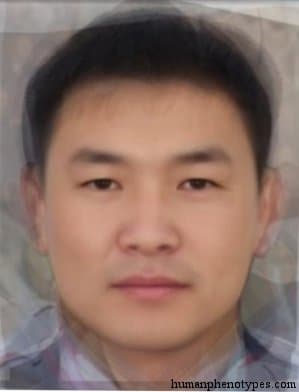
Composite source: Human Phenotypes — Gobid
Geographic Distribution
Geographically, Gobid anchors to 43.0° N, 107.0° E (Central Asia). That is the point where historical anthropologists judged Gobid most concentrated, not a hard edge; modern migration and intermarriage have long since softened whatever boundaries once existed.
Physical Characteristics
Light yellowish-brown skin, coarse straight, rarely wavy hair.
- Medium height, macroskelic, endomorph
- (Hyper)brachycephalic, chamaecranic, rather large-headed
- Mildly leptorrhine
- Flat, large and broad face, lips medium thick
- Epicanthus and cheekbones strong, body hair rather weak
Historical Background
Tungid variety of the vast Central Asian deserts and steppes, e.g. the Gobi and Southern Siberia. Developed in ancient stock-farming nomads and was found in Huns, Avars, and Mongols, who migrated West and produced Aralids, etc. Today most typical in the Buryat, Mongolians, Tuvins. Also in Yakut, South Altaians, even some Kazakhs, Evenk, Orochs, Japanese, Chinese, Miao, and Tibetans. During the 17th century Kalmyks brought it West to the Caspian Sea.
Research History & Naming
Typological names were coined, contested, and renamed repeatedly across the 20th century, and Gobid is no exception. The extract below records the researchers who defined Gobid, the alternative labels it accumulated, and where the modern consensus settled.
Originally named Central Asiatic by Yarkho (1929) , this was adopted by later authors ( Cheboksarov, 1951 ; Biasutti, 1967 ; Alexeev, 1979 ). Levin (1963) describes it in highest detail, Eickstedt (1934) as a Buryat-Kalmyk Tungid subgroup. Lundman (1967) named it Gobid.
Comparison With Nearby Phenotypes
The five phenotypes whose documented centers lie closest to Gobid, ranked by great-circle distance. They are the types players most often confuse with Gobid in the quiz, precisely because their distributions overlap.
| Phenotype | Region | Distance | Distinguishing trait |
|---|---|---|---|
| Huanghoid | East Asia | 1,176 km | Pale yellow to dusky yellow-brown skin, straight hair. |
| Baykal | Siberia | 1,183 km | Light yellowish-brown, sometimes fair skin with coarse straight, black, sometimes lighter hair and mixed eyes. |
| Changkiangid | East Asia | 1,526 km | Light to brownish yellow, sometimes fair skin with coarse straight hair. |
| Manchu-Korean | East Asia | 1,586 km | Pale yellow to dusky yellow brown skin with coarse straight, sometimes wavy hair. |
| Kham | East Asia | 1,646 km | Light, sometimes medium olive brown skin with straight, sometimes wavy hair. |
Gobid in the Game
Gobid is one of the faces that can appear in Classic Daily and Challenge Mode. When it does, the winning pin lands near 43.0° N, 107.0° E in Central Asia — and because the scoring decays with distance, recognizing the region matters more than pixel-perfect placement.
Gobid Phenotype FAQ
- Where does the Gobid phenotype come from?
- Historical sources center the Gobid phenotype on 43.0° N, 107.0° E (Central Asia). Treat that as a rough anchor: the type appeared across a wider surrounding area — its nearest documented neighbors, Huanghoid and Baykal, sit 1,176 and 1,183 km from the reference point — and its present-day distribution no longer matches the historical map.
- What does the Gobid phenotype look like?
- The composite emphasizes recurring traits: light yellowish-brown skin, coarse straight, rarely wavy hair. The full trait list for Gobid appears in the physical characteristics section above.
- Is the Gobid phenotype a race or a nationality?
- No. Phenotypes like Gobid are descriptive averages, not ancestry groups. Gobid is one of several types documented in and around Central Asia — see the comparison table above — and the same individual can carry traits associated with several of them at once. The Gobid entry describes a statistical pattern, not a group of people and not a nationality.
- How does Gobid appear in the game?
- When the Gobid face comes up in Classic Daily or Challenge Mode, you pin the world map where you believe the type is historically most common, and the score decays with your distance to 43.0° N, 107.0° E. The nearest documented type, Huanghoid, lies about 1,176 km away, so regional placement usually carries most of the score.
References & Literature
Every claim on this page traces back to the sources below — the researchers who defined, measured, and argued over the Gobid type. The originals behind the Gobid entry are worth consulting directly.
- Yarkho, A. I. 1929. Anthropologicheskiy tip kemchikskikh tannutuvintsev. Severnaya Aziya 5-6.
- Cheboksarov, N.N.. 1951. Osnovnyje printsipy antropologicheskikh klassifikatsij. TIE. 16.
- Biasutti, R. 1967 (1941). Le Razze e i Popoli della terra. 4th Ed. Vol 1-4. U.T.E.T., Torino.
- Alexeev, V. P. 1979. The Differential Geography of Races. In: Stini, W. A. Physiological and Morphological Adaptation and Evolution. De Gruyter.
- Levin, M. G. 1963. Ethnic origins of the people of Northeastern Asia. Arctic Inst. North America, Anthropology of the North. Translations from Russian sources 3. Toronto.
- Eickstedt, E. von. 1934. Rassenkunde und Rassengeschichte der Menschheit. Ferdinand Enke. Stuttgart.
- Lundman, B. 1967. Geographische Anthropologie. Rassen und Völker der Erde. G. Fischer, Stuttgart
Related Phenotypes
More entries from the same region of the historical map as Gobid, each with its own composite and trait profile.
Huanghoid
East Asia · 1,176 km away
North Sinid type, named after the Huang Ho (Yellow) river in Northern China. Developed from loess and millet farmers. Usually regarded as th...
Baykal
Siberia · 1,183 km away
Northern Tungid variety, native to the vast, sparsely populated Taiga and Tundra regions of East Siberia, adapted to survive in the coldest ...
Changkiangid
East Asia · 1,526 km away
Sinid subtype, named after the Chang Kiang (Yangtze) river in Central China. Today the most populous human variety in the world. Developed f...
Manchu-Korean
East Asia · 1,586 km away
North Sinid subtype, significantly influenced by Tungid. Typified by Manchu and Koreans. Most common in Manchuria / North China, and Central...
Kham
East Asia · 1,646 km away
Robust Sinid variety, found in its highest concentration in Eastern Tibet, especially in the Kham region in nomads and warrior castes. Could...
Further Reading
Background articles from the blog that explain where the Gobid type fits, how these composites are built, and what a face can and cannot tell you.
Ethnicity From a Face: Which Layer Carries the Signal
A face is not one trait but a stack of layers, and asking a photograph for ethnicity from face assumes every one of those layers tells...
The Daily Face Quiz: How Classic Daily Works (and How to Get Better)
Ten composite faces, one world map, the same ten questions for every player each day, up to 5,000 points. The mechanics of the daily...