Manchu-Korean Phenotype - Face Features & Origin
North Sinid subtype, significantly influenced by Tungid. The entry below collects the Manchu-Korean composite face, its documented distribution around 45.8° N, 126.6° E in East Asia, its physical characteristics, the research history behind the name, and the academic references that support all of it.
Average Face
The Manchu-Korean composite below is not a photograph of a real person. Historical anthropologists aligned multiple individual portraits from the Manchu-Korean reference population and averaged them into one image, so recurring structures — skull outline, nose form, lip thickness, brow position — dominate while individual idiosyncrasies cancel out.
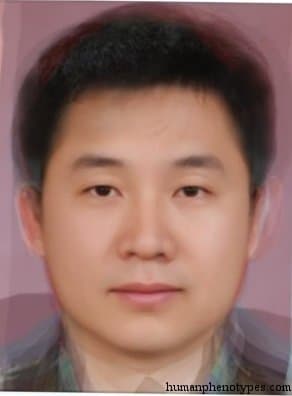
Composite source: Human Phenotypes — Manchu-Korean
Geographic Distribution
Geographically, Manchu-Korean anchors to 45.8° N, 126.6° E (East Asia). That is the point where historical anthropologists judged Manchu-Korean most concentrated, not a hard edge; modern migration and intermarriage have long since softened whatever boundaries once existed.
Physical Characteristics
Pale yellow to dusky yellow brown skin with coarse straight, sometimes wavy hair.
- Medium height, macroskelic, ectomorph to endomorph
- (Hyper-)brachycephalic, hypsicranic with a mildly leptorrhine, sometimes aquiline nose
- The face is flat with cheekbones weaker than in Tungid
- The chin weak, prognathy mild, the lower lip is relatively thick
- The Mongolian fold is pronounced
Historical Background
North Sinid subtype, significantly influenced by Tungid. Typified by Manchu and Koreans. Most common in Manchuria / North China, and Central as well as North Korea, occasionally across China and in the Amur Valley. Has a Japanese Okayama subvariety that is especially found around Kyoto and in the west of central Honshu. The Japanese Choshiu type is a gracilised modification and sometimes included.
Research History & Naming
The passage below traces who first defined Manchu-Korean, which rival names competed with it, and how later authors consolidated or disputed the classification — the raw material of any serious phenotype reference.
Defined as Manchu-Korean by Baelz (1901) , the name was kept by Yarkho (1929) , Cheboksarov (1951) or named Korean ( Debets, 1974 ). Biasutti (1941) had Korean as a North Sinid subrace. Hasebe's, Matsumara's (c.p. Matsumoto, 1921 , 1925 ) and Eickstedt's (1952c) Okayama type fits here.
Comparison With Nearby Phenotypes
Geography, not alphabet, ordered this table: the five phenotype centers closest to Manchu-Korean's, with the traits most likely to be mistaken for it (Ishikawa leads at 1,292 km). In gameplay, these five account for most of the wrong-but-nearby pins against Manchu-Korean.
| Phenotype | Region | Distance | Distinguishing trait |
|---|---|---|---|
| Ishikawa | East Asia | 1,292 km | Yellowish light brown skin with coarse straight to wavy hair. |
| Amur-Sakhalin | Siberia | 1,312 km | Light yellowish-brown skin with coarse straight to wavy, usually black hair and mostly dark eyes. |
| Choshiu | East Asia | 1,348 km | Light to brownish yellow skin with coarse straight hair. |
| Chikuzen | East Asia | 1,409 km | Yellowish light brown skin with coarse straight, sometimes wavy hair. |
| Aoshima | East Asia | 1,427 km | Light brown skin, wavy to curly, mostly black hair. |
Manchu-Korean in the Game
In gameplay terms, Manchu-Korean rewards region-level recall: the score is computed from the distance between your pin and 45.8° N, 126.6° E. Players often confuse Manchu-Korean with Ishikawa (1,292 km out) in the comparison table above — those confusions are exactly what the distance penalty is designed to expose.
Manchu-Korean Phenotype FAQ
- Where does the Manchu-Korean phenotype come from?
- Historical sources center the Manchu-Korean phenotype on 45.8° N, 126.6° E (East Asia). Treat that as a rough anchor: the type appeared across a wider surrounding area — its nearest documented neighbors, Ishikawa and Amur-Sakhalin, sit 1,292 and 1,312 km from the reference point — and its present-day distribution no longer matches the historical map.
- What does the Manchu-Korean phenotype look like?
- The composite emphasizes recurring traits: pale yellow to dusky yellow brown skin with coarse straight, sometimes wavy hair. The full trait list for Manchu-Korean appears in the physical characteristics section above.
- Is the Manchu-Korean phenotype a race or a nationality?
- No — and the Manchu-Korean naming history above shows why. Manchu-Korean was defined, renamed, and regrouped repeatedly by different researchers, which is the opposite of how a fixed racial category would behave. A phenotype is a recurring bundle of visible traits recorded across a population; the Manchu-Korean label says nothing about where any individual's ancestors were born.
- How does Manchu-Korean appear in the game?
- When the Manchu-Korean face comes up in Classic Daily or Challenge Mode, you pin the world map where you believe the type is historically most common, and the score decays with your distance to 45.8° N, 126.6° E. The nearest documented type, Ishikawa, lies about 1,292 km away, so regional placement usually carries most of the score.
References & Literature
The Manchu-Korean phenotype entry above is compiled from the 8 academic references. Readers are encouraged to consult the original Manchu-Korean sources for verification and deeper context.
- Baelz, E. 1901. Menschen-Rassen Ost-Asiens mit spezieller Rücksicht auf Japan. Verh.. Zeitschrift für Ethnologie 33, 2. 166-198.
- Yarkho, A. I. 1929. Anthropologicheskiy tip kemchikskikh tannutuvintsev. Severnaya Aziya 5-6.
- Cheboksarov, N.N.. 1951. Osnovnyje printsipy antropologicheskikh klassifikatsij. TIE. 16.
- Debets, G. 1974. Essay on the Graphical Presentation of the Genealogical Classification of Human Races. In: Bromley, Y. Soviet Ethnology and Anthropology Today. Mouton & Co.
- Bunak, V. V., Nestrukh, M. F. and Y. Y. Roginskiy. 1941. Antropologiya. Kratkiy kurs. Moscow.
- Matsumoto, H. 1921. Notes on the stone age people of Japan. American Anthropologist 23, 1.
- Matsumoto, H. 1925. Racially, Who Are the Japanese People? In: The World Tomorrow. June 1925.
- Eickstedt, E. von. 1952c. Rassentypen und Typendynamik von Asien In: Historia Mundi. Band 1, Munich, 147-166.
Related Phenotypes
If Manchu-Korean interested you, these neighboring phenotype entries cover adjacent parts of the map with distinctly different trait bundles.
Ishikawa
East Asia · 1,292 km away
Special Japanese type, influenced by ancient regional elements. Named after the Ishikawa region of Honshu. Probably represents admixed varia...
Amur-Sakhalin
Siberia · 1,312 km away
Distinctive Tungid variety, probably split from neighbouring types at the end of the Paleolithic. Native to parts of the Sakhalin-Amur regio...
Choshiu
East Asia · 1,348 km away
Gracilised variant of the Manchu-Korean type, named after the old Japanese Choshu Domain. Once common in Chinese-Korean aristocracy. Today m...
Chikuzen
East Asia · 1,409 km away
Special Japanese type, influenced by ancient regional elements. Named after the old Chikuzen province that is today part of Fukuoka Prefectu...
Aoshima
East Asia · 1,427 km away
Ainuid proper, the most ancient type of Japan. Resembles Paleolithic Japanese populations like the Jomon people. Probably a relict of an old...
Further Reading
Background articles from the blog that explain where the Manchu-Korean type fits, how these composites are built, and what a face can and cannot tell you.
Ethnicity Quiz: Five Question Types Behind the Label
A face quiz, a census form, a reaction-time experiment, a surname model and an ancestry report all answer to the same phrase.
AI Phenotype Scanner: What a Scanner Cannot Do for a Face
The phrase names a face classifier, not a device that reads a stored record. What the scanner metaphor hides, what the 209-entry...