Amur-Sakhalin Phenotype - Face Features & Origin
Historical anthropology places the Amur-Sakhalin phenotype in Siberia, with a documented center near 50.2° N, 143.0° E. Distinctive Tungid variety, probably split from neighbouring types at the end of the Paleolithic. The sections that follow unpack the Amur-Sakhalin entry in practice: the composite face, the traits it summarizes, the naming history, and the sources.
Average Face
Averaging the portraits behind Amur-Sakhalin leaves the features that repeat and erases the ones that do not. That is exactly how the Amur-Sakhalin composite below was built: individual photographs were aligned and statistically merged, exaggerating shared structure into a single reference face that no actual person looks like.
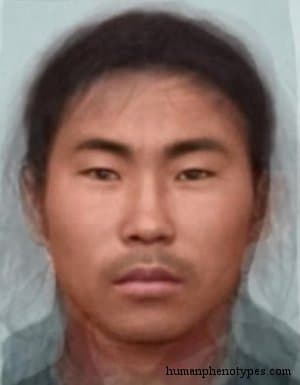
Composite source: Human Phenotypes — Amur-Sakhalin
Geographic Distribution
The reference center for Amur-Sakhalin sits near 50.2° N, 143.0° E in Siberia. Around that anchor, prevalence falls off gradually — the type is not confined to one valley or one modern border, and the historical map should be read as a gradient rather than a boundary.
Physical Characteristics
Light yellowish-brown skin with coarse straight to wavy, usually black hair and mostly dark eyes.
- Rather short, macroskelic, endomorph, sometimes ectomorph
- Brachycephalic, orthocranic with a mildly leptorrhine, slightly prominent nose
- The face is moderately flattened, broad with very protruding cheekbones
- Mongoloid features and epicanthic folds very pronounced
- Prognathy mild, body hair rather strong, eyebrows thick
Historical Background
Distinctive Tungid variety, probably split from neighbouring types at the end of the Paleolithic. Native to parts of the Sakhalin-Amur region. Typified by Nivkhs (Gilyaks), mixed in Ulchs, and rare in Orochs and Aleuts. Nivkh culture suffered heavily from Chinese and Cossack influence. The type is present only in a few thousand today.
Research History & Naming
Every label in the historical catalogue has an author and a date, and Amur-Sakhalin has accumulated its share of competing attributions. For Amur-Sakhalin, the literature extract below shows the naming chain — from the first definition through the later revisions that shaped the current entry.
Montandon (1933) and Eickstedt (1934) regarded it a Maritime Mongoloid (Tungid) variety together with Aleutians. Biasutti (1967) placed it in Paleo Asiatic. Lated defined as the Amur-Sakhalin type, a Tungid (North Mongoloid) variety ( Levin, 1963 ; Debets, 1974 ; Schwidetzky, 1974 ; Alexeev, 1979 ).
Comparison With Nearby Phenotypes
The five phenotypes whose documented centers lie closest to Amur-Sakhalin, ranked by great-circle distance. They are the types players most often confuse with Amur-Sakhalin in the quiz, precisely because their distributions overlap.
| Phenotype | Region | Distance | Distinguishing trait |
|---|---|---|---|
| Manchu-Korean | East Asia | 1,312 km | Pale yellow to dusky yellow brown skin with coarse straight, sometimes wavy hair. |
| Yakonin | East Asia | 1,541 km | Light to brownish yellow skin with coarse straight to wavy hair. |
| Ishikawa | East Asia | 1,546 km | Yellowish light brown skin with coarse straight to wavy hair. |
| Choshiu | East Asia | 2,000 km | Light to brownish yellow skin with coarse straight hair. |
| Aoshima | East Asia | 2,019 km | Light brown skin, wavy to curly, mostly black hair. |
Amur-Sakhalin in the Game
Amur-Sakhalin is one of the faces that can appear in Classic Daily and Challenge Mode. When it does, the winning pin lands near 50.2° N, 143.0° E in Siberia — and because the scoring decays with distance, recognizing the region matters more than pixel-perfect placement.
Amur-Sakhalin Phenotype FAQ
- Where does the Amur-Sakhalin phenotype come from?
- Historical sources center the Amur-Sakhalin phenotype on 50.2° N, 143.0° E (Siberia). Treat that as a rough anchor: the type appeared across a wider surrounding area — its nearest documented neighbors, Manchu-Korean and Yakonin, sit 1,312 and 1,541 km from the reference point — and its present-day distribution no longer matches the historical map.
- What does the Amur-Sakhalin phenotype look like?
- The composite emphasizes recurring traits: light yellowish-brown skin with coarse straight to wavy, usually black hair and mostly dark eyes. The full trait list for Amur-Sakhalin appears in the physical characteristics section above.
- Is the Amur-Sakhalin phenotype a race or a nationality?
- No. Phenotypes like Amur-Sakhalin are descriptive averages, not ancestry groups. Amur-Sakhalin is one of several types documented in and around Siberia — see the comparison table above — and the same individual can carry traits associated with several of them at once. The Amur-Sakhalin entry describes a statistical pattern, not a group of people and not a nationality.
- How does Amur-Sakhalin appear in the game?
- When the Amur-Sakhalin face comes up in Classic Daily or Challenge Mode, you pin the world map where you believe the type is historically most common, and the score decays with your distance to 50.2° N, 143.0° E. The nearest documented type, Manchu-Korean, lies about 1,312 km away, so regional placement usually carries most of the score.
References & Literature
Primary sources for the Amur-Sakhalin entry, listed as cited in the historical literature. The naming and classification debates around Amur-Sakhalin referenced above run through these works.
- Montandon, G. 1933. La race, les races: mise au point d éthnologie somatique. Payot. Paris.
- Eickstedt, E. von. 1934. Rassenkunde und Rassengeschichte der Menschheit. Ferdinand Enke. Stuttgart.
- Biasutti, R. 1967 (1941). Le Razze e i Popoli della terra. 4th Ed. Vol 1-4. U.T.E.T., Torino.
- Levin, M. G. 1963. Ethnic origins of the people of Northeastern Asia. Arctic Inst. North America, Anthropology of the North. Translations from Russian sources 3. Toronto.
- Debets, G. 1974. Essay on the Graphical Presentation of the Genealogical Classification of Human Races. In: Bromley, Y. Soviet Ethnology and Anthropology Today. Mouton & Co.
- Schwidetzky, I.. 1974. Grundlagen der Rassensystematik. B.I.-Wissenschaftsverlag. Mannheim.
- Alexeev, V. P. 1979. The Differential Geography of Races. In: Stini, W. A. Physiological and Morphological Adaptation and Evolution. De Gruyter.
Related Phenotypes
More entries from the same region of the historical map as Amur-Sakhalin, each with its own composite and trait profile.
Manchu-Korean
East Asia · 1,312 km away
North Sinid subtype, significantly influenced by Tungid. Typified by Manchu and Koreans. Most common in Manchuria / North China, and Central...
Yakonin
East Asia · 1,541 km away
East Asian type that has been associated with the ancient Japanese government and nobility circles. The name derives from yakunin (Jap.: bur...
Ishikawa
East Asia · 1,546 km away
Special Japanese type, influenced by ancient regional elements. Named after the Ishikawa region of Honshu. Probably represents admixed varia...
Choshiu
East Asia · 2,000 km away
Gracilised variant of the Manchu-Korean type, named after the old Japanese Choshu Domain. Once common in Chinese-Korean aristocracy. Today m...
Aoshima
East Asia · 2,019 km away
Ainuid proper, the most ancient type of Japan. Resembles Paleolithic Japanese populations like the Jomon people. Probably a relict of an old...
Further Reading
Background articles from the blog that explain where the Amur-Sakhalin type fits, how these composites are built, and what a face can and cannot tell you.
How AI Guesses Ethnicity From a Face: Eigenfaces, Landmarks, and Neural Networks
From Turk and Pentland's eigenfaces in 1991 to modern convolutional networks, face-classification AI has one core trick: reduce a face...
What Country Do I Look Like: The Count Comes Before the Face
Which country a face resembles depends on which official list you are using, and the world publishes several that disagree on how many...