Why Europeans Have Light Skin: The Alleles Arrived in Order
Light skin in Europe arrived twice over: a single transporter allele came in with Anatolian farmers, and then selection kept pushing it higher.
One amino acid in a transporter
The largest single contributor to light European skin is a change of one amino acid in a membrane transporter. SLC24A5 sits on chromosome 15 and encodes NCKX5, a potassium-dependent sodium-calcium exchanger that works in the trans-Golgi network of the melanocyte, the compartment where pigment granules are assembled. Rebecca Lamason and colleagues found the gene in 2005 by cloning the mutation behind the golden variety of the zebrafish, then showed that human SLC24A5 messenger RNA could restore pigmentation when injected into golden embryos. The human variant behind the difference is rs1426654, a substitution in exon 3 that swaps alanine for threonine at position 111.
The frequencies are what make that single letter hard to ignore. In the samples Lamason's team examined, the derived threonine allele accounted for 98.7 to 100 percent of European chromosomes, while the ancestral alanine form ran at 93 to 100 percent in sub-Saharan African, East Asian and Indigenous American samples. The same study estimated that this one change explains 25 to 38 percent of the melanin index difference between people of West African and European ancestry, and noted that the surrounding haplotype carries the longest stretch of reduced variation in the European HapMap sample.
A second gene and a limit
SLC24A5 is not alone. SLC45A2, also called MATP, encodes a transporter on the melanosome membrane that shifts the organelle's internal pH and so throttles melanin synthesis. Its European variant is rs16891982, a phenylalanine to leucine change at position 374, and the derived form sits at roughly 0.89 to 0.96 in European samples while staying near absent in African and East Asian ones. Hiroaki Soejima and colleagues ran four neutrality tests across a 7.55 kilobase region around that site in 2006 and concluded that the European pattern was consistent with strong positive selection rather than drift.
What these two genes cannot do is explain the whole map. Heather Norton and colleagues argued in Molecular Biology and Evolution in 2007 that light skin arose at least twice, in Europeans and in East Asians, along different genetic routes. The proof is a frequency: SLC24A5 cannot account for the difference between African and East Asian pigmentation, because both populations carry the ancestral alanine at position 111 at high frequency. East Asian light skin was built from other parts, and treating the European version as the standard case distorts every comparison that follows.
The Mesolithic skeletons complicate it
Sequencing old bone turned the question from a frequency table into a chronology. La Braña 1, a male skeleton from a cave in León, Spain, lived roughly 7,000 years ago and was reported by Íñigo Olalde and colleagues in Nature in 2014. His genome carried the ancestral state at the main European pigmentation loci, which is to say he was dark-skinned, and he carried the derived variant at HERC2 associated with blue eyes. A western hunter-gatherer with pale eyes and dark skin is a combination the modern world has largely sorted out of existence.
The picture is not uniform, though, and the exception matters. Mathieson and colleagues found in 2015 that samples from Motala in Sweden, unlike the western hunter-gatherers, carried predominantly derived pigmentation alleles at both SLC45A2 and SLC24A5, and Torsten Günther's 2018 analysis of Scandinavian hunter-gatherers described eyes ranging from blue to light brown alongside light skin. Further east and earlier, the oldest genome yet found carrying the derived SLC24A5 variant comes from Satsurblia Cave in Georgia, at roughly 13,000 years old. Pre-farming Europe was not one colour.
The farmers brought the allele in
The decisive move was demographic. Kılınç and colleagues sequenced nine central Anatolian Neolithic genomes in 2016 and found that the earliest farmers had conspicuously low genetic diversity, comparable to European foraging groups, and that their gene pool matched the first Neolithic migrants who spread into Europe. The derived SLC24A5 variant was already at high frequency in Anatolia before farming reached the continent. Light skin, in other words, did not have to evolve in Europe at all. It arrived, in the bodies of people who brought wheat, sheep and pottery with them.
Dan Ju and Iain Mathieson put numbers on what happened next, using 1,158 ancient genomes from West Eurasia spanning 40,000 years alongside UK Biobank summary statistics for 170 variants associated with pigmentation. They found a robust signal of directional selection, but the signal came from a small number of large-effect variants rather than from the whole architecture: a polygenic test using all 170 variants failed to detect selection in living populations. Their sharpest result is a separation of two processes. The SLC24A5 variant entered western Europe with farming migrations, and then kept rising after the admixture that carried it there.
Selection continued after arrival
That separation is the part most summaries skip. A trait can become common because the people who carried it moved, or because the people who carried it had more children, and the two look identical in a modern frequency map. Ancient DNA lets the two be told apart, and in this case both are operating: the allele was imported, then amplified. Mathieson's 2015 scan across 230 ancient Eurasians had already placed SLC24A5 and SLC45A2 among the strongest selection signals on the continent, which is why the post-arrival rise is not a surprise in hindsight.
Why it kept rising is the unsettled part. Ultraviolet B is the photon that converts 7-dehydrocholesterol into vitamin D3 in the skin, and above about 45 degrees north it is scarce for much of the year. A darker epidermis slows that reaction, so a variant that thins the pigment has a plausible advantage in a farming population eating less wild fish and game. Set against that, lighter skin loses folate to ultraviolet A and raises the risk of ultraviolet damage. The estimated strength of selection is modest in most models, the confidence intervals are wide, and the argument over how much of the rise is selection versus population structure is still running.
What the catalogue recorded as a gradient
The historical catalogue files this geography as adjacent rows. Aisto Nordid, anchored on the Baltic coast at 58.8 degrees north and named by Bertil Lundman in 1943, is recorded with pale skin, usually blonde hair and blue or grey eyes, with its strongest surviving concentration among western Finns and west Estonians. Gracile Mediterranid, anchored at 32.3 degrees north and described by Joseph Deniker in 1900 as Ibero Insular, is recorded with light brown skin and brown to brown-black hair, and its entry traces the type to Mesolithic Natufian groups in Palestine.
Read together, the two rows describe a gradient and nothing else. There is no threshold between them, no place where one record stops and the other begins, and the underlying allele frequencies behave the same way: they slide across the continent rather than stepping. The Mediterranean in the name is a latitude and a sea, not a boundary. That is the honest content of the catalogue here, and it is also why the vocabulary of types could describe the gradient while never locating an edge in it.
What the twentieth century did to the gradient
Two more entries record movement rather than climate. Anglo-Saxon, defined by Carleton Coon in 1939 and anchored on eastern England at 52.5 degrees north, is explicitly a record of the Angles, Saxons and Jutes who crossed the North Sea from the fifth century onward and of the population that formed where they settled. Alföld is blunter still: its entry attributes the type to Huns and Magyars entering the Hungarian plain in the early Middle Ages and blending with the regional populations already there.
Both are reminders that the rows describe arrivals as often as they describe inhabitants. The catalogue anchors its distributions at roughly 1,500 years ago, which is itself a date chosen for the era before the last millennium of reshuffling, and the reshuffling did not stop when the compilers put down their calipers. Post-1945 labour migration into western Europe, the movements that followed 1989, and a century of global relocation have all fed into the populations that today's biobanks sample. A frequency measured in a Leeds clinic now describes a gene pool that no 1939 field survey could have anticipated.
Frequently Asked Questions
- Is light skin in Europe caused by a single mutation?
- No. SLC24A5 at rs1426654 has the largest single effect, accounting for an estimated 25 to 38 percent of the melanin index difference between West African and European ancestry samples, and SLC45A2 at rs16891982 adds a second large contribution. Beyond those, TYR, KITLG, ASIP, OCA2 and BNC2 all shift pigmentation. Ju and Mathieson identified 170 associated variants in ancient West Eurasians but found that selection acted on only a few large-effect ones.
- Did Europe's hunter-gatherers already have light skin?
- Mostly not. La Braña 1, a roughly 7,000-year-old skeleton from Leon in Spain, carried ancestral states at the main pigmentation loci and was reconstructed as dark-skinned. The exception is Scandinavia, where hunter-gatherers from Motala carried predominantly derived alleles at both SLC45A2 and SLC24A5. The derived SLC24A5 variant was at high frequency in Neolithic Anatolia before farming reached Europe, so much of the continent's light skin arrived with migrating farmers rather than evolving in place.
- Why would lighter skin be favoured at high latitude?
- The standard explanation is vitamin D. Ultraviolet B drives its synthesis in skin, and above roughly 45 degrees north that radiation is weak for much of the year, so a thinner pigment barrier speeds a reaction that is already rate-limited. The trade-off runs the other way near the equator, where pigment protects folate from photolysis. Estimates of how strong the selection actually was remain modest and debated, and part of the frequency rise may reflect migration and population structure rather than advantage alone.
Related Phenotypes
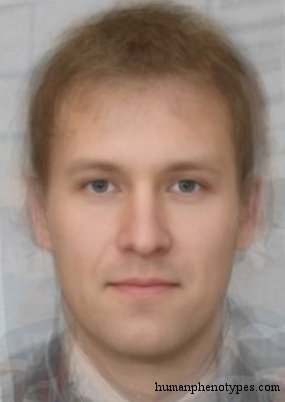
Faces from the encyclopedia that appear in this article. Open any entry for its full description, distribution, and references.
Aisto Nordid
Northern Europe
East Nordid subvariety, common in coastal regions of Baltic countries. One of the last strongholds of East Nordids that are only a minority ...
Gracile Mediterranid
Southern Europe
Mediterranid proper, smaller than other Mediterranids: the most gracile type of Europe. Appears first in Mesolithic groups of Palestine (Nat...
Anglo-Saxon
Northern Europe
North-West European type, similar to Trønder, but with a stronger Hallstatt component. Was typified by the ancient Germanic tribes of Angles...
Alföld
Central Europe
Western Turanid subtype, named after the Alföld (Great Hungarian Plain). It developed when Huns and Magyars entered the area during the earl...
Test what you learned
Put your eye for regional faces to work in the daily quiz — a composite face, a world map, and your best guess.