Nordid Phenotype: What Actually Holds the Label Together
The Nordid label was assembled from a skull ratio, an Austrian salt-mining village, and a Danish grave site, and its subvarieties disagree on shape. What they share in the record is pigmentation.
The index came before the type
In 1842 Anders Retzius presented a ratio to the Meeting of Naturalists in Stockholm: the greatest breadth of the skull divided by its greatest length, multiplied by a hundred. Skulls below 75 he called dolichocephalic, above he called brachycephalic, with a mesocephalic band of 75 to 80 added by later workers. The measure was attractive because it was size-free, so a large head and a small one could receive the same number. Retzius drew on Swedish collections and on Sámi crania, and the ratio travelled quickly into European anthropology.
The label Nordid is downstream of that instrument, not upstream of it. William Ripley used head shape in 1899 to divide Europe into long-headed Teutonic, round-headed Alpine, and long-headed Mediterranean types, and the Nordic category took its outline from the same logic. Before the calipers there was no Nordic type to find. What existed was a set of graves, a set of living conscripts, and a quotient that made both sortable.
Hallstatt was a place before it was a type
The village of Hallstatt in Upper Austria gave its name to an Iron Age culture defined by salt mining and its cemetery. The label then moved from the archaeology to the skulls. Deniker in 1900 treated it as the Nordic proper type; Coon in 1939 separated a Hallstatt or Østerdal variety from the other Nordid forms; Eickstedt in 1952 wrote Teuto Nordid; Lundman in 1988 wrote Göta or Skando Nordid. One cluster of measurements, at least five names, each borrowing authority from a different discipline.
Naming a physical type after a burial ground is a rhetorical move as much as a descriptive one. It implies continuity between the people buried at Hallstatt and the morphology in the sample, and that continuity is precisely what the measurements cannot establish. The catalogue records the name and its authors, which is the honest thing to do with a term of this kind. It does not turn the name into evidence.
Borreby breaks the long-skull rule
Borreby takes its name from Neolithic skulls found in Denmark, though the record is careful to say not all of them. Coon defined it in 1939 as a common Upper Paleolithic type with a mildly brachycephalic vault and an extraordinary large head. Set that beside Hallstatt, which the same literature places at the dolichocephalic or mesocephalic end, and the family stops looking like a family. Two members of one label sit on opposite sides of the index that generated the label.
Later authors kept the term and changed its contents. Schwidetzky in 1974 read Borreby as a broader-skulled Faelid; Charles in 1960 and Saller in 1962 treated it as often purely prehistoric, with few modern recombinations. Vallois had described broader-skulled Dalics in 1943 and again in 1971. The pattern repeats across the catalogue: a name survives because it is convenient for indexing old photographs, while the definition underneath it keeps being rewritten.
Two eastern ends: Aisto and Proto
Aisto Nordid was named by Lundman in 1943 and again in 1946 for the eastern Baltic coast. The record describes a mesocephalic vault with a higher and larger skull than Hallstatt, and places its purest form among western Finns and west Estonians. The stem is usually read as the Aesti, the amber-coast people Tacitus mentions in the Germania. Proto Nordid is the other eastern end: Eickstedt in 1952 and Vondernach in 2008 used that term, Wellisch in 1937 had called the same thing Altnordid, and Lundman in 1943 defined it as Arin Nordid.
Both are ancestral labels. They describe a form supposed to have existed earlier and to survive in diluted traces, which is where the reasoning begins to eat itself: the earlier form is inferred from the later sample, then used to explain it. The catalogue does cite independent evidence, such as Keyser and colleagues in 2009 reporting high frequencies of blonde hair and green eyes in early Kurgan burials. That is a real finding about ancient pigmentation. It does not establish a vault type.
What survives is pigmentation
Look at what the subvarieties actually share and vault shape drops out. Norid, named by Lebzelter in 1929 after the Roman province of Noricum, is brachycephalic and still sits in the family because its pigmentation is light; the record explains it as Nordid admixture with other Central European elements. Fenno Nordid, described by Eickstedt in 1934, is meso- to brachycephalic and is sometimes placed in East Baltid instead. Lightness of skin, hair, and eyes is the thread, not the index.
That is worth stating plainly, because it changes what the word means. In practice Nordid marks a pigmentation pattern with a northern European distribution, dressed in the vocabulary of cranial measurement. The measurement came first historically, but it is not what holds the group together now. A reader who takes the label for a shape has misunderstood which of its parts carries the weight.
The institute that measured a nation
The vocabulary stopped being innocent in the 1920s. Sweden's parliament decided in 1921 to fund a State Institute for Racial Biology, which opened in Uppsala on 1 January 1922 with Herman Lundborg as director, the first government-financed institution of its kind anywhere. Its best-known survey, The Racial Characters of the Swedish Nation, measured 47,387 men aged twenty to twenty-two, roughly half of that age cohort. The institute went on to take measurements from some hundred thousand people, mostly conscripts and minorities, and served as the model for the Kaiser Wilhelm Institute founded in Berlin in 1927.
Lundborg retired in 1935 and Gunnar Dahlberg turned the institute toward medical genetics; it was folded into Uppsala's Institute of Medical Genetics in 1958. Sweden's sterilisation statute of 1934, in force from 1 January 1935, stayed on the books until 1976. None of this is a reason to delete the terms from a historical catalogue. It is a reason to keep the author, the year, and the institution visible beside every entry, so that a description of a series of skulls is never mistaken for a description of a people.
Where the label stops matching
The catalogue's baseline is roughly fifteen hundred years ago, and northern Europe has moved since. At the end of 2024 Statistics Sweden recorded 2,200,238 foreign-born residents in a population of 10,587,710, about one in five. Migration at that scale, plus internal movement and forty-odd generations of ordinary mixture, means the series the entries describe is not the population standing in front of a camera. That mismatch is not a flaw in the records; it is what a historical record is.
Two older results make the same point about the categories themselves. Boas reported in 1912 that the head shapes of immigrants' children shifted measurably away from their parents', and Livingstone argued in 1962 that clinal variation leaves no boundary for a race to occupy. Skull proportions and pigmentation also fail to travel as one package. The entry stays useful as a documented description of a sample. It stops being useful the moment it is asked to name a living person.
Frequently Asked Questions
- What does the Nordid phenotype mean in the catalogue?
- It is a term from nineteenth and twentieth century craniometry for a documented appearance pattern recorded in northern and central Europe. The name arrived after the cephalic index, which Retzius presented in 1842 as skull breadth divided by length. Subvarieties such as Hallstatt, Borreby, Aisto Nordid, and Proto Nordid differ on vault shape, so what the family shares in practice is light pigmentation and a northern distribution rather than one measurement.
- Is Nordid a race or a phenotype?
- The two words are not interchangeable here. This catalogue uses phenotype in its older technical sense: a set of described characters in a historical sample, credited to a named author and a year. Race, used as a biological category, does not survive the evidence; Livingstone's 1962 argument that variation is clinal, and Lewontin's 1972 finding that most variation sits within populations rather than between them, both apply. Nordid is a historical index term, not a biological unit.
- Why did researchers stop using these types?
- Partly because the measurements were unstable, and partly because of what the programme became. The Swedish State Institute for Racial Biology, founded in 1922, measured conscripts and minorities on a national scale, and the same decades produced sterilisation statutes across the Nordic countries. After 1945 the framework lost its institutional base, and multivariate work showed that the traits used to define types do not co-vary the way the types required. The terms survive in archives and in historical catalogues.
Related Phenotypes
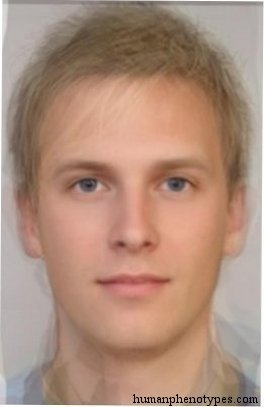
Faces from the encyclopedia that appear in this article. Open any entry for its full description, distribution, and references.
Hallstatt
Central Europe
Nordid proper, resembles the Iron Age remains of the Austrian village of Hallstatt. Most common among Swedes and South Norwegians. Frequent ...
Borreby
Central Europe
Ancient Northern European variety. Named after some of the Neolithic Borreby skulls of Denmark (not all!). Some emphasised resemblance with ...
Aisto Nordid
Northern Europe
East Nordid subvariety, common in coastal regions of Baltic countries. One of the last strongholds of East Nordids that are only a minority ...
Proto Nordid
Northern Europe
Ancient East Nordid variety, the eastern counterpart of the Aisto Nordids. Together with early Mediterranids it was widespread in prehistori...
Test what you learned
Put your eye for regional faces to work in the daily quiz — a composite face, a world map, and your best guess.