West Alpinid Phenotype - Face Features & Origin
Historical anthropology places the West Alpinid phenotype in Central Europe, with a documented center near 46.0° N, 8.0° E. Alpinid proper, historically found in the mountain regions of Western Europe. The sections that follow unpack the West Alpinid entry in practice: the composite face, the traits it summarizes, the naming history, and the sources.
Average Face
Averaging the portraits behind West Alpinid leaves the features that repeat and erases the ones that do not. That is exactly how the West Alpinid composite below was built: individual photographs were aligned and statistically merged, exaggerating shared structure into a single reference face that no actual person looks like.
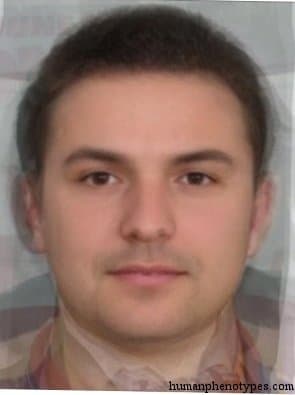
Composite source: Human Phenotypes — West Alpinid
Geographic Distribution
West Alpinid is documented across Central Europe, with its historical reference center near 46.0° N, 8.0° E. The coordinates mark where the type was most characteristic roughly 1500 years ago; population movements since then have scattered and blended the distribution far beyond that point.
Physical Characteristics
Fair to light brown skin, straight or wavy, usually (light) brown hair with a blonde minority.
- Rather short to medium height, mesoskelic, endomorph
- (Hyper-)brachycephalic, chamae- orthocranic
- Face wide and round with a great interorbital distance and soft features
- Leptorrhine, short, small, sometimes concave nose
- Female snub noses common
- Forehead steep and round
- Body hair not very strong
Historical Background
Alpinid proper, historically found in the mountain regions of Western Europe. Often a cohabitant of a second mountain type, the Dinarid. The nucleus of Alpinids lies in the Western Alps and Central France (e.g. the Swiss Disentis, the French Savoy, Auvergne and Massif Central regions). Common in Southern Germany as well (e.g. Franconia, Black Forest), the Apennines of Italy, Northern Spain, and Belgium.
Research History & Naming
Typological names were coined, contested, and renamed repeatedly across the 20th century, and West Alpinid is no exception. The extract below records the researchers who defined West Alpinid, the alternative labels it accumulated, and where the modern consensus settled.
Originally called Keltoid (c.p. Broca, 1868 ). Renamed to Alpinid by Gros and Lapouge (1897) and Ripley (1900) .This was adopted by Deniker (1900) , Coon (1939) , Eickstedt (1952) , Biasutti (1967) , Knussmann (1996) . Some included Gorid/Strandid. Lundman ( 1943 , 1988 ) separated the western low-skulls as Cevennid / (West) Alpinid.
Comparison With Nearby Phenotypes
Ranked by great-circle distance from West Alpinid's reference center, these are the five nearest documented phenotypes — the closest being Norid at 455 km. Overlapping distributions like these are exactly what makes the quiz hard, and the Norid row is where to start looking.
| Phenotype | Region | Distance | Distinguishing trait |
|---|---|---|---|
| Norid | Southeastern Europe | 455 km | Pale to fair skin. |
| Hallstatt | Central Europe | 459 km | Pinkish pale skin. |
| Central Brachid | Central Europe | 602 km | Medium brown skin, straight or wavy hair, rather tall, mesoskelic, endomorph to ectomorph. |
| Paleo Sardinian | Southern Europe | 662 km | Light brown skin, straight to wavy dark, abundant hair. |
| Dinarid (proper) | Southeastern Europe | 753 km | Light brown skin. |
West Alpinid in the Game
When the West Alpinid composite shows up in the quiz, players who know the Central Europe distribution pattern have the edge. The reference answer sits near 46.0° N, 8.0° E; pins on the wrong continent score close to zero, so even a rough regional instinct beats a precise but misdirected pin.
West Alpinid Phenotype FAQ
- Where does the West Alpinid phenotype come from?
- Historical sources center the West Alpinid phenotype on 46.0° N, 8.0° E (Central Europe). Treat that as a rough anchor: the type appeared across a wider surrounding area — its nearest documented neighbors, Norid and Hallstatt, sit 455 and 459 km from the reference point — and its present-day distribution no longer matches the historical map.
- What does the West Alpinid phenotype look like?
- The composite emphasizes recurring traits: fair to light brown skin, straight or wavy, usually (light) brown hair with a blonde minority. The full trait list for West Alpinid appears in the physical characteristics section above.
- Is the West Alpinid phenotype a race or a nationality?
- No. A phenotype is a recurring bundle of visible traits documented by historical anthropologists across a population — for West Alpinid, patterns such as fair to light brown skin, straight or wavy, usually (light) brown hair with a blonde minority. The West Alpinid entry is not a genetic ancestry, not a nationality, and not a statement about any individual person. Two people from the same country can match completely different phenotypes — one resembling West Alpinid, another closer to Norid — and one phenotype can span many modern borders.
- How does West Alpinid appear in the game?
- When the West Alpinid face comes up in Classic Daily or Challenge Mode, you pin the world map where you believe the type is historically most common, and the score decays with your distance to 46.0° N, 8.0° E. The nearest documented type, Norid, lies about 455 km away, so regional placement usually carries most of the score.
References & Literature
Every claim on this page traces back to the sources below — the researchers who defined, measured, and argued over the West Alpinid type. The originals behind the West Alpinid entry are worth consulting directly.
- Broca, P. 1868. Nouvelles recherches sur l'anthropologie de la France en général et de la Basse-Bretagne en particulier. Mém Soc. Anthr. Paris III, 147-209.
- Gros, Durand de and J. P. et de Lapouge. Matériaux pour l'anthropologie de l'Aveyron. Bull. Soc. langued. géogr. XX, XXI.
- R00
- D00
- Coon, C.S.. 1939.. The Races of Europe. The Macmillan Company. New York.
- Eickstedt, E. von. 1952. Biodynamik der Europiden. In: Historia Mundi. Band 1, Munich, 115-134.
- Biasutti, R. 1967 (1941). Le Razze e i Popoli della terra. 4th Ed. Vol 1-4. U.T.E.T., Torino.
- Knussmann, R. 1996. Vergleichende Biologie des Menschen: Lehrbuch der Anthropologie und Humangenetik. 2ed. Spektrum Akademischer Verlag.
- Lundman, B. 1943. Jordens Människoraser och Folkstammar. Nybloms Förlag, Uppsala.
- Lundman, B. 1988. Jordens folkstammar. Huddinge.
Related Phenotypes
If West Alpinid interested you, these neighboring phenotype entries cover adjacent parts of the map with distinctly different trait bundles.
Norid
Southeastern Europe · 455 km away
Central European type that closely resembles Dinarids except for lighter pigmentation. Authors interpret this to be the result of Nordid and...
Hallstatt
Central Europe · 459 km away
Nordid proper, resembles the Iron Age remains of the Austrian village of Hallstatt. Most common among Swedes and South Norwegians. Frequent ...
Central Brachid
Central Europe · 602 km away
Indo Brachid variety, with a morphological and geographical position between West and East (Indo) Brachids, but possibly resulting from diff...
Paleo Sardinian
Southern Europe · 662 km away
Ancient type, was widespread in Central Europe during the Neolithic, has survived as a minority element in the mountains of the Italian isla...
Dinarid (proper)
Southeastern Europe · 753 km away
Central European type typical for mountain and forest regions. Presents the counterpart of Alpinids. The name derives from the Dinaric Alps ...
Further Reading
Background articles from the blog that explain where the West Alpinid type fits, how these composites are built, and what a face can and cannot tell you.
Guess the Nationality: What 48 Country Average Faces Actually Show
National average faces converge with geography - neighbors look alike because populations mix along the routes terrain allows.
Ethnicity Guesser vs DNA Test: Two Different Questions About Where You're From
A DNA test answers 'what fraction of my ancestors came from reference regions' - a face quiz answers 'what historical pattern does this...