Paleo Sardinian Phenotype - Face Features & Origin
Ancient type, was widespread in Central Europe during the Neolithic, has survived as a minority element in the mountains of the Italian island of Sardinia. Its reference coordinates sit near 40.1° N, 9.0° E in Southern Europe. Rather than a single portrait, the Paleo Sardinian composite below is a statistical average, and the surrounding sections — traits, distribution, research history, references — give that average its context.
Average Face
What you see below is a statistical construction of the Paleo Sardinian reference population. Faces recorded from the Paleo Sardinian sample were overlaid and merged; the result keeps the features most members shared and discards personal variation. It reads like a Paleo Sardinian portrait, but it works like a histogram.
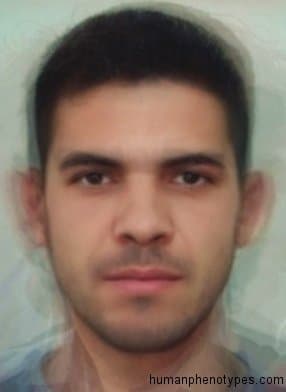
Composite source: Human Phenotypes — Paleo Sardinian
Geographic Distribution
Geographically, Paleo Sardinian anchors to 40.1° N, 9.0° E (Southern Europe). That is the point where historical anthropologists judged Paleo Sardinian most concentrated, not a hard edge; modern migration and intermarriage have long since softened whatever boundaries once existed.
Physical Characteristics
Light brown skin, straight to wavy dark, abundant hair.
- Short, meso- to endomorph, mesoskelic
- Chamae- orthocranic, dolichocephalic, rather small-headed
- Short, frequently concave, mildly leptorrhine or mesorrhine nose with a depressed bridge
- Features coarse, hardly reduced
- Face wide and low, significant supraorbital arches, forehead and hairline low, deep-set eyes, prognathy mild, jaw size modest
Historical Background
Ancient type, was widespread in Central Europe during the Neolithic, has survived as a minority element in the mountains of the Italian island of Sardinia. Morphologically similar to Berberid, although significantly gracilised and genetically different. Both show a Paleo Mediterranean state. Similar traces exist in Perigord (France), Aegean islands, Eastern Sicily, Southern Calabria, and Southern Turkey.
Research History & Naming
The passage below traces who first defined Paleo Sardinian, which rival names competed with it, and how later authors consolidated or disputed the classification — the raw material of any serious phenotype reference.
Defined by Cipriani (1934) and adopted by others ( Biasutti, 1967 ; Knussmann, 1996 ). Analysed by Hanscher and Schmitz (1976) as well as Vondernach (2008) . Lundman integrated it in Berid ( 1967 , 1988 ) / Berberid ( Lundman, 1952b ), Fischer (1943) in Coarse Mediterranid. Sardinians are genetically unique ( Calò et al. 2008 ).
Comparison With Nearby Phenotypes
Geography, not alphabet, ordered this table: the five phenotype centers closest to Paleo Sardinian's, with the traits most likely to be mistaken for it (Berberid leads at 568 km). In gameplay, these five account for most of the wrong-but-nearby pins against Paleo Sardinian.
| Phenotype | Region | Distance | Distinguishing trait |
|---|---|---|---|
| Berberid | North Africa | 568 km | Light to medium brown skin, curly-wavy, brown to black hair. |
| West Alpinid | Central Europe | 662 km | Fair to light brown skin, straight or wavy, usually (light) brown hair with a blonde minority. |
| Dinarid (proper) | Southeastern Europe | 782 km | Light brown skin. |
| Norid | Southeastern Europe | 835 km | Pale to fair skin. |
| Hallstatt | Central Europe | 905 km | Pinkish pale skin. |
Paleo Sardinian in the Game
In gameplay terms, Paleo Sardinian rewards region-level recall: the score is computed from the distance between your pin and 40.1° N, 9.0° E. Players often confuse Paleo Sardinian with Berberid (568 km out) in the comparison table above — those confusions are exactly what the distance penalty is designed to expose.
Paleo Sardinian Phenotype FAQ
- Where does the Paleo Sardinian phenotype come from?
- Historical sources center the Paleo Sardinian phenotype on 40.1° N, 9.0° E (Southern Europe). Treat that as a rough anchor: the type appeared across a wider surrounding area — its nearest documented neighbors, Berberid and West Alpinid, sit 568 and 662 km from the reference point — and its present-day distribution no longer matches the historical map.
- What does the Paleo Sardinian phenotype look like?
- The composite emphasizes recurring traits: light brown skin, straight to wavy dark, abundant hair. The full trait list for Paleo Sardinian appears in the physical characteristics section above.
- Is the Paleo Sardinian phenotype a race or a nationality?
- No — and the Paleo Sardinian naming history above shows why. Paleo Sardinian was defined, renamed, and regrouped repeatedly by different researchers, which is the opposite of how a fixed racial category would behave. A phenotype is a recurring bundle of visible traits recorded across a population; the Paleo Sardinian label says nothing about where any individual's ancestors were born.
- How does Paleo Sardinian appear in the game?
- When the Paleo Sardinian face comes up in Classic Daily or Challenge Mode, you pin the world map where you believe the type is historically most common, and the score decays with your distance to 40.1° N, 9.0° E. The nearest documented type, Berberid, lies about 568 km away, so regional placement usually carries most of the score.
References & Literature
The Paleo Sardinian phenotype entry above is compiled from the 10 academic references. Readers are encouraged to consult the original Paleo Sardinian sources for verification and deeper context.
- Cipriani, L. 1934. Appunti antropologici sulla Sardegna. L'Universo 15, Florence.
- Biasutti, R. 1967 (1941). Le Razze e i Popoli della terra. 4th Ed. Vol 1-4. U.T.E.T., Torino.
- Knussmann, R. 1996. Vergleichende Biologie des Menschen: Lehrbuch der Anthropologie und Humangenetik. 2ed. Spektrum Akademischer Verlag.
- Hanscher P. and I. Schmitz. 1976. Gibt es einen paläosardischen Typus? Homo 27. 205-210.
- Vonderach, A. 2008. Anthropologie Europas. Völker, Typen und Gene vom Neandertaler bis zur Gegenwart. Ares Verlag. Graz.
- Lundman, B. 1967. Geographische Anthropologie. Rassen und Völker der Erde. G. Fischer, Stuttgart
- Lundman, B. 1988. Jordens folkstammar. Huddinge.
- Lundman, B. 1952b. Die heutigen Menschen Europas. In: Historia Mundi. Band 1, Munich, 135-146.
- Fischer, E. 1943. Rassenkundliche Probleme in Weißafrika. In: Beiträge zur Kolonialforschung. Tagungsband I, 130-139.
- Calò, C. M, Melis, A., Vona, G. and I. S. Piras. 2008. Sardinian Population (Italy): a Genetic Review. Int. J. Mod. Antrhop. 1-121.
Related Phenotypes
More entries from the same region of the historical map as Paleo Sardinian, each with its own composite and trait profile.
Berberid
North Africa · 568 km away
A Proto Atlanto Mediterranean type, originally named after Berbers and the North African Barbary. Associated with Paleolithic types that onc...
West Alpinid
Central Europe · 662 km away
Alpinid proper, historically found in the mountain regions of Western Europe. Often a cohabitant of a second mountain type, the Dinarid. The...
Dinarid (proper)
Southeastern Europe · 782 km away
Central European type typical for mountain and forest regions. Presents the counterpart of Alpinids. The name derives from the Dinaric Alps ...
Norid
Southeastern Europe · 835 km away
Central European type that closely resembles Dinarids except for lighter pigmentation. Authors interpret this to be the result of Nordid and...
Hallstatt
Central Europe · 905 km away
Nordid proper, resembles the Iron Age remains of the Austrian village of Hallstatt. Most common among Swedes and South Norwegians. Frequent ...
Further Reading
Background articles from the blog that explain where the Paleo Sardinian type fits, how these composites are built, and what a face can and cannot tell you.
Race Guesser: Why the Word Does Not Fit a Face Quiz
The phrase is a search term before it is a tool. Here is where the word race came from as a sorting device, why a century of measuring...
AI Ethnicity Guesser: What the Tools Really Return
An AI ethnicity guesser returns a label from a fixed list rather than a measurement of ancestry. Here is what the models are trained on...